Reclaiming (y)our Life

Listening to people can be revealing. If you listen (really listen), people will tell you a lot about themselves. Listen to the story they are telling. Listen to the one that they may not know they are telling.

While connecting at a conference, a story came to light.

“Carl, glad to hear that all the girls are doing well, still hard to believe your kids are that old, because you are so much younger.”

During the same conversation, we began to talk about running. I extended an invite to run with our group later that day.

“I am running more, but I am so old compared to you guys. I could never keep up.”

And later that day.

“Since I am so much older, I don’t have the same energy I used to.”

The real story was pretty clear.

As the group run was finishing, this person was finishing their run (ironically we all finished at the same time) and we were all standing in the lobby. I had a choice. Should I let their story continue or was there an opportunity to engage in this storyline?

“You know I couldn’t help but notice how much of your dialogue is about your age, how old you are, especially compared to others.”

“Is it that obvious?”

We reviewed our earlier conversations and that pattern that was previously hidden from them became clear.

“I didn’t realize how many times I said it.”

“Why do you think you are so defined by your age?”

“I think that so much of my life was defined by the roles that I have played: spouse, parent, and professional, that now I feel that I am trying to reclaim my life.”

“What do you mean reclaiming your life?”

“There are few decades of my life that went by so fast, and I was so focused on others, that I lost myself.”

We continued to talk. I could relate to this feeling of losing yourself when the demands of life, work, family, and career are competing to define us. We also talked about the role that these words are playing in the current reality. How the focus on age, and being older in some ways is not helping. Those words are trying to create a new limiting definition.

We agreed on two things:

1. We would be more aware of any self-limiting dialogue.

2. We would continue this journey of reclaiming our life and check in once in a while on the progress.

As we were about to part ways, I couldn’t help but ask one more question.

“How old are you anyway?”

It turns out that their perception of some vast age gap between us, was only four years.

Here are a few pieces of advice.

1. Listen. Listen to those around you, and your own words. How are you shaping your future reality by the word you use? What stories are you and others really telling?

2. Reclaim. Identify areas where you need to reclaim your life. What are those things that you had hoped to do, but your roles got in the way?

Keep me/us posted on your progress either in the comments section or via email on the contact me page.

(P.S. Just last night I read this story which may help all of us realize what is still possible, despite our age. And I thought running into our 80’s was possible…)
Good Lost None Bad

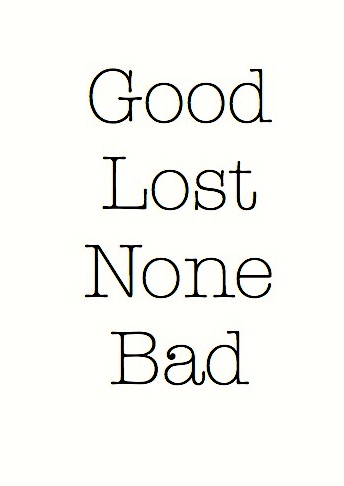
Good, Lost, None, and Bad

For some reason, I have been thinking about the hierarchy of certain things. Thinking about how to classify particular relationships, friends, jobs, bosses, employees, customers, and connections in a way that brings perspective.

Good describes things that are positive and contribute to you and your wellbeing.

Lost describes things that were once Good, but have left or been removed from your life.

None describes things that have never been part of your life.

Bad describes things that are negative and erode your life.

Why do we need this hierarchy?

Frankly, Good is easy. If all of our things fell into this category the rest of the list would not be needed. We would be and have good parents, friends, relationships, employees, bosses, and customers. By classifying the Good, at least we have something to strive towards.

The Lost, None, and Bad is where things can become less clear.

Lost can be hard. We had it: a marriage, a parent, a relationship, a friend, a job, a boss, or a customer. It was Good, now it has been Lost. The temptation is to classify this as Bad. A Lost parent, boss, friend, or employee is much better than a Bad one. We were able to experience the Good. We feel grief because it was Lost. Despite being Lost, we have the memories and experiences of what was once Good.

None is tricky. None may masquerade as Bad. Not having that parent, relationship, friend, job, or customer actually feels Bad. But None is not the same as Bad. None has plenty of its share of emptiness and loneliness, but that is a far cry from the negative destruction that Bad can bring.

Bad at first glance is easy. Bad encompasses all of the negative and harmful things. However, Bad is not satisfied with being at the bottom of this hierarchy. Bad wants you to believe that there are only two classifications: Good and Bad. Bad wants a more simple definition: If this thing is not Good (all the time and consistently and forever), it is Bad.

A Lost [parent, job, relationship, spouse, employee, customer, or boss] is better than None.  None is not actively destructive like a Bad [parent, job, relationship, spouse, employee, customer, or boss].

Does having a few ways to classify these things be helpful? How could separating out the Lost and the None from the Bad provide some additional peace or freedom?

Not all events that you currently face, or that shaped and define you are Bad.

Bad likes to take all the credit.

As we strive for more Good in life, don’t let Bad fool you into thinking that Bad is all that remains. Sometimes Lost, and even None, are not so Bad when they are in perspective and in their respective hierarchy.

I Will Be There Someday

long-stairs-225x300

(Image Courtesy of Angryjogger.com)

Coaching someone is an interesting adventure. You are trying to help someone develop themselves, establish and accomplish their goals, and encourage them when the journey becomes difficult. A typical coaching session includes checking in and checking up on any progress since the last session.

Progress can be slow.

Progress can be hard.

Progress is about making a repeated effort, over and over again.

Having someone else check in with you can be helpful.

Having someone else check in with you can be frustrating.

Sometimes there is great progress.  Sometimes progress is slow. Sometimes obstacles get in the way. When checking in, you can sense when progress has been slow by the tension during the meeting. There is a quiet hesitation as you begin to ask questions.

When frustration builds, answers sort of blurt out.

“I will be there someday…”

Those words told a story. A story of frustration at how steep the journey had become. A story where each subsequent step was harder than the last. A story that felt endless when trying to envision the top of those stairs when standing at the bottom.

Those words told another story. A story with a little hope. A story that needed to rest between steps. A story that needed to remember to occasionally look back, and see that each step was one step closer to the top. A story that despite the hardship, still believed that “I will be there someday.”

Where has your journey become steep? Where has the progress slowed or stopped?

Maybe today is a good day to remind yourself to take that next step, and remember that YOU will be there someday.


The Decade of Training

Wander Tag(Image Courtesy of Etsy.com)

Through a combination of coaching conversations, and reflections on my own life I have noticed a pattern. Many of us wish we were further along in our lives, careers, or relationships. We speak as if there is some place we should be, but we are behind in the race. We speak with regret and sadness as if we are currently missing out and life would be somehow different.

“I have been in this job for 6 years now and am in a rut and it feels wasted.”

“I didn’t really know what I wanted to do, and moved from job to job and didn’t make progress.”

“School was not a focus for me, and I wasted those years.  Now I have to go back again.”

“Just imagine where I would have been if I didn’t squander those years.”

These conversations made me think of that quote from J.R.R. Tolkien. Maybe it is okay to wander for a little while, because those years are not always lost.

Instead of seeing those years (however long it has been) as a waste, maybe a perspective change would help. Perhaps we could view that time as the Decade of Training.

The Decade of Training helped form who we are today.

The Decade of Training helped us create goals and start to pursue them.

The Decade of Training helped us try different things.

The Decade of Training helped us know that failure is part of the journey.

The Decade of Training helped us learn to get back up and keep moving.

Those years in the Decade of Training are not necessarily lost, unless you give up and assume that it is too late to pursue the goals for your life, career (or second career, or third career), or relationships.

Most of us today will live into our 90s. To put that in perspective, when we reach 60, we will still have 1/3 of our lives ahead of us.

The real question is now that you have been trained, what will you do with it?

Their Own Role In Their Story

ant-lifting-log-300x228

(Image Courtesy of soulseeds.com)

During the final session of a five-part series with leaders, we asked them to create an intentional leadership plan and present it to the rest of the group. Each leader tackled the greatest challenge before them in the next year, and described how they were going to make progress.

This can be an intimidating group. They are the top in their field. They have accomplished a lot. They are all viewed by each other as very successful.

Many outlined how knowing themselves helped lay the foundation for this project. Some had slides and handouts. Others simply stood up and talked. All were open about their own weaknesses.

It was the weaknesses that resonated with me the most. These leaders were pretty hard on themselves. At times, the group would interrupt the presenter, just to encourage them and remind them how incredible they really were, despite those weaknesses.

I was having a conversation with one of them afterwards.

“It’s funny, we see others strengths, and our own weaknesses filtered through some insecurity.”

They replied with something that stuck with me.

“Totally, though I was surprised at some people’s inability to see their own role in their story, including me.”

Their own role in their story. It is so easy to see others as strong, courageous, determined and successful, while discounting yourself.

We see their strengths, but know our weaknesses.

We see their success, but see our failures.

We hear their words, but hear our inner voice.

Where have you discounted your own role in your story? Where have you focused on your weaknesses, while forgetting the strengths?

You have an important role to play in your story and your life.

If you could only see yourself the way we see you. You’d be surprised at how strong and courageous you really look.

Keep Your Story Fresh

“What do you do with all that random information?”

A close friend asked me the other day. I must have been spouting off about some random facts that I had learned, but the details today escape me.

Apparently, my habit of trying to learn everything about anything I can get my hands on can be a little annoying if you are on the receiving end of my latest rant.

Within a week, during a routine drive time conversation with another close friend they experienced a question from a colleague after presenting to a large group.

“How do you know all that random information that you somehow weave into your presentation?”

“I need to keep my story fresh” they replied.

Those words resonated.

I need to keep my story fresh.

If we are going to stay relevant, current and in demand the old stories won’t do.

We have to learn, grow, develop, and stay teachable.

The seemingly random facts.

The new interactions.

The new class.

The new book.

The new experience.

They all join together to keep your story fresh.

To my first friend, I finally have the answer about my random rants and continual need to devour any information that comes my way.

“I am keeping my story fresh.”

To my second friend, thanks for the words we all needed to hear.