Speaking of Customer Service

I am always looking for new customer service stories. Good or bad, I love to hear how we are all treated by companies and organizations. These experiences help us learn to provide good customer service to our customers either internal or external.

A few years back, a family member gave me a digital thermometer. It is one of those seemingly practical gifts that turns out to be something you use everyday. It has become essential to our cooking.

But there was a problem. We melted/lost the little plastic cover to the battery compartment. For months we had a piece of tape covering the spot, and the battery would fall out of place, requiring repositioning the battery over and over again.

The other day, as I was wrestling with the device, I noticed there was an address and phone number listed on the side.

I called.

Rachel answered the phone. She was nice and listened to my tale of the missing cover.

“I can send you another one right away. Which color is it? Red? Yes we just need your address.”

I thanked her and immediately got an email confirmation that the little red cover was on its way.

Yesterday I went to the mailbox and retrieved a small brown envelope. After a quick tear of the top, the contents slid into my hand.

It was not the cover that made my day.

Customer Service

What a simple act. What an amazing way to demonstrate to a customer that the call, the part, or the issue was not a burden.

Thank you Rachel for setting a standard for all of us.


The Shirt, the Challenge, and the Surprise

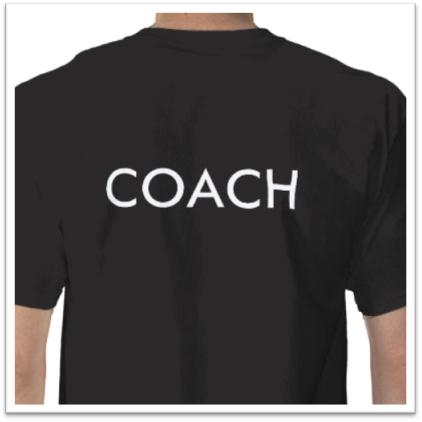
Coach T-Shirt

The Shirt

When teaching a class on coaching, I joke with the class about having shirts made up that say “COACH” and threaten to hand them out and make them wear them in their workplace.

 “What if I gave you a shirt like this and made you wear it in your workplace when you get back on Monday? Who here would want to wear it? What would your employees say?”

A few replies to my questions from a recent group of leaders during a class on coaching appear below.

“Not a chance.”

“They would ask me if I started coaching one of my kid’s teams.”

“I would be laughed out of the place.”

I pressed a little further to find the root of the hesitation on being labeled the “COACH” in their workplace. Each was a leader in their organization. Each had a title and at least a few employees. But something was stopping them from coaching.

As the conversation progressed, the obstacles became more clear. There wasn’t enough time to coach (and get their own work done). The culture would be critical of this approach. They were not coached as employees, and the list went on and on until an even more revealing answer came to light.

“Because when a team is failing, they fire the Coach!”

There it was, the real fear behind the hesitation. Being the focus of performance may result in the owners switching leaders if the organization is not performing. With the fear out in the open we could move towards agreeing on why coaching is essential to the team’s success.

Coaching goes beyond holding people accountable for task completion. Coaching is about developing people as individuals, stretching them, and helping them achieve more both individually and collectively. Coaching requires a combination of encouragement and accountability. Coaching is needed for teams.

The Challenge

Beyond a mere threat, I actually had these shirts made up and hand them out at the end of the class. Periodically, I would get an email about how wearing the shirt in the workplace helped the leader focus on coaching their employees, despite the initial awkwardness. I even heard from a leader who must wear a uniform each day at work, but wears the “COACH” shirt underneath once a week as a reminder to coach their employees.

A few months ago, I changed my strategy. In addition to having them take a shirt, I issued a challenge. The first leader to email me a picture of them in their workplace wearing the shirt would win a prize.

The Surprise

The responses have been great. Within a day or two I start to receive photos of these leaders wearing their “COACH” shirt in the workplace. The challenge helped provide some incentive, but the results have been greater than just a prize. Many leaders have been surprised as they experience something more once the awkwardness fades: their employees have embraced the concept and are enjoying the coaching.

But that is not the only surprise.

Last week I taught the Coaching class in the morning, but then there was a break where the group had a few other instructors before concluding the day with me. I headed back in the room and started the session.

It was when I clicked to the second slide of the PowerPoint.

There it was. A photo appeared on the screen. It was a photo of the entire class wearing their “COACH” shirts in the lobby. They had managed to take the photo and put it into the presentation during the break.

“Technically, since we are all on the clock, this counts as working.”

I laughed. I was encouraged by their creativity. I was surprised.

After giving out prizes to all of them, I reminded them that now that they had gotten over their initial hesitation, they could all become better coaching in their workplace.

Over the next few days, other photos appeared in my inbox. Coaches were identifying themselves, and starting to do the work. They were making a difference.

How about you? Do you need a shirt as well?

Make a list of those in your workplace, circles, or life that need some coaching. Once the awkwardness fades, it may be just what they need.

The Inspirational Ones

Sunrise Inspiration

You know the ones.

The ones that encourage you.

The ones that build you up.

The ones that can see your energy and passion.

The ones that you look forward to seeing and connecting with.

The ones that meet you for breakfast and leave you thinking you can accomplish anything.

The ones that say “Wow” when they see your work.

They are the Inspirational Ones.

Remember to thank them for the role they play in your life.

But don’t just rely on them to be the ones who inspire others.

You too can be one of the Inspirational Ones.

Encourage.

Build Up.

See Energy and Passions.

Connect.

Meet.

Say Wow!

Give it a try today, it may just Change the World.

Lists are Good

Lists are GoodI have a love/hate relationship with lists.

Lists keep track of what needs to be done.

Lists can feel overwhelming when there are so many things to be done.

A friend recently had a contractor over their house. The house needed numerous small repairs. As they prepared to walk from room to room and discuss the projects, my friend handed the contractor a list.

“I hope you don’t mind, but I made a list of all of the various projects.”

“Lists are good. I cannot tell you how many times I come to someone’s house and they rattle off all these things that were not part of our original discussion and expect me to remember them all.”

There was a sigh of relief from my friend. The last contractor didn’t have the same perspective on lists. There would be discussions, but not all projects were remembered or completed. There seemed to be agreement on what needed to be done, but various details would be missed that required projects to be either redone, or re-visited.

When it comes to lists, I think our egos can come into play.

“Don’t worry about it.” (As we tap our heads.) “I got it, I will remember, I don’t need to write it down.”

We don’t always have it.

We don’t always remember.

We do need to write it down.

Lists help in other ways. Lists provide accountability to ensure that we accomplish the task. Lists also provide the often needed sense of accomplishment. Each crossed-off item can bring pride for a job well done.

I will try to bring a little more love, and a little less hate to my lists.

I will also try to remember: Lists are Good.

Emotional Rickets

I think I have Emotional Rickets.  (Bear with me on this one.)

During a recent conversation, I was explaining how certain situations cause an emotional response that is hard for me to regulate. Anger moves pretty fast, and there are times it catches me off guard.

According to Daniel Goleman, there are five hierarchical levels of emotional intelligence:

1. Self-Awareness

2. Self-Regulation

3. Motivation

4. Empathy

5. Social Skills

I like to picture these five areas as going up steps, one at a time to reach the top. Mastering a prior step helps bring you to the next. Whenever I have an issue with one of these steps, I back up a step to see if there was something in a previous step area that would provide a clue the issue at hand. In this case, I was having an issue with Self-Regulation (step 2).   That left only one step to return to: Self Awareness (step 1).

Rickets is a disorder caused by a lack of vitamin D, calcium, or phosphate. It leads to softening and weakening of the bones. Bones are not only are weaker, but have additional pain and tenderness.

So, Emotional Rickets is when you have a lack of some positive emotional events (and perhaps some negative ones) that leave you in a weakened state.  In additional to weakness, you can add additional pain and tenderness from an emotional perspective.

I repeat, I think I have Emotional Rickets.

This revelation seemed to help, suddenly I could picture the issue.

If my legs were injured, I would not run as hard.

If my arms were injured, I would not lift as often.

If my back was injured, I would not move around as much.

For some reason, I was expecting my brain and emotions to respond to events as if there were no prior injury, no prior events, no limitations. As if it were strong.

lifting_brain

(Image Courtesy of blogs.hawkeyecollege.edu)

But my Emotional Rickets require me to be much more aware of my limits. I may need to work harder than others to achieve the same results. I will be sore, and will not want to go again. I may need more rest and recovery time after each event.

In time, I hope to strengthen this area. I do not kid myself about the amount of work and time it may take to do make even small gains. Progress will require some discipline and work.

Where have you had Emotional Rickets? Where have you been left in a tender and weakened state? Where has this hindered relationships or caused issues? Maybe a little progress in this area for all of us could really change the world. 


I Will Be There Someday

long-stairs-225x300

(Image Courtesy of Angryjogger.com)

Coaching someone is an interesting adventure. You are trying to help someone develop themselves, establish and accomplish their goals, and encourage them when the journey becomes difficult. A typical coaching session includes checking in and checking up on any progress since the last session.

Progress can be slow.

Progress can be hard.

Progress is about making a repeated effort, over and over again.

Having someone else check in with you can be helpful.

Having someone else check in with you can be frustrating.

Sometimes there is great progress.  Sometimes progress is slow. Sometimes obstacles get in the way. When checking in, you can sense when progress has been slow by the tension during the meeting. There is a quiet hesitation as you begin to ask questions.

When frustration builds, answers sort of blurt out.

“I will be there someday…”

Those words told a story. A story of frustration at how steep the journey had become. A story where each subsequent step was harder than the last. A story that felt endless when trying to envision the top of those stairs when standing at the bottom.

Those words told another story. A story with a little hope. A story that needed to rest between steps. A story that needed to remember to occasionally look back, and see that each step was one step closer to the top. A story that despite the hardship, still believed that “I will be there someday.”

Where has your journey become steep? Where has the progress slowed or stopped?

Maybe today is a good day to remind yourself to take that next step, and remember that YOU will be there someday.