New Patterns, New Memories

Getting together with people, especially with those who are close, is not always easy.

Logistics. What time, where, who, and what?

Dynamics. The past, the incident, that time, and those words.

Expectations. The food, the venue, the relationships, and the activities.

Patterns. When to eat, what to do, and how you interact.

Memories. Good, bad, stressful, and past.

These various categories cause an interesting dynamic when trying to connect with others. When these categories are associated with past stressful get-togethers, the days before you see these people again can be filled with stress and pressure.

This stress and pressure can hijack the present event by overwhelming you before you even arrive.

But, what if you could shift the pattern?

What if you tried a new approach?

I am lucky to be part of a group that is experimenting with a new pattern. 

Instead of crashing after a meal, we go for a walk (and talk).

Instead of huddling around the TV, we are playing fun and weird games.

Instead of large group discussions, we are making time to connect and catch up individually.

A new pattern is forming.

New memories are replacing the old.

Good Patterns. Good Memories.

It is awkward at first? Oh yeah, but totally worth it.

Eel Gloves

American Eel (USFWS Biologist Steven Smith hollding eel caught while night electrofishing for salmon in Whallon Bay)

(Image Courtesy of adirondackalmanack.com and USFWS)

Sometimes we can be hard to pin down.

Sometimes we wiggle and squirm our way out of accountability, progress, or accomplishment.

Sometimes we say we are going to do something, but try to slip out of it.

A good friend calls it being slippery. Slippery like an eel.

But they make Eel Gloves.

Eel Gloves make it possible to hold onto the slipperiest eel.

Maybe what each of us need is that friend, partner, spouse, coach, or mentor that has OUR pair of Eel Gloves.

The person with the Eel Gloves could hold on to us when we are trying to explain away our lack of progress.

The person with the Eel Gloves could wrestle with us, not let go, and make us face why we are trying to slip out of the accountability.

That sounds like a good name for a coaching option for 2016.

Eel Gloves Coaching: You may be slippery, but we can still hold on.


The Forgiveness Receipt

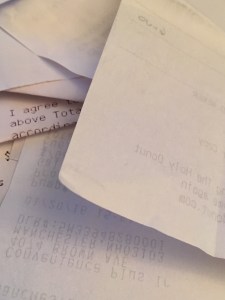
Forgiveness Receipt

We do something wrong. There is a transaction that needs to occur.

We need to apologize. We need to say we are sorry and ask for forgiveness.

A real apology:

Not a

“I am sorry if I [offended, hurt, misunderstood, overreacted…]

But more of a

“I am sorry for [offending, hurting, misunderstanding, overreacting…]

I read recently that how we respond during this transaction is important. Instead of saying “that is okay” which implies that what occurred was acceptable, the article encouraged people to complete the transaction with “I accept your apology” or if you are able “I forgive you.”

A helpful idea ran through my mind: The Forgiveness Receipt.

The Forgiveness Receipt would be proof of the transaction.

The Forgiveness Receipt could serve two purposes.

Purpose One: A reminder for the person that needed to ask for forgiveness. I recently noticed that I tend to apologize more than once, as if the first one didn’t take. The person I kept apologizing to kindly reminded me that we had already transacted this apology, and I didn’t need to keep revisiting the issue. The issue is gone, and The Forgiveness Receipt would be a great reminder, especially when I am feeling a little insecure.

Purpose Two: A reminder for the person that forgave. I also noticed that I tend to revisit old offenses, long after the transaction. The Forgiveness Receipt would serve to remind me that the I forgave, and can no longer hold that offense against the other person.

Until I can find a receipt book worthy of this task, The Forgiveness Receipt will be more of a mental note. Or maybe this T-Shirt would serve as a better reminder.

Be sure to ask about your receipt.

Untitled

A Little Friendly Research (My Turn)

I asked you a series of questions, and your answers appeared in the last 7 posts. Your answers were vulnerable, honest, funny, serious, and clever. Your answers inspired questions, discussions, and honest conversations about friends, and friendships. Your answers inspired some actions, as friends connected, reached out, answered phone calls, and actions became a little more deliberate and focused.

I wondered about how to end this series, and a few of you suggested that I weigh in on those same 9 questions.

So, it is my turn.

Question 1: What are the best attributes of your good friends?

They are intentional. They reach out. They call me, text me, and email me. They initiate as well as respond. They seem to have this internal counter that knows when too many moments, hours, days, or weeks have passed and the alarm goes off and they remember to connect.

Question 2: Do you think friendship is hard? Why or why not?

Friendship seemed easier in elementary school when you walked with the same person every day to school, then goofed around every weekend together on little adventures in the woods and on the pond. Friendship seemed easier when you were on a ship and saw them everyday for 6 months, and ate, slept, and worked together. Friendship seemed easier in college when you were in that crappy little apartment waiting for your paychecks so you could actually buy meat at the store.

Friendship seemed to get harder in the next stage of life. New jobs, new cities, new neighborhoods, new kids, and new distances between all of them.

Friendship is getting easier and harder at the same time in this current stage. My expectations have grown as the years have passed. What satisfied this need to connect years ago, doesn’t seem like enough. I have more time for friends then a decade ago, but some of them don’t have the same time available to me. The number of friends “goal” has been replaced with a depth of friendship “goal” which I recently realize is a much harder prize to attain.

Question 3: What do you expect from a friend?

Balance and equity in the long-run. I may need something from them for a season, but I want to find a season to give back as well. They shouldn’t be the only one to initiate connection, I want to call them, text them, email them, or reach out as well. I need that same little internal counter in my head that reminds me that too much time, distance, or life has gone by and I need to take action.

This question caused me to wrestle the most. I fear my expectations may be causing interference with some friends because my expectations may be higher, and unspoken.

There is tension expectation. How do we learn to give freely, and not be taken advantage of? When do you give? When do you need? How do you measure balance and equity?

No great answers, yet the wrestling seems like a good thing for me to work on.

Question 4: How much time in a given week do you think about your friendships?

A LOT! Until I read your responses, I thought I was a bit of an outlier (well I may still be). There was comfort to know that I am not the only one who thinks about this pretty often.

My mind wanders towards friends and friendship throughout my entire day. The morning computer/writing time, the commute, at random times each day, lunchtime, afternoon coffee, closing time, the other commute, dinnertime, vegging out time, before I sleep (you get the idea).

Bottom line, if you are my friend, I think about you a lot.

Question 5: What are your best attributes as a friend?

I care about you. I think about you. I connect with you. I am here when you need something (yes that has included the occasional furniture moving). I invest in you. I want you to succeed. I have hope for you. I find time for you. I love you.

Question 6: If you could say one thing to your friends that would help explain what you need from them, what would you say?

Be real. Be present. Be available. Be my friend.

Question 7: How many close friends would you say you have?

Nine.

Question 8: Anything else you would like to share?

Yes. This process, this journey has helped me understand friends and friendship in a new way. Your responses have helped shape me and I don’t want this journey to end.

Earlier this week I was teaching a class and we talked about leadership. One participant mentioned that leadership has an expiration date. In other words, if you are not exercising those skills, they expire, go bad, and become rotten.

I think this applies to friendships as well.

Question 9: In 10 words or less, what advice would you give the World about friendships?

Intention. Balance. Mindful. Time. Hope. Connect. Remember. Savor. Initiate. Love.


A Little Friendly Research Part 7 (The Finale)

Part 7. The Finale.

Wondering what this is all about? Start here.

I asked. You answered.

Question 8: Anything else that you would like to share?

[Insert name] is a great friend.

This exercise, especially questions 6 and 7, gave me pause – made me think. Thank you for that.

Yes.

Regardless of the type of relationship you have you get out what you put in.

Friendships are difficult. time and distance have a way of seeing some friendships lose their closeness. Yet many friends, who I don’t see on a regular basis because of distance, etc. can pick up where they left off immediately because the disruption of the friendship wasn’t based on wounds of differences, but just life. Others dissolve because of differences that went unresolved. Those are the hardest. Unresolved conflict is tough.

[insert name] is a great friend and I appreciate [name].

Question 9: In 10 words or less, what advice would you give to the World about friendships?

Treat a friendship like a romantic relationship and vice versa.

Friends are one the greatest gifts you will receive. They… (sorry there was a 10 word limit.)

(Just Kidding) …provide laughter as well as keep you from wandering off in the desert of life.

Be the friend you want to have.

It’s not a contest.

People always come into your life for a reason, enjoy!

Being willing to be vulnerable when you want to retreat because you are hurt or misunderstood, is well worth it. If that friend truly values you and your friendship, he or she will cover that vulnerability with grace. Your friendship can grow stronger in spite of the struggle. Way more than 10 words. Lol.

I’m breaking the rules and combining 8 and 9.

I don’t have any advice, but I will share a wish. When I think about my friendships, it occurs to me that most (if not all) of them are largely based on convenience. It’s convenient because we live near each other, or because we work together, or because we’re in class together, etc. If that convenient variable were removed, I don’t know what would happen to those relationships. Would they make the effort to maintain them? Would I? I know that feeling like a friend-when-convenient is pretty sad; I’ve felt that way, and I’m sure I’ve made others feel that way too. I wonder if this is just the way it is with the friendships we have in adulthood?

If so, my wish is that we could find a way to do better than that. I wish that friendships were a higher priority, despite all of other things competing for our time and energy. I wish we valued them more. I wish that we’d protect them, and fight for them. I wish we’d be more willing to do the work to sustain them, even when it’s not convenient. Especially then.

Ten words: Food and friendship enhance each other.

Thank you again for all of you who answered and shared this post with others. Keep sharing, keep answering, and most of all keep questioning.

What’s next? My turn.

A Little Friendly Research Part 6 (Questions 6 and 7)

Part 6.

I am a little sad that this series is coming to an end.

You see, I asked a bunch of you to weigh in on 9 questions about friends and friendship. After this post, only 2 questions remain. It feels a little like the day before the last day of vacation. You are still relaxing, sitting by the pool, but the normal world is vying for your attention. Suddenly instead of enjoying the sun on your face, you begin to think about packing, traveling, unpacking, getting back into the routine, grocery shopping, making dinner, and doing laundry. You have to work to keep the world out of your vacation for another day. I had to remind myself to enjoy this post, this day, and not worry about what the next post may bring.

If you are totally lost, start at the beginning. Think about the questions. Take out a sheet of paper and jot down your own answers, the compare them against this smattering of wisdom, openness, and advice.

They are friends.

They have friends.

Perhaps their words, answers, and ideas will help you in your own journey.

Question 6: If you could say one thing to your friends that would help explain what you need from them, what would you say?

Question 7: How many close friends would you say you have?

Just love me for me.

Four.

Confirmation that I’m being the friend that they need me to be.

15.

I need to know that you care, and I might need to be reassured sometimes.

Few. I could count them on one hand and have fingers to spare.

I don’t know what I need from my friends, other than to be friends.

6.

And please don’t give up on me.

4-5.

Honesty. I don’t want someone to tell me what I want to hear or what they think I want to hear.

5.

don’t give up on me.

4 or 5.

Trust: I need to know you have my back, will be my cheerleader and defender and think the best of me.

I have a lot of folks in my life who I love deeply. But many are just too far away or seen too seldom to consider “close” friends. So I would say right now, there are 7 people I consider close/deep friends.

Availability.

Question 8 and 9 remain.