Everything Requires a Conversation

A few days ago, I sat down with someone who began discussing a few issues that needed to be addressed in their workplace.  All were minor issues, but were getting in the way of getting goals accomplished and creating some minor disruptions or tension throughout their building.

The first issue was described in detail with a question at the end.

“What do you think I need to do about this?”

“It sounds like you need to have a conversation.”

The next issue was described, this time it was about a conflict and how another person’s work-style was causing disruption.

“What do you think I need to do about them?

“It sounds like you need to have a conversation.”

By the time we approached the third issue, it became clear that this was even more complex and involved multiple departments and people.  Again the question came.

“What do you think I need to do about this?”

But before I could answer…

“I know what you are doing to say…EVERYTHING REQUIRES A CONVERSATION!”

I paused, wrote it down on a sticky note and posted it on my computer monitor.  They were right.  Most, if not all of the conflicts and issues at home, in the office, or where you volunteer exist because people are involved.  The only way to make progress is to have a conversation.

I am not saying that these conversations are easy.  I spent a good portion of my time facilitating conversations between individuals and teams that have gone far too long without having the conversations needed to address the issues when they were small.

Take out a piece of paper and make a list of the top three conversations you should be having.  They are not always easy, but for me making a list helps keep me accountable to accomplish the task, especially when it is a difficult one.  And remember, everything requires a conversation.

The Adventure Within (the Adventure)

The Adventure Within (the Adventure)We try to get outdoors as often as we can as a family.  With all of the work, school, life, and errands, this can be a real challenge.  As part of the yearly goal setting, hiking a certain mountain where we live was on the list for 2012.

Labor day weekend seemed like the logical choice for us, and this hike was on one of the oldest daughter’s “bucket list” for college.

What a perfect way to cross off a goal on a few lists while spending some quality time with the girls.  Our backpacks were full of snacks, water, supplies, band aids, eye drops, extra allergy medicine, bug spray and a few random things like headphones and a few toys.

The route was selected based on a consensus of research.  The route was a bit longer but a less steep path since this mountain is bigger than our casual small hikes of the past.  Walking sticks in hand, our small tribe’s adventure began.  The day was perfect, mid 70’s with a cool breeze and good spirits all around.  We were entertained by a series of jokes at the expense of a small dam.

“Looks like we are on the dam trail.”

“Hey, I am walking on the dam footbridge.”

” Welcome to the dam, I will be your dam tour guide, and I will be here to answer all of your dam questions.”

“Hey, is that the damn dam over there?”  (It got a little out of hand, and we had to redirect the conversation.)

After about an hour, our middle daughter mentions that the tread on the tip of her boot is coming loose.  We stop, and a small bungee like cord from a backpack wrapped around the toe seems to solve our problem.  We hike on.  After a short while, she mentions her boots again.

“Ummm, Dad, I think you need to see this.”

“Did the bungee come loose?”

“Nope, but this did.”

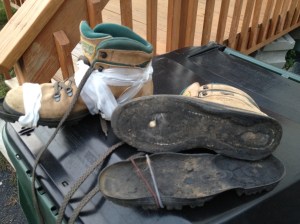
She was holding the entire boot tread in her hand.  It had come completely separated from the boot and we are miles from the starting point, and not quite halfway to the summit.  We spring into action, searching for every kind of solution we can in our bags.  Now it had been a while since we did serious hiking and we packed pretty well with one exception.  There was no tape.  Not even that white medical tape you typically find in first aid kits.  What we would have given for a roll of duct tape!

Luckily a friend of ours had given us a few paracord survival bracelets (small woven bracelets made from parachute cords), and the kids remembered to wear them.  We separated the cords and tied up the shoe.  The hike continued.  It wasn’t a perfect solution, but we had a mountain to climb.  Another 20 minutes went by.

“Ummm, Dad, it is happening again.”

Her second boot suffered a similar fate.  The tread had completely separated itself from the boot.  We stopped in a little clearing to eat lunch and assess our situation.  After additional attempts to tie the treads on, a few tears, lunch, and asking every passing hiker if they had any tape, it was clear that the summit was not a reality.

The hike down was not easy, and included continual evaluation and readjusting the cords and the addition of a few hair elastics.  Eventually some medical tape was provided by a sympathetic passerby.

Towards the end, one of the treads came completely off again.  Instead of stopping, or even missing a step, my daughter simply held it up high above her head and marched on.  Her strong defiant stand against the day’s difficulty was signaling that she was not giving up, and she was going to make it.  And she did.  We all did.

Later while in the car, we were discussing the high points of the hike, and what each of us remembered.  Besides another round of jokes about the “dam footbridge” by our youngest, we talked about working together to solve the boot issue, and what we liked best about the day and what we were thankful for.

“Remember when my boots fell apart, I was kinda scared, but we worked it out and made it back safe.  Now it is pretty funny.”

We all laughed about the boots.  Once safely in the car the fears or even tears became a distant memory.  We never made it to the summit.  The adventure that we planned was not the adventure that we had.  But isn’t that the way life is sometimes?  The unexpected challenges or obstacles bring both hardship and excitement to our adventure. 

I Remember When…

The other day I spent about an hour in the pool with my youngest daughter.  After a dizzying session of whirlpool creation, we began talk.  We talked about the squirrel trap she created.  How those little guys stole all of the almonds she scattered across the driveway, but none of the blueberries were harmed.

At some point I thought of about how amazing it was to be having this conversation with this little person.  My thoughts drifted to all of the memories of her growing up and I started to share some of that with her in the way that my wife and I sometimes share with each other.  We call it “I remember when…”

I remember when you were born.

I remember when you used to be afraid of the deeper pool.

I remember when I first saw you climb our tree like a monkey.

Then it dawned on me to alter it a little and begin to ask questions instead.

Do you remember when…

Do you remember when you were born?  No, but I remember the pictures.  Did I really have all that dark hair?  Yes.

Do you remember when we collected rocks at the beach?  Yes.  But mostly, I liked throwing them in the water.

The questions helped, and eventually she didn’t need prompting and it began to flow.

I remember when I was little and played with a pink basket in your room.

I remember when I first went to school.

I remember when my older sisters came home from college and I cried, because I missed them.

Today, what do you remember?  Take a few moments and reflect and share a few with us, or someone close to you.  Try this out with people you know and ask them what they remember.

Bringing the Cup Home

Typically, “bringing the cup home” is a good thing.  Unfortunately, not all awards are for positive achievement.

There are a few friends that I talk to regularly, usually while driving to work in the morning.  These morning calls have become a way to connect with each other, but they serve another purpose: determining who brought the cup home that week.

This is no ordinary cup.  This cup signifies personal failure either with our wives, our kids, or at work.  I won’t tell you what we actual call this cup, but think of a good term for when someone is not at their best or kind of a jerk and you will be on the right track.

Our conversations can be pretty funny.

“So, get this.  I came home from work and within 2 minutes yelled at the kids.”

“During an argument I said she was a lot like her mother.”

“While in a meeting today, I came across like a total jerk when I tried to convey my position.  It was definitely a CLM (career limiting move).”

Why do we do this?  It is not that we are proud of these failures.  As I said, no one wants this cup at their house.  The reason we talk about these shortcomings is to get them out into the open, discover the cause, and try to grow and develop past these issues.  The ability to be transparent about who you really are is a great first step.  Speaking out these failures provides a level of accountability that helps us remember to think before we speak, to be more patient, and not excuse away our behaviors.

How often do you bring the cup home?  Where do you fail?  Do you have someone or a few someones to talk through these issues?  If not, perhaps today is a good place to start.  These conversations certainly helped us grow, and created the kind of friendships that run deep.  We all need the kind of friends who are not afraid to speak the truth when we bring the cup home.

By the way, we are looking for suggestions or ideas to build an actual cup that could be passed from house to house.  But it should be hideous enough that no one would actually want it in their home.

But I am not that way with YOU!

What we say matters.  How we interact with others matters.  Lately there has been a pattern in many conversations that almost went unnoticed until someone close to me pointed it out.  I call this pattern the unintentional high standard.

A quick definition is in order.  The unintentional high standard is when someone describes their expectation of something or someone else then proceeds to discuss how that other person or thing is not meeting that standard.  This can be in the form of a rant, complaint, or sometimes a tirade.

“I cannot believe that [insert name here] has not called me more often.  I feel like this relationship is one-sided.”

“Did you see the dish they brought to the party, did they even try?”

“I cannot believe [insert spouse or significant other here] wasn’t more [pick one: caring, compassionate, understanding, loving, excited, interested, engaged] about [insert topic here].”

At some point in one of these interactions while you are simply the bystander or listener, you begin to wonder how often this person says the same things about you to others.  If they are holding up this standard for others, even if unintentional, they must be holding this standard against you too.  Maybe you even dare to ask.

“So, is this the way you feel about me?  When I don’t call as often, or brought that crappy side dish to the party?”

“No, I am just ranting, but I am not that way with You!”

Really?  Are you the one exception to this high standard?  Do you get a pass that the rest of the universe doesn’t receive?  And how does it feel to be around someone who is always pointing out where others are not meeting the mark?

For the next week or so, spend a little time listening and see how often we all create these unintentional high standards.  Maybe we should do a little less ranting and a little less complaining.  I pointed this out to someone recently, and the saddest part was they didn’t even realize they were doing it.

Chapter Two: The Law of the Few

Gladwell describes how all people were not created equal when it comes to their influence on others.  There are a “few” people with a “particular and rare set of social gifts” who are either Connectors, Mavens, or Salesmen.

Connectors know lots of people and create those small degrees of separation away from everyone (including Kevin Bacon).  On page 39, he provides a list of names to help gauge your own level of Connector status.  I was amazed at how much variation existed within the various groups where he gave this assessment.  I am curious, what was your number?  My number was 45.  It did help that one of the names on the list was Weber. 

I particularly liked how Connectors are described on page 51: “The point about Connectors is that by having a foot in so many different worlds, they have the effect of bringing them all together.”  Poor William Dawes, it appears he was out ridden by a Connector.

Mavens are those that accumulate knowledge on things and readily share it with the rest of us.  We trust their views on cars, appliances, schools, books, or even ice cream.  “They aren’t passive collectors of information…once they figure out how to get that deal, they want to tell you about it too.”  Page 62.

Salesmen, or those people who can persuade us and convince us are the last group.  These are individuals that can change our minds, and sometimes even get us to buy things (even if it is just an idea).  Gladwell describes communication with this groups as more of a dance.  Think about your last interaction with an actual salesperson, what did you like or not like about that interaction?

Which are you?  ConnectorMavenSalesmen?  Who are the Connectors, Mavens, or Salesmen around you?  Do these few influence you?  If so, how?  Let us know, and what you thought of this chapter, and remember to post on at least one other person’s post.