Eel Gloves

American Eel (USFWS Biologist Steven Smith hollding eel caught while night electrofishing for salmon in Whallon Bay)

(Image Courtesy of adirondackalmanack.com and USFWS)

Sometimes we can be hard to pin down.

Sometimes we wiggle and squirm our way out of accountability, progress, or accomplishment.

Sometimes we say we are going to do something, but try to slip out of it.

A good friend calls it being slippery. Slippery like an eel.

But they make Eel Gloves.

Eel Gloves make it possible to hold onto the slipperiest eel.

Maybe what each of us need is that friend, partner, spouse, coach, or mentor that has OUR pair of Eel Gloves.

The person with the Eel Gloves could hold on to us when we are trying to explain away our lack of progress.

The person with the Eel Gloves could wrestle with us, not let go, and make us face why we are trying to slip out of the accountability.

That sounds like a good name for a coaching option for 2016.

Eel Gloves Coaching: You may be slippery, but we can still hold on.


The Forgiveness Receipt

Forgiveness Receipt

We do something wrong. There is a transaction that needs to occur.

We need to apologize. We need to say we are sorry and ask for forgiveness.

A real apology:

Not a

“I am sorry if I [offended, hurt, misunderstood, overreacted…]

But more of a

“I am sorry for [offending, hurting, misunderstanding, overreacting…]

I read recently that how we respond during this transaction is important. Instead of saying “that is okay” which implies that what occurred was acceptable, the article encouraged people to complete the transaction with “I accept your apology” or if you are able “I forgive you.”

A helpful idea ran through my mind: The Forgiveness Receipt.

The Forgiveness Receipt would be proof of the transaction.

The Forgiveness Receipt could serve two purposes.

Purpose One: A reminder for the person that needed to ask for forgiveness. I recently noticed that I tend to apologize more than once, as if the first one didn’t take. The person I kept apologizing to kindly reminded me that we had already transacted this apology, and I didn’t need to keep revisiting the issue. The issue is gone, and The Forgiveness Receipt would be a great reminder, especially when I am feeling a little insecure.

Purpose Two: A reminder for the person that forgave. I also noticed that I tend to revisit old offenses, long after the transaction. The Forgiveness Receipt would serve to remind me that the I forgave, and can no longer hold that offense against the other person.

Until I can find a receipt book worthy of this task, The Forgiveness Receipt will be more of a mental note. Or maybe this T-Shirt would serve as a better reminder.

Be sure to ask about your receipt.

Untitled

The Right Vibe

I sat and watched them interact with each other. Laughing, joking, and connecting. It was their party, I was only there because someone close is now part of this team.

I could have been the outsider, but felt completely at home.

My mind wandered back through all of the interactions I have had with various people on this team over the years.

There was something different about them. Something great.

They all had the Right Vibe.

Vibe: a person’s emotional state or the atmosphere of a place as communicated to and felt by others.

I happened to be sitting next to the owner. I couldn’t help myself.

“I have to share something with you. Over the years I have watched your team, and your people. They have a certain Vibe about them. You are in the health industry, and they all have a certain healing Vibe. You feel it when you walk in the reception area, treatment room, and even this party. Thanks for creating the Right Vibe, it is amazing to witness.”

There is a lot of talk out there now about the culture of an organization being the deciding factor on true success. Many are pointing to the culture (what I like to call the Vibe) of an organization as one of the most important aspects to foster and create.

How can you provide amazing customer service if your Vibe is negative, controlling, and overly micro-managed?

How can you provide health care if your Vibe is unhealthy?

How can you motivate your employees to care about a customer’s needs when your Vibe leaves your employee’s needs unmet?

Think about your Vibe. What is being communicated or felt by others?

It may be time to find the Right Vibe.

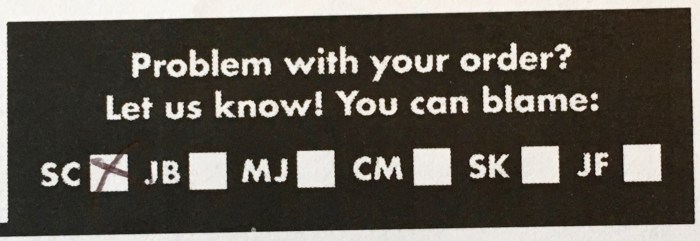
The Customer Service Check Box

Customer Service Check Box

The process seemed like every other company. Place the order. Wait for the package to arrive. Check to make sure that everything is in the package upon arrival.

But this company is different.

At the top of the packing sheet is this small little check box.

“Problem with your order? Let us know! You can blame:”

What a simple way to send a message to your customers.

“We may not get everything right, but let us know if we don’t. And by the way, we are also letting you know that there are actual people behind this order. People who are responsible for getting it right.”

But this check box is not just for the customer, it is for those 6 people who work there. They take pride in their work, enough to say “I am putting my name on this and call me out if it is wrong.”

What simple check box, process, or idea could send the same message to your customers?

By the way, when the order arrived it was not exactly what I ordered. You see this company always adds a little extra bonus gift with your order. So I got what I ordered and a nice surprise as well.

Think about the message that sends.


A Tale of Three Me(s): Past, Present, and Future

The Three Mes

This concept of the “three Me(s)” came out of an ongoing conversation I  have been having with a close friend.

When you meet someone, at first glance, they may seem ordinary enough, but there is more to them. By our count, there are in fact three of them: a Past, a Present, and a Future version. These three Me(s) or You(s) are trying to coexist and work together, but there can be tension between them.

Let’s meet the three Me(s) and learn what they have to tell us.

Meet Present Carl. Present Carl has a lot on his plate. He is juggling multiple roles, jobs, tasks, and ideas. His desk is covered in piles. Present Carl has lists, and lists of things to accomplish. He is a little overwhelmed (maybe a lot) and is easily distracted (maybe a lot). Present Carl has a lot of work to do, and he is trying to balance the work along with enjoying life, connecting with his close family and friends.

There are two other Me(s). One is waiting to arrive.

Meet Future Carl. This guy has it made. Things are going well for him. He is successful and has “made it.” Future Carl is a successful author, consultant, speaker, husband, father, and friend who lives in a cool community (maybe two), sets his own hours and schedule, works with an amazing team, and sips good strong coffee while working on creatively cool projects that change the world.

There is the last Me. One who existed before.

Meet Past Carl. He was a pretty good guy (most of the time). He tried hard, but tended to procrastinate. He was easily distracted, overwhelmed, got frustrated, and didn’t always like the hard work that was in front of him. Past Carl liked to get in the car and go on adventures instead of mowing the lawn, planting a garden, or crossing things off that ever growing to-do list.

Unfortunately, there is tension between the three Me(s): Past, Present, and Future. They are not always on the same page. They fight, blame each other, and resentment can build between them. Sometimes they don’t even know they are on the same team, and may actually be working against one another.

Present Carl tends to blame the other two. He blames Future Carl for dreaming up these lofty goals. He blames Past Carl for not doing enough work, for procrastinating, and for not saving or sacrificing enough. Ironically, Present Carl tends to be the one dreaming up those goals, while at the same time not doing the work today. But he likes to blame the other two.

Past Carl feels under-appreciated, overlooked, and less important. He wasn’t asleep at his post. He studied, worked hard, and tried to face what each day would bring. He did some of the tasks while trying to balance life each day.

Future Carl cannot seem to understand what is taking so long. Why didn’t the other two get their act together? Why didn’t they pay the price? Why didn’t they invest? “Just think where we could be today if they had just [insert expectation here].”

Present Carl tends to be the most judgmental. He feels trapped between Past Carl and Future Carl. He doesn’t always like being in the middle. The projects aren’t getting done, the pressures are mounting, and the joy of accomplishment has been replaced by resentment toward the burdensome expectations.

How can we help and reconcile the Past, Present, and the Future me(s)?

Present Carl could start by forgiving Past Carl. Past Carl did a lot of things that were not perfect, and included some failings along the way. However, Past Carl got Present Carl to where he is today. Instead of resentment, Present Carl can show gratitude and recognize the work, sacrifice, and circumstances of Past Carl and grow to appreciate him.

Once forgiven, Past Carl is free to just be.

Present Carl, no longer burdened with the blame and resentment, can have a new perspective. He realizes that soon he will become Past Carl as well. The work he does or doesn’t do, matters. He looks ahead to Future Carl and realizes that he needs to be free from the burden of him as well.

Future Carl can help here. Future Carl can ask Present Carl to forgive him as well. He didn’t intend for the goals, and achievements to be a heavy weight on Present Carl. He wants the best for him, and sees cool things ahead in the journey. Future Carl begins to root for Present Carl.

Present Carl is now free.

Present Carl understands he needs to do work, but not as a resentment-filled task. His work each day is more of a gift to Future Carl. Present Carl doesn’t “have to” do things, but “gets to” do things to make a difference for someone he really cares about. Present Carl also begins to cherish the work of Past Carl and regularly thanks him for the sacrifice that got him here. Past Carl begins to root for Present Carl as well.

All three of them, Past Carl, Present Carl, and Future Carl are learning to operate as a team. Their appreciation for each other has grown, and gratitude and mutual grace has replaced the blame that used to dominate their interactions. They are not perfect, and it is taking the three of them some time to get used to their new roles. When the old attitudes or patterns creep back in, they remind each other of how much they care about each other, and forgive again.

The hope for you is that your three Me(s) will learn to walk together in grace and peace. That they will become more of a team, and stop working against each other and begin to cherish and root for each other.

May all of (y)our Me(s) find what they need.

A Little Friendly Research (My Turn)

I asked you a series of questions, and your answers appeared in the last 7 posts. Your answers were vulnerable, honest, funny, serious, and clever. Your answers inspired questions, discussions, and honest conversations about friends, and friendships. Your answers inspired some actions, as friends connected, reached out, answered phone calls, and actions became a little more deliberate and focused.

I wondered about how to end this series, and a few of you suggested that I weigh in on those same 9 questions.

So, it is my turn.

Question 1: What are the best attributes of your good friends?

They are intentional. They reach out. They call me, text me, and email me. They initiate as well as respond. They seem to have this internal counter that knows when too many moments, hours, days, or weeks have passed and the alarm goes off and they remember to connect.

Question 2: Do you think friendship is hard? Why or why not?

Friendship seemed easier in elementary school when you walked with the same person every day to school, then goofed around every weekend together on little adventures in the woods and on the pond. Friendship seemed easier when you were on a ship and saw them everyday for 6 months, and ate, slept, and worked together. Friendship seemed easier in college when you were in that crappy little apartment waiting for your paychecks so you could actually buy meat at the store.

Friendship seemed to get harder in the next stage of life. New jobs, new cities, new neighborhoods, new kids, and new distances between all of them.

Friendship is getting easier and harder at the same time in this current stage. My expectations have grown as the years have passed. What satisfied this need to connect years ago, doesn’t seem like enough. I have more time for friends then a decade ago, but some of them don’t have the same time available to me. The number of friends “goal” has been replaced with a depth of friendship “goal” which I recently realize is a much harder prize to attain.

Question 3: What do you expect from a friend?

Balance and equity in the long-run. I may need something from them for a season, but I want to find a season to give back as well. They shouldn’t be the only one to initiate connection, I want to call them, text them, email them, or reach out as well. I need that same little internal counter in my head that reminds me that too much time, distance, or life has gone by and I need to take action.

This question caused me to wrestle the most. I fear my expectations may be causing interference with some friends because my expectations may be higher, and unspoken.

There is tension expectation. How do we learn to give freely, and not be taken advantage of? When do you give? When do you need? How do you measure balance and equity?

No great answers, yet the wrestling seems like a good thing for me to work on.

Question 4: How much time in a given week do you think about your friendships?

A LOT! Until I read your responses, I thought I was a bit of an outlier (well I may still be). There was comfort to know that I am not the only one who thinks about this pretty often.

My mind wanders towards friends and friendship throughout my entire day. The morning computer/writing time, the commute, at random times each day, lunchtime, afternoon coffee, closing time, the other commute, dinnertime, vegging out time, before I sleep (you get the idea).

Bottom line, if you are my friend, I think about you a lot.

Question 5: What are your best attributes as a friend?

I care about you. I think about you. I connect with you. I am here when you need something (yes that has included the occasional furniture moving). I invest in you. I want you to succeed. I have hope for you. I find time for you. I love you.

Question 6: If you could say one thing to your friends that would help explain what you need from them, what would you say?

Be real. Be present. Be available. Be my friend.

Question 7: How many close friends would you say you have?

Nine.

Question 8: Anything else you would like to share?

Yes. This process, this journey has helped me understand friends and friendship in a new way. Your responses have helped shape me and I don’t want this journey to end.

Earlier this week I was teaching a class and we talked about leadership. One participant mentioned that leadership has an expiration date. In other words, if you are not exercising those skills, they expire, go bad, and become rotten.

I think this applies to friendships as well.

Question 9: In 10 words or less, what advice would you give the World about friendships?

Intention. Balance. Mindful. Time. Hope. Connect. Remember. Savor. Initiate. Love.