The Actual Book List

180 (1)

A while back I gained some perspective when I read the blog post from Wait But Why about how much time we may have left at any given point in our lives. One of the things that rattled me (besides the fact that I may only have 20 more holidays left with certain people) is how many books I may read by the end of my life.

Life is busy and distracting, and although I like to read, I am not a fast reader and start a lot of book, yet never finish them. I typically would have 6 to 8 books on my nightstand. With a series of fits and starts I would go back and forth between all of these books, yet never finish them.

At my then pace of about 4 books per year (I am only counting actual books that I actually finished – you know all the way to the last page) at best I only had 180 books left to read.

180.

With the millions of books in the world, and thousands being added everyday, 180 books became a scary proposition.

I used to brag about books I was reading, or books I intended to read. But those books remain unfinished.

For 2016, I decided to create a new pattern, a new approach.

I now have the actual book list.

These are books I have actually read in 2016. I write them down right after I finish and savor that last page. There is something important about that transaction. Instead of the pressure of seeing those stacks of unread books, I now have a list of what I actually did.

I am a big fan of lists. But lists, especially aspirations or dreams can feel so unattainable that those same lists that are designed to help us, can become an overwhelming burden of non-accomplishment.
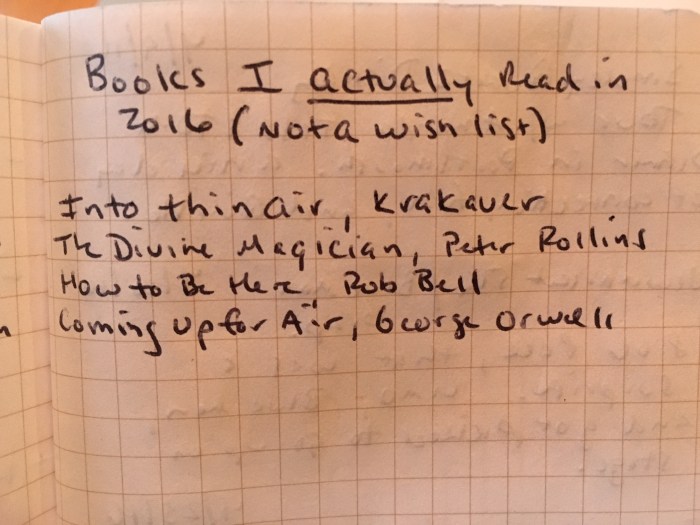
The Actual Book ListInstead of a list of what I would like to accomplish, the actual book list records the progress that I actually made. There is something more satisfying about this list.

The good news: at this pace the 180 may just become 360, but I don’t want to get ahead of myself.

The real number is 4 for 2016 as of today. But even 4 in the midst of a crazy, busy, and distracted life feels like an achievement.

Elliptical Orbits

solar-system-orbit

(Image Courtesy of wiseGEEK)

Apparently I have a lot in common with early astronomers. Both Copernicus and Galileo thought that planets traveled in perfectly round orbits, because the circle was an “ideal shape.” Circular orbits made sense, something is moving around something else, and a circle is a pretty good choice and seems right. Especially if you have an “ideal shape” or expectation in your mind in the first place.

With all the recent friend research we did together, friends and relationships continue to be present in my mind. I found myself using the term “orbit” a lot with friends.

“Hey, I want you back in my orbit.”

“You seem to be drifting out of my orbit.”

“Why can’t we stay in orbit?”

But there is a law of motion in the universe. Johannes Kepler noticed that the “ideal shape” didn’t explain everything. Instead, he discovered something else.

The orbit of a planet follows an ellipse with the sun at one focus. He discovered that the motion and travel was not an “ideal shape” but instead an almost flattened version of the ideal.

This means that at any given time, planets will be further away from the sun, and other times they will be closer, but still in orbit.

When it comes to friends, I fell into the same “ideal shape” trap. Since I assumed that being in orbit with a friend was a perfect circle, any perceived distance was interpreted as getting out of orbit.

But maybe, Kepler’s First Law of Motion can apply here too.

Let’s call it Carl’s First Law of Friendship:

“The orbit of a friend follows AN ELLIPSE with YOU at one focus.”

Realizing that a friendship may follow an Elliptical Orbit helped explain why friends are not always constant or “perfect.” Sometimes they are closer, sometimes they are further away, but that is how orbits work.

Want to know more? Check out this great video on Elliptical Orbits. And just like the astronomers, we will keep trying to understand this whole weird and wonderous universe of friends, and friendships.


Changing Perspective

It was one of those breakfasts. Balancing trying to eat while savoring each sentence, word, and idea that comes to life when you get together with one of those inspirational ones.

Mind racing.

Pen furiously trying to keep up with the gems.

Another great idea.

That phrase.

That idea.

That thought.

An interesting story unfolds.

A new office. The old one is cluttered. The new office represents a new start. A new set of patterns. Walking in a new larger role.

But the moving day was delayed. Projects, ideas, and work was spread out in a conference room instead. On a larger table.

Instead of sitting, hunched over, almost closed off, they had to stand.

Standing allowed for a larger view, a change of perspective.

Changing perspective was a reminder to get above the piles, the issues, the projects.

Changing perspective was a reminder to take it all in and get above the weeds.

The physical change prompted the mental one.

Changing perspective serves as a good reminder for all of us.

Make a change, find a new space. Stand up, go get a coffee. Try physical changes that may prompt the changing perspective you need.

The Customer Experience

Field Notes Sweet Tooth

I recently found Field Notes as a way to regain the lost art of writing things down. Their designer, Aaron Draplin is an amazing speaker [see his Ted talk], and you can tell his philosophy and approach have permeated the company and experience.

[Let me be really clear up front, this is not a paid advertisement. I do not have anything to gain by writing about this product. I purchase them just like anyone else and I typically do not mention actual companies or products in this post, but the repeated positive experience has created an exception.]

There is something about writing something down, especially in an electronic age. The feel of the paper, the ink of the pen. Recent studies have found that writing things down (versus typing) may help us learn and retain more.

I have been filling up my own Field Notes memo books over the past years. Savoring each word, idea, and memory. They captured thoughts from random to sacred. Sitting on a park bench writing down dreams and ideas felt special and meaningful.

I have started giving them away to my close friends, inviting them into the experience.

Recently I subscribed to their quarterly shipment.

I expected to just receive the newest and latest colors/styles each quarter. But I began to realize it was more than just a few books.

Many companies sell you products.

There is something you need. You order it or go to the store and purchase it. You use it up. You purchase it again.

But a few companies invite you into an experience.

Something different, something unique. The more you spend time with them, the more you feel like you are part of something more.

As each quarterly shipment arrived, there was always something extra.

A pencil.

A pen.

A small gift.

When one shipment arrived, it even included candy to celebrate the “sweet tooth” edition.

They are also the company with the “who to blame” check box, to make sure the got the order right.

The experience continued.

I kept thinking to myself, this company is different, the experience feels different, and somehow special.

The other day another package arrived.

It was not time for another quarterly shipment.

It was something different.

To celebrate their 30th quarterly shipment, they sent along a bonus “Thank You” to all of the subscribers, customized to us.

Going the extra mile to make your customers feel important moves the relationship from a product to a customer experience.

What can we all do to move our customers from products to an experience?

To Field Notes: Thanks for leading the way.

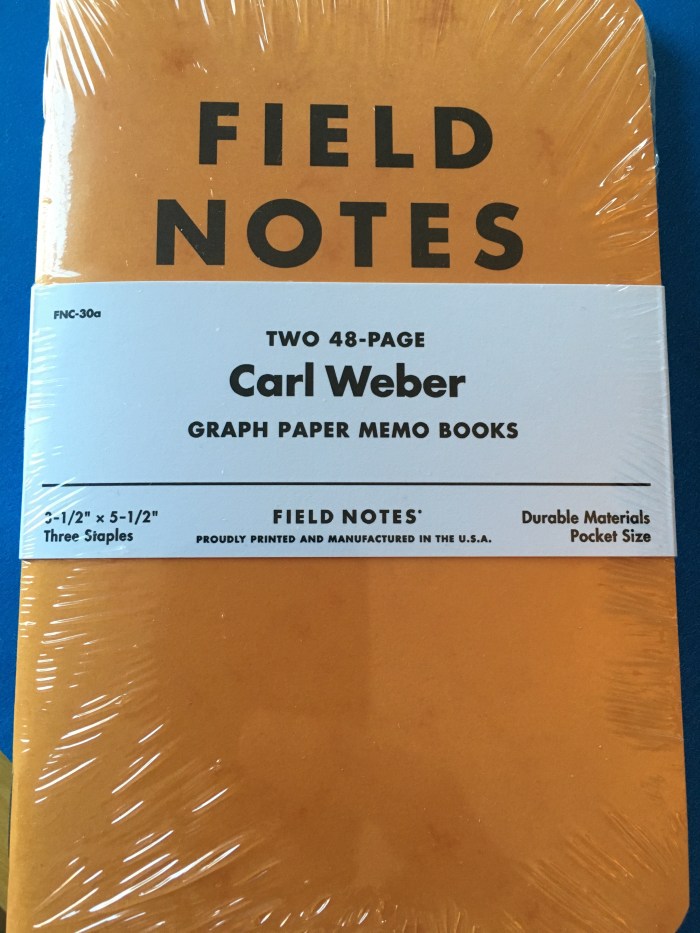
Field Notes Carl Weber


Hating Salmon and Lemon Squares

“He hates Salmon.”

“He hates Lemon Squares.”

“He is grumpy if he doesn’t eat.”

“He is grumpy if woken from a nap.”

“He [insert event, either one time or a repeated event that happened, and form a hard-wired rule about the person despite the passage of time, even years].”

There was a time when I didn’t really like eating salmon. You know the poached (was it boiled?) kind smothered in a creamy sauce with dill.

Rule #1: Carl hates salmon.

There was a time when desserts in general were not my favorite, I am more of a savory person, and since periodically I may be training for something or trying to lose weight, sweets of any kind are not my friend.

Rule #2: Carl hates lemon squares.

Years later, the remnants of those rules still appear. People are surprised when I eat Salmon (grilled and savory is my favorite) or take a bite of a lemon square.

The preferences at that moment were not meant to create a hard-wired rule.

The preferences were a snapshot in time.

But, times change.

And people change.

We think we know them.

We think they are the same.

We think we had it right.

How many times have these hard-wired rules created obstacles between us?

How many times have these snapshots been held up as a representation of us?

Be careful of the hard-wired rule trap.

You have changed, and so have the people around you.

P.S. I am also not always grumpy because I am hungry or when I wake from a nap, sometimes I am just grumpy.

Yes

Yes

Yes.

But I am tired.

Yes.

But I want to rest.

Yes.

But I would much rather [insert distraction here].

Yes.

But it will be hard.

Yes.

But I may fail.

Yes.

But people may laugh at me.

Yes.

But I am afraid.

Yes.

But I am not qualified.

Yes.

But I am not ready.

Yes.

Learning to say Yes while wading through the obstacle swamp our minds and bodies create for us may make all the difference.