Homework, Frustration, and Emotional Intelligence

Homework

While having lunch the other day with a friend, the conversation moved from simply catching up on the details of our lives to deeper places. We started to talk about emotional intelligence and the role it plays in our success.

To provide an example, I shared a story.

A few years ago, while trying to help one of our daughters with her homework, I got upset. The helping, the explanations, and the examples were not gaining traction. In fact, it seemed to make things worse. My emotional glass got cloudy.

I have already admitted to having Emotional Rickets when it comes to emotional intelligence. Of the five hierarchical steps by Daniel Goleman, the first two always help me unpack issues that I may be having.

Step 1, Self-Awareness

Step 2, Self-Regulation

If I am having a problem with Self-Regulation (getting upset), I go back down a Step to Self Awareness and try to figure out what is happening.

What is the negative emotional trigger? What else may be going on inside?

“Why is helping with her homework causing you to get upset?”

“I don’t know, maybe because I want her to succeed.”

“Ok, that is one possibility, but helping her succeed shouldn’t cause you to be angry. What else is happening, what are you afraid of?”

“I am afraid that she won’t do well, that she won’t get into college, that this time was somehow wasted.”

“Keep going.”

“I am afraid that this means that I have not helped or prepared her enough. That her failing is a reflection of me. That I am not a good Dad.”

There it was: the real issue. Fear of failing as a Dad.

I was trying to Self-Regulate an emotional state around homework that was really about something else. By going back a step, by finding greater Self-Awareness, the Self-Regulation becomes easier.

It was never about the homework. In fact, the inability to Self-Regulate was actually contributing to that fear becoming a reality.

Thankfully, she still lets me help with homework. (After some serious apologizing and a few tears.) Those feelings or fears still exist, but the ability to regulate the emotions in the moment have become much easier.

The next time you find yourself getting upset about homework or having trouble with Self-Regulation when [insert your specific story here] try this simple process.

Take a step back, ask yourself the hard questions.

What is really happening? What are you afraid of?

Moats, Distance, and Drawbridges

Caerlaverock_Castle_from_the_air_1


(Caerlaverock Castle in Scotland courtesy of Wikipedia)

On the call the other day, I was connecting and checking in with someone important to me. They were describing an old relationship that did not end well. They had been hurt. Words were exchanged. The relationship, although important, had essentially ended.

Because of some recent circumstances, they needed to connect with this other person. Connecting after a falling out is never easy. They were wrestling with how to proceed, and the feelings associated with the time that had passed.

As we talked, I explained that sometimes we need to create Moats. Moats are protections for our core relationships. We keep those inside safe, and others are kept at a healthy Distance.

Distance is the natural by-product of a Moat. Those relationships can be good, but they have limits. Those relationships may be “not so good” but the Distance helps you keep your emotions and expectations in perspective.

Those inside are kept healthy and safe (including you).

When discussing how to move forward, we realized that Moats need Drawbridges.

Drawbridges allow us to let people in when needed. Drawbridges allow us to connect with the greater world by making a decision to lower the bridge.

The Moat still exists, but the connection can be made. When the time has passed, the Drawbridge can be raised again, when and if needed.

We all have Moats. The logical by-product of these Moats are Distance.

It is the Drawbridge that helps us manage both.


Rusty Connections

RustyOldHinges

(Image Courtesy of http://www.angiesroost.com)

A friend recently reached out to make sure we were okay. Nothing specific happened, just a little time passed since we last connected.

“Are we okay?”

“Yes. Why, do you think something is wrong?”

“No, just sometimes when time passes our connections get a little rusty.”

Rusty Connections. As time passes things don’t move with the same fluidity. There can be resistance or breakdown. Sometimes, things just stop working.

Our relationships and our connections with others can get rusty. They may have become stiff and lack the flexibility they once had. The passage of time may have caused them to stop working the same way they did years ago.

There is good news. With effort, many of these Rusty Connections can move again. That effort may take the form of a phone call, a text or email, or even a letter (see below). But remember, a rusty hinge doesn’t return to its original state. Time has passed, and it will move again but in a slightly different way. Perhaps with a little more effort.

(I have a good friend who is single-handedly attempting to bring back the written correspondence approach, and I applaud and am participating in this effort. Why not give it a try?)

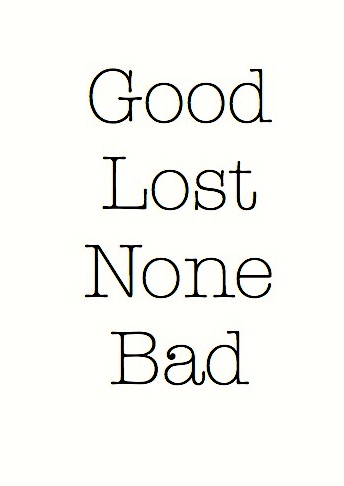
Good Lost None Bad

Good, Lost, None, and Bad

For some reason, I have been thinking about the hierarchy of certain things. Thinking about how to classify particular relationships, friends, jobs, bosses, employees, customers, and connections in a way that brings perspective.

Good describes things that are positive and contribute to you and your wellbeing.

Lost describes things that were once Good, but have left or been removed from your life.

None describes things that have never been part of your life.

Bad describes things that are negative and erode your life.

Why do we need this hierarchy?

Frankly, Good is easy. If all of our things fell into this category the rest of the list would not be needed. We would be and have good parents, friends, relationships, employees, bosses, and customers. By classifying the Good, at least we have something to strive towards.

The Lost, None, and Bad is where things can become less clear.

Lost can be hard. We had it: a marriage, a parent, a relationship, a friend, a job, a boss, or a customer. It was Good, now it has been Lost. The temptation is to classify this as Bad. A Lost parent, boss, friend, or employee is much better than a Bad one. We were able to experience the Good. We feel grief because it was Lost. Despite being Lost, we have the memories and experiences of what was once Good.

None is tricky. None may masquerade as Bad. Not having that parent, relationship, friend, job, or customer actually feels Bad. But None is not the same as Bad. None has plenty of its share of emptiness and loneliness, but that is a far cry from the negative destruction that Bad can bring.

Bad at first glance is easy. Bad encompasses all of the negative and harmful things. However, Bad is not satisfied with being at the bottom of this hierarchy. Bad wants you to believe that there are only two classifications: Good and Bad. Bad wants a more simple definition: If this thing is not Good (all the time and consistently and forever), it is Bad.

A Lost [parent, job, relationship, spouse, employee, customer, or boss] is better than None.  None is not actively destructive like a Bad [parent, job, relationship, spouse, employee, customer, or boss].

Does having a few ways to classify these things be helpful? How could separating out the Lost and the None from the Bad provide some additional peace or freedom?

Not all events that you currently face, or that shaped and define you are Bad.

Bad likes to take all the credit.

As we strive for more Good in life, don’t let Bad fool you into thinking that Bad is all that remains. Sometimes Lost, and even None, are not so Bad when they are in perspective and in their respective hierarchy.

Emotional Rickets

I think I have Emotional Rickets.  (Bear with me on this one.)

During a recent conversation, I was explaining how certain situations cause an emotional response that is hard for me to regulate. Anger moves pretty fast, and there are times it catches me off guard.

According to Daniel Goleman, there are five hierarchical levels of emotional intelligence:

1. Self-Awareness

2. Self-Regulation

3. Motivation

4. Empathy

5. Social Skills

I like to picture these five areas as going up steps, one at a time to reach the top. Mastering a prior step helps bring you to the next. Whenever I have an issue with one of these steps, I back up a step to see if there was something in a previous step area that would provide a clue the issue at hand. In this case, I was having an issue with Self-Regulation (step 2).   That left only one step to return to: Self Awareness (step 1).

Rickets is a disorder caused by a lack of vitamin D, calcium, or phosphate. It leads to softening and weakening of the bones. Bones are not only are weaker, but have additional pain and tenderness.

So, Emotional Rickets is when you have a lack of some positive emotional events (and perhaps some negative ones) that leave you in a weakened state.  In additional to weakness, you can add additional pain and tenderness from an emotional perspective.

I repeat, I think I have Emotional Rickets.

This revelation seemed to help, suddenly I could picture the issue.

If my legs were injured, I would not run as hard.

If my arms were injured, I would not lift as often.

If my back was injured, I would not move around as much.

For some reason, I was expecting my brain and emotions to respond to events as if there were no prior injury, no prior events, no limitations. As if it were strong.

lifting_brain

(Image Courtesy of blogs.hawkeyecollege.edu)

But my Emotional Rickets require me to be much more aware of my limits. I may need to work harder than others to achieve the same results. I will be sore, and will not want to go again. I may need more rest and recovery time after each event.

In time, I hope to strengthen this area. I do not kid myself about the amount of work and time it may take to do make even small gains. Progress will require some discipline and work.

Where have you had Emotional Rickets? Where have you been left in a tender and weakened state? Where has this hindered relationships or caused issues? Maybe a little progress in this area for all of us could really change the world. 


After Injury

As a follow-up to my the post “I am good as possible” it seemed important to share what can happen when we take that risk, try something new, and stretch ourselves.

My Right Knee

(Image Courtesy of My X-Ray, My Youngest Daughter and a Ski Jump)

Injury. It happens to all of us.

In this case, it happened to my right knee. While skiing/trying to catch up with my youngest daughter, I followed her over a jump. Regret arrived almost as quickly as the decision was made, only to be overshadowed by intense pain.

Obviously, it was not a great decision. That split second resulted in numerous bags of ice, pain relievers, doctors visits, x-rays, and some physical therapy.

But, we all sustain injury. Injury may be physical, emotional, or relational. Injury can happen at home, at work, on the slopes, or just about anywhere.

Injury will happen.

Some injury can be prevented, but not all.

During injury, we have to manage the pain, rest, and rebuild.

The choices we make after injury may be the most important.

We may choose to avoid.

We may choose to fear.

We may choose to stop trying.

We may choose to try again, but perhaps with a little more caution/wisdom.

The decisions we make after injury determine if our world becomes a smaller place, with less risk, less adventure.

Keeping our world big after injury is its own risk.

As my leg healed and the pain left, I kept anticipating that the pain would return. My steps were more cautious, and the memory of the pain was almost as real as when it actually hurt.

The other night was my first time chaperoning without skiing. I was not ready to put on those skis, so I modified my role. I encouraged the kids. I made sure they all knew where they were going, and cheered them on.

I have decided to ski next week. I am making the choice to keep my world big, despite the fear and memory of the pain, and possibility of another injury.

Where has injury impacted you?

What choices can you make after injury?

To continue in my role from the other night…

Don’t give up.

You can do it.

Keep your world big.

Get back up.

Get back on those skis.