Untethered

There may be a better word, a better term, or a better way to describe that interesting feeling that comes from feeling completely scattered and overwhelmed.  However you describe it, the unanchored position during chaotic times can undo us.  Unfortunately, this untethered state can creep into our lives before we realize it, and the blur of activity seems to help keep us unaware of our own state of mind.

Are you untethered?  Answer a few of these questions to see.

1.  Are you feeling anxious even if no specific event can be pointed to as the cause?

2.  Do you feel that time is slipping from you and you are not accomplishing what you need to?

3.  Is your to-do list growing at a rate faster than your accomplished tasks?

4.  Are you tired, even when you are not doing anything?

5.  Do you have a hard time starting projects even when the deadline is looming?

6.  Do you jump from task to task despite not completing the prior activity?

If you answered yes to 3 or more of these, you may be in an untethered state.

What can we do if we find ourselves in an untethered state?

Here are a few recommendations.

1.  Don’t make any large decisions (unless absolutely necessary).

2.  Slow down, make lists of what you need to do as long as you also include a list of what you should STOP doing.

3.  Do at least one of the difficult or hard tasks on the list first each day.

4.  Connect with others and be accountable for the hard things on that list.

5.  Find a tether or anchor that will help keep you from being scattered.  This can be a person, a book, a setting, or a state of mind.  For me this includes going to a “third space” or a place that is not my home or office where distractions are limited.  My favorite space is a local library or local coffee shop where it seems just separate enough from my other places that I can focus on specific projects that need to be completed.

6.  Regulate your screen time (Computer, phone, and TV).  Too much seems to act like a distraction from our actual lives.

7.  Stop multitasking.  Doing multiple things at once just add to the untethered state.  Accomplishing the most important task in front of you will prove more productive than simply doing a piece of five tasks.  I printed out a little card for my desk with a few simple words “What is the highest and best use of my time…RIGHT NOW!”  This small reminder acts like a tether that keeps the focus on what I need to do, especially if I was avoiding a particular task.

8.  Get some exercise.  You don’t have to run a marathon, but get moving.  Go for a walk, run on that treadmill, or just stretch your arms above your head and breath deeply.

When you find yourself in an untethered state, remember to try a few ideas on the list. Start slowly, and over time you may feel more anchored, more in control.

You can do it! I know you can! 

We Just Need a Strong Leader

Working with teams is great.  But, I have noticed a pattern.  When there is difficulty, conflict or lack of communication an interesting pattern emerges during the various sessions.  What I hear during these sessions is consistent.

Sometimes these statements are a muttering in the back of the room, other times they are directly proclaimed for the group.

“We just need a strong leader.”

“If the [insert bosses title here] did more of [whatever topic we are discussing] we wouldn’t be in this mess.”

My personal favorite – “This is all well and good, but when will our leader apply some of these principles?”

In most cases I am there because the leader has identified the issue and wants to inspire collective solutions and buy in from the group.  Admittedly these leaders have not always lead deliberately, but the demands of their time and energy has increased, and they assumed that these teams would self-manage or self-lead through the routine of the day.

Then something interesting occurs.  The leader begins to lead, and in a strong and deliberate way.  The leader provides clear direction, communicates a larger vision, and begins to hold everyone accountable for results.  This newfound accountability eventually finds its way to those vocal critical few.  According to their earlier statements, what follows would logically be a happy embrace of this new leadership model.  Tragically, it doesn’t.

“Who does [insert leader’s name here] think they are messing with the way we have done things?”

“Can you believe that they want us to report on our activities, why don’t they just leave us alone like before?”

“Why do they keep making us go to meetings?  Why are they in our space so often?  Why are they asking so many questions?”

As the leader becomes stronger and tackles the various issues they find that the people who so clearly demanded strong leadership, are the ones who fight the hardest against it when it arrives.  Often, those vocal few are no longer there in a few years because when they said “We Just Need a Strong Leader” what they really meant was “I need someone to complain about to deflect attention from my own lack of personal leadership.”

Maybe that vocal person was right.  The organization did need stronger leadership, but you should be careful what you wish for…you just might get it.

Theory, Paper and Real Life

Sadly, a lot of times I am better in theory or on paper than I am in real life.  I have certain beliefs about the way the world or people should be, how they can better connect with and work with each other and I think, write and even periodically teach these concepts. Applying these concepts to my own life has proven to be a challenge.  I will give you a few examples.

Preparing to teach on emotional intelligence and becoming stressed about it and losing my cool with the kids about their homework.

Writing a blog about communicating while getting into an argument with those around me.

Teaching on coaching in the workplace while canceling my coaching session with one of my employees.

My ability to offer great advice to others while failing to take that exact same advice for my own present situation is remarkable (unfortunately).

I heard a very important idea from Jack Enter, a speaker and author.  During a session on failing as a leader, he warned us that believing in something and putting it into practice are two separate things.  He warns us to be careful about being satisfied with our beliefs while never executing on the actions necessary to do the steps needed to be the people and leaders we need to be.

Our (or at least my) ability to allow this disconnect between theory, who we are on paper, and real life is amazing.  The ability to have two seemingly contrary positions without noticing it has become more apparent to me, especially when I fail.

Jack recommends disciplining ourselves to implement these concepts, while being accountable to others so we actually do these things.  How to you make sure your theories or who you are on paper makes it into your real life?

For me, the morning phone call helps because it provides a space to be honest about where I didn’t measure up, and be accountable to others to make changes that bring my life more in line with these theories I believe.

Fear

Fear.  Fear is all around us.  Fear can drive a lot of what we do (or not do) in life.  Typically we avoid those things that cause us fear, but every now and then we press into our fears and try to overcome them.

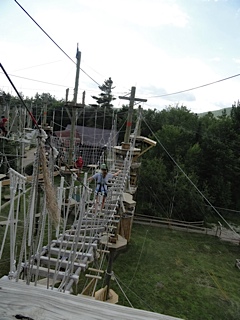
Earlier this summer we decided to press into some of that fear together with our older girls by taking them to a ropes course.  The day started with learning to put on the harness and various safety tips.  After a short climb through the practice course, we were on our way.

The course is designed in a way that each challenge builds in difficulty as you progress up the levels to the top.  At the top you are rewarded with long zip-lines that travel into the tree canopy.  The challenges can build self-confidence once achieved, but can create fear as they become more and more difficult and are higher and higher in the air.

One daughter was able to embrace the fear and move from challenge to challenge.  Any observer would be able to tell she was afraid, but she kept her narrator in check with a long string of positive self-talk.

“I can do this.”

“I have been working out a lot this summer, and I think it helps.”

“I think I look cute in this helmet.”

Our other daughter wrestled with the fear.  After a few levels, the intensity became overwhelming and her narrator started to creep in with self-doubt.

“I can’t do this.”

“I want to get down.”

“Let’s go home.”

We subscribe to the “Challenge by Choice” approach, which means that there is no pressure to continue and each person can make the choice to continue or not.  We do encourage each other to stretch and challenge ourselves but do not apply pressure or guilt if someone needs to stop.

We regrouped a little and talked things out.  As we talked we discovered that she really wanted to do was to go down the large zip line and was disappointed that there was no way to get there except through the challenges.  Everyone in our group spoke encouragement and life into her.  They reminded her how much she had accomplished already and we would all work together to get her to that zip line, if she wanted to.

“I will try.”

Our little tribe began to work together and communicate in a way that had not happened earlier that day.  Everyone was listening, helping to plan, and deciding who would travel to which challenge to either demonstrate how to accomplish it, or be available to help. Amazing words of encouragement traveled between all of us.

For the first few challenges, our daughter closed her eyes and grabbed onto my harness and rode to the other side.  Tears were streaming down her face as we moved from one challenge to the next.  (The first time we did this, I almost fell backwards and fear crept into my head and I hoped I could continue, but knew I had to keep it together.)

When we reached the top tower, there were just a few challenges left to reach the zip line. The first was a rope and wooden bridge that we dubbed the “pirate bridge.”  It was at this challenge that our daughter shifted.  Confidence had replaced most of the earlier fear and the journey was almost over.  She stood at the edge of the tower and clipped her harness to the guide wire first.

“I think I can do this one myself.”

And she did.

Isn’t that the way life should be?  By facing our fears together we can help each other combat that narrator that tries to tell us that we cannot succeed and perhaps fear can play a smaller role in our lives.

The Third E

While working with a pretty dynamic group, the discussion touched on what their particular styles brought.  This group is very similar in world view and style, so I asked them a simple question.

“What do you bring as a team?”

“Energy!”

What else?

“Emotion, and a passion for doing the job and doing it well!

“What else?” (There I go again with the “deep” questions.)

The group looked around a little, surveyed each other and for some reason the “E” theme continued.  Finally, the third E emerged.

“Ego.”

There was silence and the word sort of hung there for a minute.  They were right.  All the energy and emotion could be great, but that third E could undo their efforts if they were not careful.  For all the positive aspects, there was a potential blind spot.  Recognizing that Egos were at play shed light on the drawbacks of their styles.

Now all they have to do is leverage the first two, and keep the third in check.  Naming the potential hazard to their success was an important step.  Do you have a third E?  What will you do about the third E once you name it?

The Adventure Within (the Adventure)

The Adventure Within (the Adventure)We try to get outdoors as often as we can as a family.  With all of the work, school, life, and errands, this can be a real challenge.  As part of the yearly goal setting, hiking a certain mountain where we live was on the list for 2012.

Labor day weekend seemed like the logical choice for us, and this hike was on one of the oldest daughter’s “bucket list” for college.

What a perfect way to cross off a goal on a few lists while spending some quality time with the girls.  Our backpacks were full of snacks, water, supplies, band aids, eye drops, extra allergy medicine, bug spray and a few random things like headphones and a few toys.

The route was selected based on a consensus of research.  The route was a bit longer but a less steep path since this mountain is bigger than our casual small hikes of the past.  Walking sticks in hand, our small tribe’s adventure began.  The day was perfect, mid 70’s with a cool breeze and good spirits all around.  We were entertained by a series of jokes at the expense of a small dam.

“Looks like we are on the dam trail.”

“Hey, I am walking on the dam footbridge.”

” Welcome to the dam, I will be your dam tour guide, and I will be here to answer all of your dam questions.”

“Hey, is that the damn dam over there?”  (It got a little out of hand, and we had to redirect the conversation.)

After about an hour, our middle daughter mentions that the tread on the tip of her boot is coming loose.  We stop, and a small bungee like cord from a backpack wrapped around the toe seems to solve our problem.  We hike on.  After a short while, she mentions her boots again.

“Ummm, Dad, I think you need to see this.”

“Did the bungee come loose?”

“Nope, but this did.”

She was holding the entire boot tread in her hand.  It had come completely separated from the boot and we are miles from the starting point, and not quite halfway to the summit.  We spring into action, searching for every kind of solution we can in our bags.  Now it had been a while since we did serious hiking and we packed pretty well with one exception.  There was no tape.  Not even that white medical tape you typically find in first aid kits.  What we would have given for a roll of duct tape!

Luckily a friend of ours had given us a few paracord survival bracelets (small woven bracelets made from parachute cords), and the kids remembered to wear them.  We separated the cords and tied up the shoe.  The hike continued.  It wasn’t a perfect solution, but we had a mountain to climb.  Another 20 minutes went by.

“Ummm, Dad, it is happening again.”

Her second boot suffered a similar fate.  The tread had completely separated itself from the boot.  We stopped in a little clearing to eat lunch and assess our situation.  After additional attempts to tie the treads on, a few tears, lunch, and asking every passing hiker if they had any tape, it was clear that the summit was not a reality.

The hike down was not easy, and included continual evaluation and readjusting the cords and the addition of a few hair elastics.  Eventually some medical tape was provided by a sympathetic passerby.

Towards the end, one of the treads came completely off again.  Instead of stopping, or even missing a step, my daughter simply held it up high above her head and marched on.  Her strong defiant stand against the day’s difficulty was signaling that she was not giving up, and she was going to make it.  And she did.  We all did.

Later while in the car, we were discussing the high points of the hike, and what each of us remembered.  Besides another round of jokes about the “dam footbridge” by our youngest, we talked about working together to solve the boot issue, and what we liked best about the day and what we were thankful for.

“Remember when my boots fell apart, I was kinda scared, but we worked it out and made it back safe.  Now it is pretty funny.”

We all laughed about the boots.  Once safely in the car the fears or even tears became a distant memory.  We never made it to the summit.  The adventure that we planned was not the adventure that we had.  But isn’t that the way life is sometimes?  The unexpected challenges or obstacles bring both hardship and excitement to our adventure.