Decisions versus Feelings

Whether running or life in general, I have noticed a pattern. Feelings can interfere with our decisions

Feelings can disrupt us.

Feelings often provide the much desired excuse to stop moving forward.

Recently I have just been observing how often I hear myself or others verbalizing how feelings have the veto power over our decisions.

Here is what I found: we say these things all the time.

“I am not sure if I will feel like running later.”

“I will let you know how I feel before I decide.”

“I don’t know if I feel up to doing 6 miles today.”

“Let’s see how we feel before we say yes.”

Who gave feelings this power over us? Who said feelings are ahead of everyone else in the line of importance? I understand that feelings are part of the mix, but when did feelings take the chair at the end of the table? The corner office? When did feelings start running the show?

After noticing this pattern during a recent conversation, I couldn’t help but bring it up.

“I heard you say multiple times that this decision is dependent on how you feel. What is preventing you from making the decision now?”

“Multiple times? Really?”

“Yup.” (I know, I know, great follow-up.)

“Well, I guess it is really fear. Fear of not being able to do it. Fear of not being successful after I put myself out there.”

Fear.

One of the most disruptive of feelings. Fear seems to be elbowing its way to the front of the feelings line.

There is a little secret to put feelings in their place.

Decisions.

Decisions to go for that run ahead of time.

Decisions to take on the project.

Decisions to take a risk.

Decisions to push yourself.

I heard a great quote about feelings:

“Feel what you feel. But do not trust them as objective reality.”

When feelings start elbowing their way to the front of the line, try making a few decisions to put them back where they belong.

P.S. Our little running team made the decision to run the other day when it was below 20 degrees and dropping almost a degree every 15 minutes.

Among Giants

Among Giants

I have a project. An exciting, new project. A project that I have been talking about for months. A project that partners me with another person (someone who is extremely intelligent, organized, and a deep thinker). We met on the project a few times, took notes, and had a game plan with various assignments.

This project has been on my plate for a few months. I started some research, then stopped. I opened the file to start writing, then stopped. I took the folder out of my briefcase, only to put it back in. For whatever reason, I could not “Ship It” or make progress.

Something was triggering this procrastination. I tried to pin down the reason, but could not find the words.

I took a risk and called this partner. We decided to meet.

“I have to confess. Despite the excitement around this project and our discussions, I have not made any progress on my part.”

“Well, to be honest, I have had the same struggle.”

Another risk. The real risk.

“Ok, here is the thing. I am a little intimidated working with you on this project because you know this material and have studied it in more depth, and are so smart, and so…”

“What? You are intimidated by me?”

The reason for the mutual procrastination was revealed. We both viewed the other person as more competent, intelligent, and suited for this project. I am sure some it stems from the “Less Than Default Switch” and this setting skews our perspective of others.

Our conversation continued.

“It is almost as if I am among giants, when I compare myself to others.”

“Exactly, but I am still surprised you feel that way. I understand why I feel that way, but not you.”

Among giants. Our perceptions of others, their abilities, their accomplishments, their status can warp our own self-perception. This distortion can create the fear and insecurity that holds us back from trying, shipping, or stretching ourselves.

They are not actually giants. They are fellow travelers on this journey. But this problem seems older that just me and this project. Older than you and your project, idea, or journey as well.

“Why, man, he doth bestride the narrow world
Like a Colossus, and we petty men
Walk under his huge legs and peep about” Cassius

(Julius Caesar, Act 1, Scene 2)


Running into our 80’s

I am a runner.

Sometimes my narrator tries to convince me that I am someone who used to run, or someone who just runs now and then.

Sometimes when I tell other people I run, they try to convince me that running will ruin my knees.

Sometimes I wonder if I will injure myself again.

Sometimes I think about giving up, and slowing down.

Sometimes fear creeps in.

But,

Maybe it is each and every choice to run that makes me a runner.

Maybe my voice can override those other voices.

Maybe it is lack of activity that also ruins knees.

Maybe I could listen to the orthopedic doctor who said I would be running into my 80’s with the right plan.

Maybe my miles will decrease, but my activity will remain.

Maybe learning to dance with fear is better in the long run.

Where have you been convinced that you should give up, slow down, and stop “running”?

Where has the fear or the voices told you that it is too late?

Perhaps we could all be running into our 80’s.

Perhaps you could be [insert your activity, goal, or dream here] into your 80’s.

New Experiences and Bucket Lists

During a recent dinner conversation, the topic moved to bucket lists. Not everyone (me included) has a bucket list. Bucket lists are about trying new experiences. Experiences that are important enough to try in our lifetime.

Sometimes we don’t want to make a list. (Just one more thing that feels like work or the potential to fail when we don’t accomplish something.)

Sometimes it is scary to write down these items. (What if I cannot do it, what if it requires me to overcome fear?)

Sometimes we think we are too [insert your own self-limiting description here] to make a list. (We are too old, scared, busy, etc.)

Sometimes we live through other people’s lists. (I can join them or not, but not create or plan for my own.)

Sometimes we think about these new experiences, but the distance between thinking and doing can be a very long journey. (Dreaming is great, but doing is so much work.)

One of my favorite bloggers/bucket list enthusiast is Christine Barba. I have enjoyed reading her list and it provided the right inspiration for my own list.

I have started my list. One of my goals this year is to finish the list.

One bucket list item has been to attend a TED and TEDx event.

TEDxPiscataquaRiver

Looks like I can cross this off my bucket list.

Bucket lists require risk. Bucket lists require us to stretch ourselves.

Do you have a bucket list? Maybe it is worth spending a few moments to write down a few today. Don’t wait. Feel free to share your top three items with us in the comments section?

After Injury

As a follow-up to my the post “I am good as possible” it seemed important to share what can happen when we take that risk, try something new, and stretch ourselves.

My Right Knee

(Image Courtesy of My X-Ray, My Youngest Daughter and a Ski Jump)

Injury. It happens to all of us.

In this case, it happened to my right knee. While skiing/trying to catch up with my youngest daughter, I followed her over a jump. Regret arrived almost as quickly as the decision was made, only to be overshadowed by intense pain.

Obviously, it was not a great decision. That split second resulted in numerous bags of ice, pain relievers, doctors visits, x-rays, and some physical therapy.

But, we all sustain injury. Injury may be physical, emotional, or relational. Injury can happen at home, at work, on the slopes, or just about anywhere.

Injury will happen.

Some injury can be prevented, but not all.

During injury, we have to manage the pain, rest, and rebuild.

The choices we make after injury may be the most important.

We may choose to avoid.

We may choose to fear.

We may choose to stop trying.

We may choose to try again, but perhaps with a little more caution/wisdom.

The decisions we make after injury determine if our world becomes a smaller place, with less risk, less adventure.

Keeping our world big after injury is its own risk.

As my leg healed and the pain left, I kept anticipating that the pain would return. My steps were more cautious, and the memory of the pain was almost as real as when it actually hurt.

The other night was my first time chaperoning without skiing. I was not ready to put on those skis, so I modified my role. I encouraged the kids. I made sure they all knew where they were going, and cheered them on.

I have decided to ski next week. I am making the choice to keep my world big, despite the fear and memory of the pain, and possibility of another injury.

Where has injury impacted you?

What choices can you make after injury?

To continue in my role from the other night…

Don’t give up.

You can do it.

Keep your world big.

Get back up.

Get back on those skis.

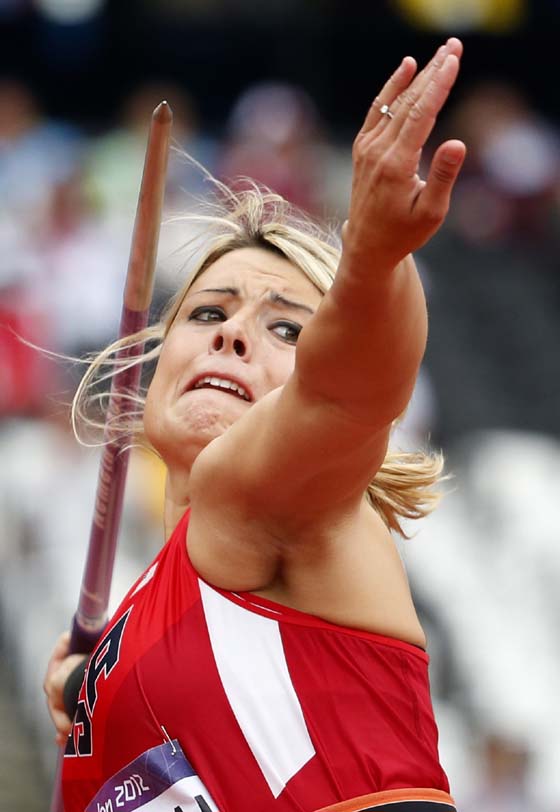
Throwing the Javelin

London Olympics Athletics Women

(Image Courtesy of http://ydtalk.com)

Over the past few weeks I have been part of an experiment. A learning experiment. Seth Godin, one of the coolest people on the planet recently announced a new way of learning: Learning Together.

Beyond creative, the Krypton Community College (with its cool narwhal mascot) is an experience in learning with other people. The first class was centered on help to move past (or dance with) our fears, pick ourselves, and move projects forward. Part of an early assignment included interviewing people who brought something into the world and how fear played a role in the process.

The thought of asking pretty amazing and accomplished people about fear was scary in itself.

What if these folks didn’t really experience fear?

Maybe fear is just what the rest of us feel.

Was that what sets them apart in their success?

Maybe that is why I am not as successful.

I pressed on and scheduled an interview anyway (dancing with my own fear). When the questions moved away from the details of what this person had accomplished to how they felt and dealt with any fears that were part of the process, an amazing story emerged.

I learned that this person had to give a talk on a technical topic to hundreds of experts in this field. This person was not a technical expert on the subject at hand, but was part of trying to raise awareness, address challenges, offer solutions, and help increase funding for this issue.

Speaking to this crowd did bring fear (which surprised me because they are so confident). Fear of not being credible, or coming across in a way that would not acknowledge the depth of knowledge in the room and limit the receptivity to these new ideas.

So, they called their dad for advice.  I will let them tell the rest in their own words:

My dad’s stellar advice on how to handle presenting information to a group of providers who were twice my age and real experts in the issue was to start off my presentation by joking that I was actually going to teach them how to throw the javelin.

It worked like a charm. I started to get into the stance, told them I was intimidated by their knowledge and expertise and recognized they knew the field much better than I did. So, I said that I’d changed up my plan for the presentation and was teaching javelin instead since I was the expert in that.

They all laughed, and were super supportive when I actually got into the real presentation. I also felt way more comfortable. And, throughout our time together a number of them became great thought partners/mentors/teachers and took me under their wing.

I think acknowledging my fears, owning them, and accepting them really helped start our work off on the right foot, and rather than feeling skeptical the group wanted to help me and later felt more comfortable sharing their fears about the work we were doing.

Great advice for any of us wrestling with our next project, idea, task, or talk.

Acknowledge the fear.

Own the fear.

Accept the fear.

And begin by Throwing the Javelin.