
Badfriend.com

badfriend

Have you ever had that friend that just drifted away? You stopped calling. They stopped calling. Weeks pass and evolve into months. The next thing you know, years pass. When you reflect on the relationship, there were no major fights or arguments, but time creates this sort of distance between you. That distance becomes a larger and larger incentive not to pick up that phone, or send that text. Even worse, when you mount the courage to send that message, it is not returned and your efforts are in vain.

While reconnecting with a close friend recently (it had been years without calling or connecting) we talked about ways to prevent this in the future. Both of us need to commit to calling, texting or emailing each other. It makes it harder that this particular friend is 1,824 miles away so the odds of bumping into each other at the local market is pretty slight.

In order to ensure that we stay connected, we came up with an idea for a website and service for anyone who needs a little help being a better friend.

In the spirit of creating funny domain names, we called it badfriend.com (it is not a real site…yet).

Here is how it would work.

You sign up on the website and identify your friends. Your friends are either already members or you can invite them to the service. There are various levels of connection services that help remind you to send that email or text. You can initiate that conversation through the website or app, and automatic reminders are sent to remind you to connect with your friends. You would have your own email address @badfriend.com and the system would send your friends notice when you were not meeting your requirements as a friend.

If you do not connect regularly you are charged a penalty.  However, if you do connect with your friends you earn points. These points enter you into a lottery for cash prizes, similar to the experiment that VW did with speed camera in Sweden.

Relationships are not always easy. Being a good friend takes work. Imagine how amazing it would be to have a website and app managing it all for you and creating the right incentives and penalty.

Until then, it is up to us to make the decision to stay connected, pick up that phone, or send that message.

If it has been a while since you called or connected, you can always start how I initiated my conversation with this friend:

“Hi, this is Carl@badfriend.com, I am sorry for not connecting, lets start again.”

Pick one friend, the one that was once close but time has created distance. It won’t be easy, but pick a day within the next week and connect, it may just be worth it.

Which Race Are You Running?

Yesterday I got to cross off a goal from my list. I ran a 5K.  Sure, running a 5K is a perfectly good goal. Running a 5K has been on my yearly goal list for a few years and I have been able to cross it off each year. This year the goal was different. Simply running a 5K was not the goal yesterday. The actual goal was to run a 5K together with my daughter.

ShoesRunning with my daughter was the goal. We got new shoes (note the distinct advantage I have simply from shoe size) signed us both up a few months ago, and a small competition began. Every few weeks a photo would appear on my phone. The photo was of the treadmill time of her latest run. In addition to these photos, periodic smack-talk began to appear alongside.

Once I get new shoes maybe I’ll smoke you in a race 😉

Perhaps as a way to defend myself, photos of my treadmill times were exchanged (especially when my times were faster), along with various replies, especially when she was getting nervous.

I’m kind of nervous!! I hope I’m not too far after you 😁

Luckily you will have your dad at your side encouraging you

And I hope to have my dad behind me cheering me on

This would cause more photos, and faster times, and more replies. This banter and friendly competition helped both of us stay on track and keep running so we would be ready for race day. But when race day arrived, something happened.

A few people who I know were also racing that day. I tend to be competitive by nature and I have been running at my fastest pace in years. I felt a different goal rise up inside me. This was my chance. A chance to finally demonstrate that I was faster than these other runners and have a “win” and obliterate my last year’s time. My daughter must have sensed something because she casually mentioned that it would be okay if I ran ahead, despite our earlier goal of running together.

I had a choice to make. And isn’t this a choice we all face at some point? We work together with other people. The original idea is a team achievement, then an individual opportunity comes our way. What we decide in that moment is important. Do we honor our original commitment? Do we give into ourselves and break away from the pack in order to “win”? I had to ask myself:

Which race are you running?

My choice appears below. (I am wearing the red hat, she is in the bright yellow shirt.)

As for beating those other people, there is plenty of time and plenty of races ahead of us. (And they should know that I am coming after them in the next race.) For now, I am happy with my choice. A message on my phone as she was driving back to school confirmed that it was the best choice.

But you’re a great dad and ran with me so basically you won the whole race

Today, make sure you are running the right race…It may just change the world.

Support

Support

Support takes many forms. Support can be listening to a friend, or coworker. Support can be making a meal, or remembering to call. Support can be a random text that reminds another person that you are there and thinking of them.

Support is being the kind of boss that remembers that people have lives outside of work. Support is the parent that encourages, even when things are tough. Support is helping people stretch, especially when they are afraid. Support is help picking up the pieces when it goes wrong.

Lending a hand. Helping others. We all need support. We all provide support.

In the long run, support must be in balance in our lives. We are receiving support while providing support to others. Many times this balance is disrupted. Either we are receiving a disproportional share, or providing the increased support. In the short-term, this one-sided equation is acceptable. Perhaps an event required this unequal ledger (loss of a loved one, job, or relationship). Righting that balance requires us to understand the role of support in our lives.

Sometimes you find yourself in a support deficit, that place where you have been providing support without reciprocation. The support deficit can be draining, and may be a sign that you need to set some boundaries with those around you. It may signal that you need to speak up.

What support are you providing? What support are you receiving? Are you remembering to give as you receive? Is there that friend who calls, but you do not initiate calls? Call them.  Is there someone coaching you and encouraging you? Reach out to them, but not just because you have a need.

Use your own need as a measure of how you could be providing support to others.

Need encouragement? Encourage. Need a friend? Be one. Need help? Be helpful.

You can do it. Together we can change the world.

HALT or you may regret the outcome

About half way through a session with senior leaders on how emotional intelligence impacts the work place, I had to admit that the prior day I failed miserably at it myself. Emotional intelligence is the ability to identify, assess, and control your own emotions, while being able to empathize and work with others and their emotional state.

The discussion traveled toward finding ways to slow the world down, and understand your own emotional situation. We talked about identifying certain negative emotional triggers, or those events, people, or activities that can hijack you and cause you to react instead of respond to those around you.

One leader spoke up about a technique that served them well during their career. This technique was a simple way that a mentor encouraged them to think about their emotional state, before the term emotional intelligence was in the mainstream.

One simple word: HALT

HALT stands for Hungry, Angry, Lonely or Tired. When you feel yourself getting emotionally charged, you are supposed to stop (the word HALT helps you remember that part) and ask yourself if any of these attributes are true.

Am I hungry? Am I angry? Am I lonely? Am I tired?

These four states are not exclusive and more than one can be true at the same time. The mentor compared these four to an engine: one with four cylinders. If all four are in a good state, the engine (our emotional state) runs smooth and without issues. If one cylinder becomes disabled, the engine starts to run pretty rough, but it may still get us there. If two or more are disabled, it is time to shut the car off and seek help.

For me, about two and a half cylinders were disabled at the time when I interacted with a few people in my circle. I was angry (my primary emotion), tired, and little lonely. The HALT approach would have helped me identify some of the primary causes of the hijacked emotional state. My emotional glass was cloudy, and it spilled out on those around me.

Of the four parts of HALT, lonely was the one state that at first felt strange to consider until I unpacked it a little. It is easy for me to identify when I am hungry, angry or even tired. Identifying the lonely that proved most valuable. Most days I am surrounded by people, but do not have time to connect deeply. Connecting with others becomes even harder as I pack more and more events into work and life, but the lonely remains.

HALT helped me as an “after-the-fact” diagnosis of what happened, and the new goal is to use it prior or during the next stressful event.  I hope it provides you with some insight into your world and your relationships.

After apologizing and trying to own my emotional state, I went and had breakfast with a close friend. With the lonely cylinder repaired, the engine is beginning to run smoothly again.

By the Book or What Book?

DISC

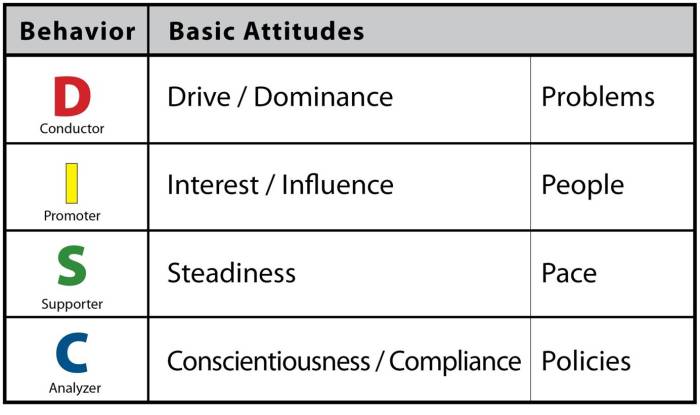
In an earlier post, we talked about the impact of having high Drive or D style and how it can manifest. As a reminder these four categories are part of a DISC assessment based on the work of William Marston. Today we will look at another style, one that measures how we view and comply with rules around us: the C style.

The C in DISC measures a person’s compliance or how they view the rules around them. A higher compliance person is “by the book” and a lower compliance person often asks, “what book?” 

One of the easiest way to determine where you fall on this scale is to think about how you cook. Do you follow the recipe or do you just wing it? Do you look up how to measure a dash, or do you just put it in? The higher compliance people follow the recipe, and lower grab a few ingredients and hope it turns out well.

We recently had a friend over the house to show them how to cook a turkey. (I have a theory that our parents and sitcoms made such a big deal about cooking a turkey that we have somehow determined that they are hard to cook.) Prior to their arrival, I tried to explain how easy it is to cook these birds. You just unwrap it, take out the bag of nasty stuff from inside, rub it with oil and some spices, and sit around for 3 hours while it cooks.

Convinced that this was harder than described, we walked them through the procedure while they took copious notes. The preparation took less than 5 minutes. We joked about their style, and how their high compliance at times looks for rules and procedures, and without a clear plan or recipe, this person can feel a little lost.

On the flip side, this high compliance is an amazing trait. This person is thorough, detail oriented, and keeps an eye on quality. They bring an amazing ability to make sure project are done well and on-time. After we laughed about the note taking, we realized that we had the next 3 hours to connect.  Not a bad recipe for relationships, especially when there was wine.

Are you by the book? Do you follow the recipe, or do you just grab whatever is on the shelf? Do you look at rules and assume they were meant for other people? Next time you are cooking or around someone who is, take a moment and watch.

If you are interested in obtaining your own DISC assessment to see where your compliance ranks, contact me for more details.

The “I’ll be right there” people

Recently I noticed an interesting group of people. These people interact with those around them in a noticeably different way. These people differ in a lot of ways. Some of them are in business or sales, some provide a service, others are just friends to others.

They have one distinct common characteristic: they are “I’ll be right there” people.

“I’ll be right there” people are people who understand the larger relationships at stake, no matter what their role. “I’ll be right there” people answer the call for help or service to meet a need. “I’ll be right there” people help others despite their job description or their pay scale. “I’ll be right there” people are not put off at your request, they see it as an opportunity to connect with you instead.

Imagine the result when your clients consider you an “I’ll be right there” consultant.

Imagine the result when your customers consider you an “I’ll be right there” salesperson.

Imagine the result when your employees consider you an “I’ll be right there” boss.

Imagine the result when your communities consider you an “I’ll be right there” citizen.

Imagine the result when your kids consider you an “I’ll be right there” parent.

Imagine the result when your friends consider you and “I’ll be right there” friend.

Today, instead of just imagining what it would be like, listen for the next request and simply reply…“I’ll be right there.”