This is still broken

I couldn’t help but count. I was waiting for my friend at a popular coffee shop.

Nine out of every ten cars. Including my friend.

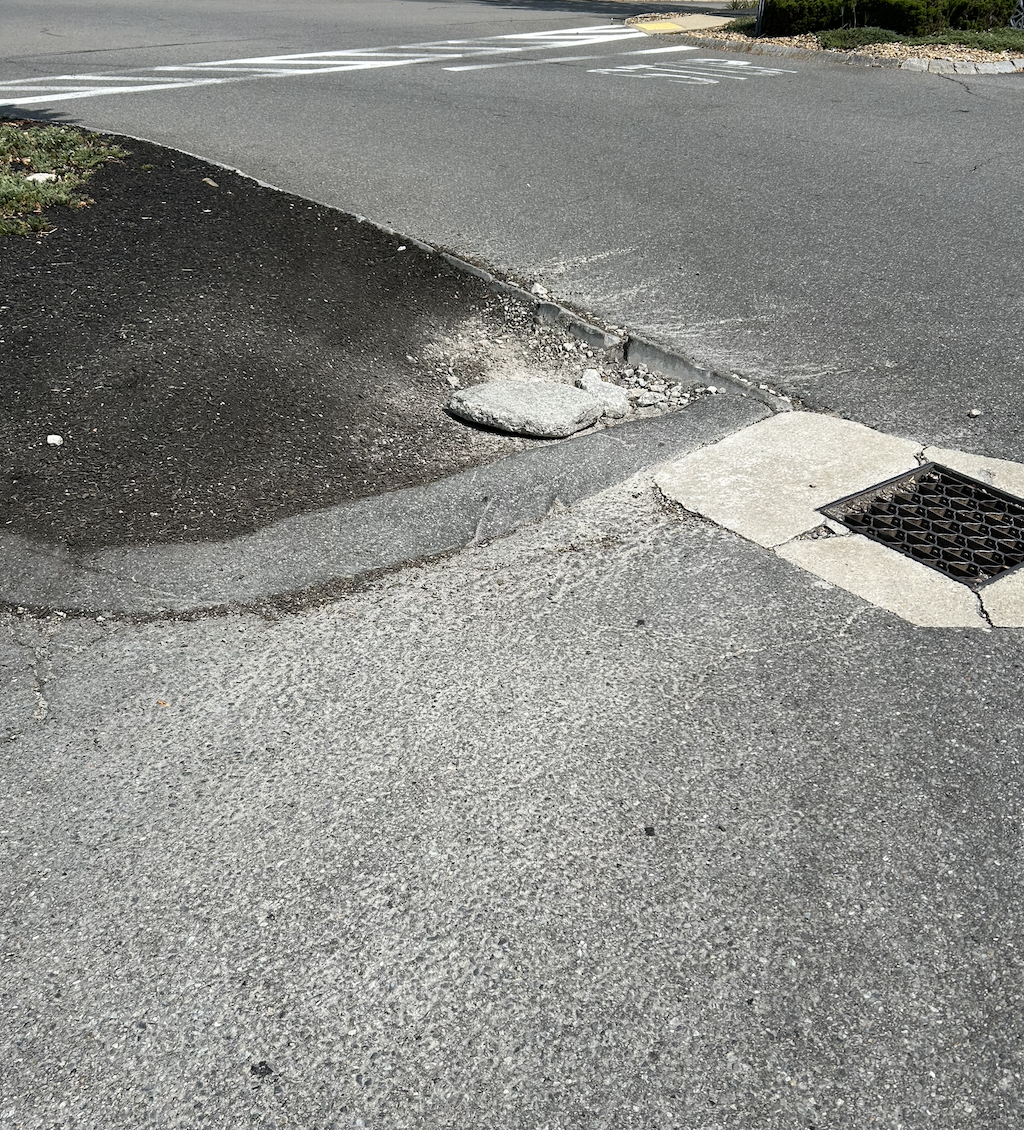
They all drove over the curb. It seemed odd at first, but it was almost every car.

There was both surprise and panic on each driver’s face. “What just happened?”

Various degrees of possible damage to cars. Especially the low ones and to rims.

The sudden jolt of the SUVs going “off road.” Not so smooth when jumping the curb.

I couldn’t help but think of that TED talk.

Almost 20 years ago, Seth Godin gave a talk called “This is Broken.” It is easy to see things broken all around us after watching.

Seth gave examples of things broken for various reasons, including “not my job.”

This popular coffee shop has a problem. The parking lot is tight.

Customers are damaging their vehicles. The curbing and layout were part of a plan.

The plan was approved and met some standard. The reality is different than what was planned.

The plan is no longer working. Someone decided to put a large cement paver in that space to help ease the pain of each curb jump. To mitigate the issue.

This is Still Broken. The original design is not working.

Yet, it will be someone’s job to repair the curbing, and perhaps periodically replace the cement paver.

Yet, it will be someone’s job to fix rims, and pull dents.

Yet, it will be someone’s job to reply to possible claims.

But, whose job is it to fix this?

Whose job is it to develop better designs and regulations?

Whose job is to find what is broken and offer solutions?

Look around you (especially after you watch Seth’s talk). You may be surprised what is broken around you.

(Warning: you cannot unsee this video and you will notice everything that is broken!)

You will see what others can’t.

You will notice what is broken.

And, it just might be your job to fix it!

Memories, Milestones, and Emotions, Oh My

Memories, especially tied to significant events or Milestones in our lives are strong.

Our Emotions, and even our bodies are aware of this invisible timeline.

The corresponding Emotions can arise as these Memories or Milestones approach.

Joy, Sadness, Pride, Outrage, Excitement, Embarrassment, Humility, Despair, Love, Loss.

These Emotions are reminders that something significant happened. Happened to us, for us, with us, because of us, or around us.

Little monuments of events that build us.

These Memories, Milestones, and Emotions can be wonderful.

Love, friend, child, pet, job, relationship, adventure, home, career…

These same Memories, Milestones, and Emotions can be challenging.

Love, friend, child, pet, job, relationship, adventure, home, career…

Some of the Emotions feel like gains.

Some of the Emotions feel like losses.

Either way, these Emotions are requesting something.

To be acknowledged, to be heard, to be remembered?

In the past, Resistance and Distraction was my strategy for the losses.

With the gains, it was mostly Reduction and Discounting.

(I am realizing how sad it is that we tend to amplify the negative, while reducing the positive.)

I am beginning to see these Memories, Milestones, and Emotions as less of a nuisance and more of a Guide.

I am still periodically surprised when they arrive, and I don’t always see them coming.

Once these Guides arrive, I am learning to welcome them and ask how they are here to help.

Walking through these Memories, Milestones, and Emotions appears to be a path forward.

A path towards continued growth.

Oh, My!

20,089

20,089

Yesterday I couldn’t help but reflect on that number.

20,089 days.

20,089 days of existing on this planet.

20,089 days of such variety.

There were good days, and bad.

There were easy days, and hard.

There were successful days, and failure.

There were joy-filled days, and sorrow.

There were adventure days, and mundane.

There were healthy days, and sick.

There were intentional days, and carefree.

There were helpful days, and helpless.

There were wild days, and tame.

There were days.

And, there are more days to come.

How many more days?

10,957?

Many of the 20,089 days have been dominated by The Narrator seeking to limit my perception of what is possible.

This voice has been trying to convince me that I am not good enough or less than.

But there is a whisper of a new voice.

Faint gentle sounds.

Encouraging. Inspiring. Calling.

I think I know its name.

It has always been here.

It has tried to break through, but has been overshadowed.

I am trying to hear that voice in the midst of all the other noise.

All the other distractions.

All the past days.

I think I know its name.

Five years ago. A good friend sent me a story for my birthday.

ROOKIE MISTAKE

“I suppose you’ll want me to come back,” she said.

“I’ll clear my calendar,” I said. “Whenever you want to stop by.”

You never say “whenever you want to stop by” to your muse.

In your intoxicated bliss, make sure she adds her next visit to her calendar – in pen.

***

Iain Young didn’t get a good look at his muse. He’s pretty sure he wouldn’t recognize her.

My friend was pointing the way.

The Muse.

My Muse.

Your Muse.

For the next 10,957 (or however many days we have) let’s seek out that other voice.

The inspiring one.

The encouraging one.

The one that reminds you that all work and life is creative.

The one that calls you to more.

The one that reminds you that you can!

The one that says “what is possible?”

I think our Muse wants more appointments with us – in pen!

Acting As If

It was painful to the touch.

I never realized how heavy my own head could be, especially when I could barely turn or lift it.

The pain radiated from the back of my skull through my neck, clavicle, and down my back.

An accident? Nope.

An injury while doing something risky? Again, no.

An event that happened that required physical feats of strength? I wish.

Apparently just “sleeping wrong” created this overload of spasms and agony. Mid-life occupational hazard.

Four days. Ibuprofen overload.

Four pain-filled days. Learning to move, not move, and do simple tasks.

Relief. Physical Therapy and stretching.

The next few days were interesting.

Despite being pain free, I found myself acting as if the pain was still there.

Cautiously moving, acting as if the soreness and stiffness remained.

Acting as if…

Acting as if is a concept in positive psychology that has us aspire to what we want to become or goals we want to achieve, and then start acting as if we have already arrived or achieved those goals in the face of challenges or obstacles.

Acting as if, builds our self confidence, our self-perceptions, and helps against self-sabotage and builds a more positive mindset.

By the second pain-free day, I began to notice the power of acting as if.

When I was acting as if the pain was still there, I was stiff, cautious, moved slower, and was afraid.

In that moment, I had to remind myself that the pain was gone and start acting as if things were normal. My movements became more fluid and natural.

My mind wandered to all the times I have been acting as if pain, limitations, and obstacles are still here. Limiting me.

I began to think about all the time WE have all been acting as if a lot of things are still present. Limiting us.

Where could we all try acting as if?

Acting as if that pain is no longer present.

Acting as if we achieved our goals.

Acting as if we are enough.

I look forward to hearing about your acting as if journey, and until then I will be here acting as if we have already arrived together.

Relational atrophy

It’s been a while.

When the world shut down, so did my relationships.

I fell out of practice.

Survival, stress, and a focus on tasks and solving problems took the main stage.

I got rusty.

New habits formed: isolating habits that didn’t include the same connection as before.

It was a long, but subtle shift.

From less, to more, to loss.

Less phone calls, less fun, less light-hearted conversations.

Less time WITH others.

Less time FOR others.

Less.

When there is less, something will fill that void.

More negativity, more urgency, more stress, more vigilance, more protection mode, more burn-out.

The results were loss.

Loss of connection.

Loss of friends.

Loss of time.

Loss.

The best way to describe where I am today is a state of Relational Atrophy.

Weaker, out of practice, easily tired, and doing simple things are much harder.

Understanding and acknowledging this Relational Atrophy helps.

Finding a way forward is next.

Similar to exercise, this process won’t happen overnight.

It might take some time for these muscles to remember.

Small steps.

Apologies.

Invites to get coffee.

Invites to connect.

Invites to get gelato.

Phone calls.

Texts.

Scheduling time for others.

Scheduling time WITH others.

Time.

Those relational muscles will return.

New habits will form.

Take a moment to think about how these past few years impacted you and your relationships.

How has Relationship Atrophy impacted you?

Where have you fallen out of practice with others?

How can you take one step today to flex those relationship muscles?

The good news is we might not be alone, and we can try moving forward together.

One more idea – schedule time under the tree. Let me know, I will make the coffee.

Giving What you Didn’t Get

They were a little late to the Zoom call. Technical issues.

They were nervous. You could hear it in their voice.

They won the contest at a recent supervisory training.

The prize was a one on one with me.

“I want you to know that I listened to everything during the training. I started applying it right away.”

They have been in this industry a while. It’s not glamorous work. It is hard work.

They were used to doing things the way someone else taught them. How to do the work, how to speak to others, how to give orders, how to set the standard, how to provide correction.

“I didn’t realize that my employees needed something different. I’ve been just doing what I have been doing for years.”

They never thought about their own style.

They never thought about their employees’ style.

They just gave what they were given.

Then it all changed.

“I realized how often I am just correcting others. How often I point out what is wrong, tell them how I would do it, and make them do it my way. No questions, no feedback, just telling. I never considered “how it feels on the other side of me” as you challenged us.

I suddenly understood that I was the problem. My style, my approach, my choice of words, how I was taught to do this job – all of it. It was not what they need from me.”

Within days they met with every employee. More questions than directives.

What did they need?

What was getting in the way of doing the job well?

“I also took seriously your challenge to “go find what is right” and tell my employees about it.”

They found what was right. They told them.

Barking orders stopped.

Engagement.

Latitude on decisions and process started.

Two-way conversations.

Insight and new ideas on how to do the work.

They started to give differently.

“My biggest takeaway is realizing that I was giving exactly what I got, instead of giving what I didn’t get.”

Giving what you didn’t get.

Giving more than what you got.

Giving especially what you didn’t get.

Where can you give what you didn’t get?

In this season of giving, maybe this is what we all need.

Let’s all try to give something that we didn’t get.

Let’s start today.