The Relationship Reset Button

Reset Button

(Image Courtesy of Acceleraction.com)

So often in relationships, whether at home or work, with family or friends or loved ones, the past can overly shape the present.

You had a disagreement with that person. Now every interaction is awkward.

You lost your cool. Now others walk on eggshells around you.

You used to be fascinated by someone’s uniqueness. Now these issues only seem to cause you frustration.

You overly questioned someone’s work. Now they feel that you don’t trust them.

While working with a small group, we noticed this pattern and discussed how it impacts their ability to work together. The more I reflected, the more I noticed this pattern in my own circles.

The past interactions do not disappear, they build on each other to form a strange and often distorted view of others. I read recently that our memories can deceive us. Our memories exist, but each time we access them again they can change and the newer version of the story replaces the old memory.

I thought about how this can impact our relationships. Perhaps this is why it is so hard not to feel like a little kid around your parents. Maybe this is why people in more close relationships are heard complaining about the other one (many times in front of that person). This may be why it is so hard to rebuild a relationship at work that has gone south.

Those memories keep building and changing in a way that reinforces the negative issues.

What we could use is the Relationship Reset Button. This handy device would be available to any two people or a small group where all parties decide to let go of those past hurts, judgements, or misunderstandings. With a simple press of the button, everything would reset. They would be able to start fresh, start new, and get another chance at their relationship.

Yesterday I worked with this small group again. They pushed the Relationship Reset Button. There was history. There was conflict. There was a past. It wasn’t easy, but they stared over.

They let go, and began to appreciate each other’s differences.

They started to anticipate what the others may need, and started to provide that instead of being frustrated by requests.

They started to see that together they could accomplish so much more.

Along the way, some of the past began to return, but they would get together and remind each other that they had started over. These occasional issues didn’t build a new history, but were seen as lingering shadows that would continue to diminish as their new relationships grew.

Where can you use the Relationship Reset Button? Where has the past overly shaped and distorted some of your best relationships? The new year is about to start, so why not go ahead and press it and see what this year brings?
Jumping to Offense

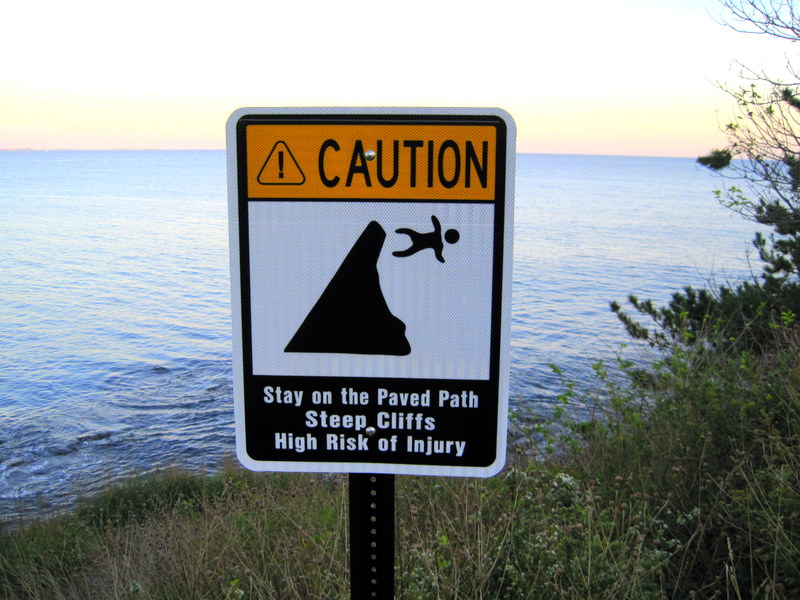
Cliff Sign

(Image Courtesy of http://www.aroundtheworldl.com)

The other day during a conversation with someone close, I noticed something about our interaction. It was a simple conversation, nothing too deep or seemingly important, but a pattern revealed itself.

The pattern was simple: I jump to offense.

Let me explain. This means that my mind appears to be on a quest to find a way to be offended at what someone else is saying. By quest, I mean that my mind considers this its highest priority and will devote both time, energy, and resources to ensure the quest’s success.

Here are a few examples:

“It is getting kind of late for sending out Christmas Cards”

My Jump: So are you saying that I should have sent these out?

“It would be nice to do more interactive things at the next holiday with everyone”

My Jump: So they expect me to plan this then be responsible for meeting everyone’s idea of what is fun?

“We need to make sure we are attentive to the bottom line”

My Jump: So they are saying that I am overspending?

There are risks in jumping to offense, just like the risk of jumping off a cliff. It is dangerous and there is unseen peril just beyond the lip. Luckily I am beginning to notice this pattern as it occurs (or shortly afterwards).

I realize that I need to retrain my mind to see the warning sign on the edge of that cliff before I go off jumping. Picturing that warning sign helps, but also explaining to the person I am talking with if it begins to happen.

Here are a few tips for my fellow jumpers:

  1. Recognize your bent toward Jumping to Offense.
  2. Understand that Jumping to Offense is dangerous, for you and others.
  3. Slow down and listen, don’t respond right away.
  4. Ask clarifying questions, make sure you understand what the other person is saying.
  5. If you do jump, climb back up and reconcile with those around you.
  6. Repeat steps as needed.

Where are you Jumping to Offense? Take a few moments to think about where you could, as my grandmother always used to say, “look before you leap.”

P.S. I am going to print out this photo and put it where I can see it every day.

Recovery Days

Life can be hectic. Work can be demanding. Our schedules fill up with commitments. This endless sea of activity will take its toll.

Our bodies wear down. We become sick.

Our creativity decreases. We go through the motions like empty shells.

Our relationships suffer. We react instead of respond to others.

What is the solution? Since no progress has been made on the Super Secret Bonus Day, the solution requires some discipline.

During a much-needed get away with some amazing friends, we discussed possible solutions. The consensus was clear: Recovery Days.

Recovery Days are days that each of us has to put on our calendars periodically that allow us to gain back energy (rest), creativity, and connection. These Recovery Days become more important during seasons of our lives that require more creativity, more commitment, or more hours.

Striking this balance can seem impossible. Don’t wait too long, or until your calendar is already packed. Once your calendar is full, it is too late. As your calendar begins to fill and commitments are piling up, find the space for a Recovery Day and lock the day. Honor the commitment to yourself in the same way you would for a client or customer.

I just scheduled my first Recovery Day for June, right after a busy two weeks. Go ahead and schedule your Recovery Day today. Imagine what your work, creativity, and relationships may look like when you have recovered. You may find yourself ready to take on that next challenge, and who knows, it may just Change the World.

HALT or you may regret the outcome

About half way through a session with senior leaders on how emotional intelligence impacts the work place, I had to admit that the prior day I failed miserably at it myself. Emotional intelligence is the ability to identify, assess, and control your own emotions, while being able to empathize and work with others and their emotional state.

The discussion traveled toward finding ways to slow the world down, and understand your own emotional situation. We talked about identifying certain negative emotional triggers, or those events, people, or activities that can hijack you and cause you to react instead of respond to those around you.

One leader spoke up about a technique that served them well during their career. This technique was a simple way that a mentor encouraged them to think about their emotional state, before the term emotional intelligence was in the mainstream.

One simple word: HALT

HALT stands for Hungry, Angry, Lonely or Tired. When you feel yourself getting emotionally charged, you are supposed to stop (the word HALT helps you remember that part) and ask yourself if any of these attributes are true.

Am I hungry? Am I angry? Am I lonely? Am I tired?

These four states are not exclusive and more than one can be true at the same time. The mentor compared these four to an engine: one with four cylinders. If all four are in a good state, the engine (our emotional state) runs smooth and without issues. If one cylinder becomes disabled, the engine starts to run pretty rough, but it may still get us there. If two or more are disabled, it is time to shut the car off and seek help.

For me, about two and a half cylinders were disabled at the time when I interacted with a few people in my circle. I was angry (my primary emotion), tired, and little lonely. The HALT approach would have helped me identify some of the primary causes of the hijacked emotional state. My emotional glass was cloudy, and it spilled out on those around me.

Of the four parts of HALT, lonely was the one state that at first felt strange to consider until I unpacked it a little. It is easy for me to identify when I am hungry, angry or even tired. Identifying the lonely that proved most valuable. Most days I am surrounded by people, but do not have time to connect deeply. Connecting with others becomes even harder as I pack more and more events into work and life, but the lonely remains.

HALT helped me as an “after-the-fact” diagnosis of what happened, and the new goal is to use it prior or during the next stressful event.  I hope it provides you with some insight into your world and your relationships.

After apologizing and trying to own my emotional state, I went and had breakfast with a close friend. With the lonely cylinder repaired, the engine is beginning to run smoothly again.

The “Know Yourself” Message

Know Yourself. Change the WorldOne of my first posts involved explaining the tagline for what this little adventure is all about. The “Know Yourself. Change the World.” post was almost a year and a half ago. I began to reflect on those simple words, and wondered if this message is still valid. Wondering if this message still resonates.

Imagine my surprise when I opened up a Christmas present from my oldest daughters. It was a coffee mug that they had customized for me. Right there on the mug was the tagline, the message. They both read my posts (when they are not studying hard while away at college…hint, hint). The message resonated enough for them to include it in my Christmas gift.

Sometimes a simple confirmation is all that we need. Someone to recognize the efforts we are putting forward. This gift is more than just a vessel for my coffee. This gift is a daily reminder that the message resonates and to keep trying to change the world by helping others know themselves.

What is your message? Where can you help encourage someone else’s message?

As for what is on the other side of the mug, well that is a story for another day.

The Long Hardened Road

800px-The_Long_Road_Ahead

Photo by Jon Rawlinson accessed on Wikimedia Commons

While working with a group we were discussing the stress associated with their jobs.  We discussed the role of that emotional intelligence plays in dealing with that stress, and how their glass can become cloudy.  The conversation took an interesting turn.

The cloudy glass image helped them identify their current emotional state, but did not address the larger picture.

They were on a journey.  They began their careers with hopes, dreams, and a passion to serve.  Over the years, the negative or stressful parts of their job, caused a hardness to form.  With every subsequent negative event, they would take a step down a long hardened road.

This journey was not overnight.  Each step was subtle, and not readily noticeable.  Days passed.  Weeks passed.  Years passed.  One day they found themselves becoming so hardened, so far down that road that they were was almost unrecognizable.

“How did we get so far down this road?”

“When did we become so hardened towards the job and the people?”

“How do we get back?”

The trouble with incremental steps is the difficulty noticing the change.  They never planned to go so far down that road, to become so hardened.  It was just one step.  But one step became another, and another, and another.  It wasn’t until they looked back years later that they saw the distance they had traveled.

I began to wonder.  How many times does this happen to us?  A bad event happens, and it hardens us.  Then another comes our way.  Another disappointment, another failure, another hardship.  We begin to walk down that road and the result is a hardness as our hopes and dreams fade.

Where have you walked down this road?  How can you begin to take a step back?  This group collectively agreed to find their way back.  May we all find the strength follow them.