By the Book or What Book?

DISC

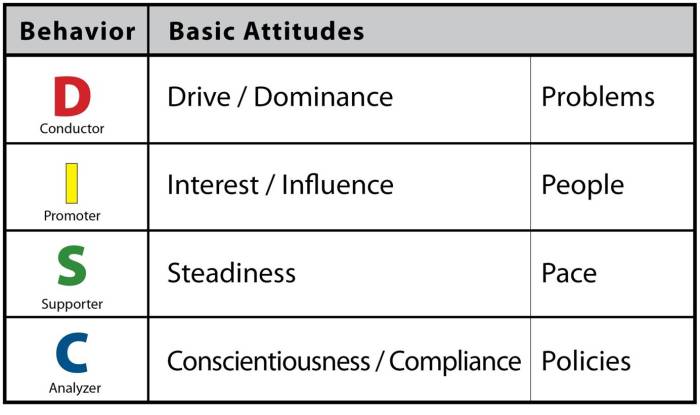
In an earlier post, we talked about the impact of having high Drive or D style and how it can manifest. As a reminder these four categories are part of a DISC assessment based on the work of William Marston. Today we will look at another style, one that measures how we view and comply with rules around us: the C style.

The C in DISC measures a person’s compliance or how they view the rules around them. A higher compliance person is “by the book” and a lower compliance person often asks, “what book?” 

One of the easiest way to determine where you fall on this scale is to think about how you cook. Do you follow the recipe or do you just wing it? Do you look up how to measure a dash, or do you just put it in? The higher compliance people follow the recipe, and lower grab a few ingredients and hope it turns out well.

We recently had a friend over the house to show them how to cook a turkey. (I have a theory that our parents and sitcoms made such a big deal about cooking a turkey that we have somehow determined that they are hard to cook.) Prior to their arrival, I tried to explain how easy it is to cook these birds. You just unwrap it, take out the bag of nasty stuff from inside, rub it with oil and some spices, and sit around for 3 hours while it cooks.

Convinced that this was harder than described, we walked them through the procedure while they took copious notes. The preparation took less than 5 minutes. We joked about their style, and how their high compliance at times looks for rules and procedures, and without a clear plan or recipe, this person can feel a little lost.

On the flip side, this high compliance is an amazing trait. This person is thorough, detail oriented, and keeps an eye on quality. They bring an amazing ability to make sure project are done well and on-time. After we laughed about the note taking, we realized that we had the next 3 hours to connect.  Not a bad recipe for relationships, especially when there was wine.

Are you by the book? Do you follow the recipe, or do you just grab whatever is on the shelf? Do you look at rules and assume they were meant for other people? Next time you are cooking or around someone who is, take a moment and watch.

If you are interested in obtaining your own DISC assessment to see where your compliance ranks, contact me for more details.

The “I’ll be right there” people

Recently I noticed an interesting group of people. These people interact with those around them in a noticeably different way. These people differ in a lot of ways. Some of them are in business or sales, some provide a service, others are just friends to others.

They have one distinct common characteristic: they are “I’ll be right there” people.

“I’ll be right there” people are people who understand the larger relationships at stake, no matter what their role. “I’ll be right there” people answer the call for help or service to meet a need. “I’ll be right there” people help others despite their job description or their pay scale. “I’ll be right there” people are not put off at your request, they see it as an opportunity to connect with you instead.

Imagine the result when your clients consider you an “I’ll be right there” consultant.

Imagine the result when your customers consider you an “I’ll be right there” salesperson.

Imagine the result when your employees consider you an “I’ll be right there” boss.

Imagine the result when your communities consider you an “I’ll be right there” citizen.

Imagine the result when your kids consider you an “I’ll be right there” parent.

Imagine the result when your friends consider you and “I’ll be right there” friend.

Today, instead of just imagining what it would be like, listen for the next request and simply reply…“I’ll be right there.”

Let the Teamwork Begin

Snow Snow Snow

It snowed. It snowed a lot. It is still snowing. In the next few hours the daunting task of digging out begins in our neighborhood, and neighborhoods all around us. These events cause a strange sense of teamwork that doesn’t always exist as we rally together and help each other. I have said before that sometimes snow is just what we need.

Let the teamwork begin! Now we just need a better way to keep this teamwork going when the snow isn’t falling outside.

What is YOUR Legacy?

Sometimes people get right to the point. After about the third sip of a cappuccino with a friend in a local coffee shop, they asked me this question.

“What is your legacy?”

Still trying to sip some of the foam from the cup… “What?”

“You know, what is it that you hope to leave behind? What are you building? What impact to you hope to have beyond yourself and how will it remain?

The question challenged me. The question made me wonder about how we live our lives. My mind started to wander towards goals. Goals are great, but far too often, goals have a starting point and an endpoint. Once the goal is accomplished, we reach the destination and we stop.

A legacy is something you are building. Building something and arriving at a destination are not the same thing. A legacy challenges us to build our entire lives. A destination is simply a place we came to and stopped.

These thoughts wandered further towards the concept of retirement. For many retirement is a destination. Once you have enough resources, you arrive at your destination…and stop. You stop working, stop connecting, and stop building.

Legacy is calling. It is calling us to keep creating, keep contributing, and keep building. Legacy says there is still more to be done. Legacy shatters the myth that all of our accumulated experience and knowledge is no longer needed. Legacy reminds us that we are valuable, and the world needs us.

One simple question remains. 

What is YOUR Legacy?

Understanding the Differences

The Differences
Helping others on their journey is one of my favorite things. There are times it is important to gather some of these people together. When in a group, we discuss how their particular styles impact others to help the other people understand the differences among them.

During a recent session we were discussing differences around a creative approach versus a more practical approach. We talked about how each person may see things, and how these differences may manifest.

One person is more practical, the other is more creative. As we were taking, I glanced down at the participants notebooks. Their notebooks clearly provided the illustration I needed during our time together. They are different people, each bringing something valuable to the relationship. Understanding those differences helps each of them see the world from the other person’s viewpoint. It is this kind of understanding that helps move beyond conflict and deepens relationships.  

Our notebooks are different. We are different. We all have something we bring to the table, the relationship, or the workplace. Sometimes opening up your notebook is the first step towards understanding.

Opportunities or Obstacles?

We are all faced with tasks or assignments that are not always our first choice. Some are placed upon us from others, some just arrive at our doorstep. I am not talking about the great tasks we enjoy, and are excited about starting. These are the tasks that you would rather not complete. The tasks we tend to procrastinate.

What makes these tasks less desirable? Sometimes these tasks are just unpleasant, but more often a different pattern emerges. These tasks typically invoke a fear or insecurity that wakes the narrator. These tasks combined with that negative voice become large obstacles.  Obstacles that cause us to stop.

More recently, I have recognized this pattern. Now when that task combines with my inner voice I pause and size up the obstacle. Is it really as bad as I thought? Will I really fail completely?  Probably not!

At these times I reflect on something I heard recently. (I cannot remember where I heard it so if you can attribute it, let me know.)

“Do the next thing you know the least about…”

This reminds me to push beyond the obstacle, and look for the opportunity. Will it be perfect? Nope. Will I learn? Yes. 

As scary at it can seem, I am looking forward to the next opportunity. I just have to remind my narrator to be quiet, because I have work to do!