This is still broken

I couldn’t help but count. I was waiting for my friend at a popular coffee shop.

Nine out of every ten cars. Including my friend.

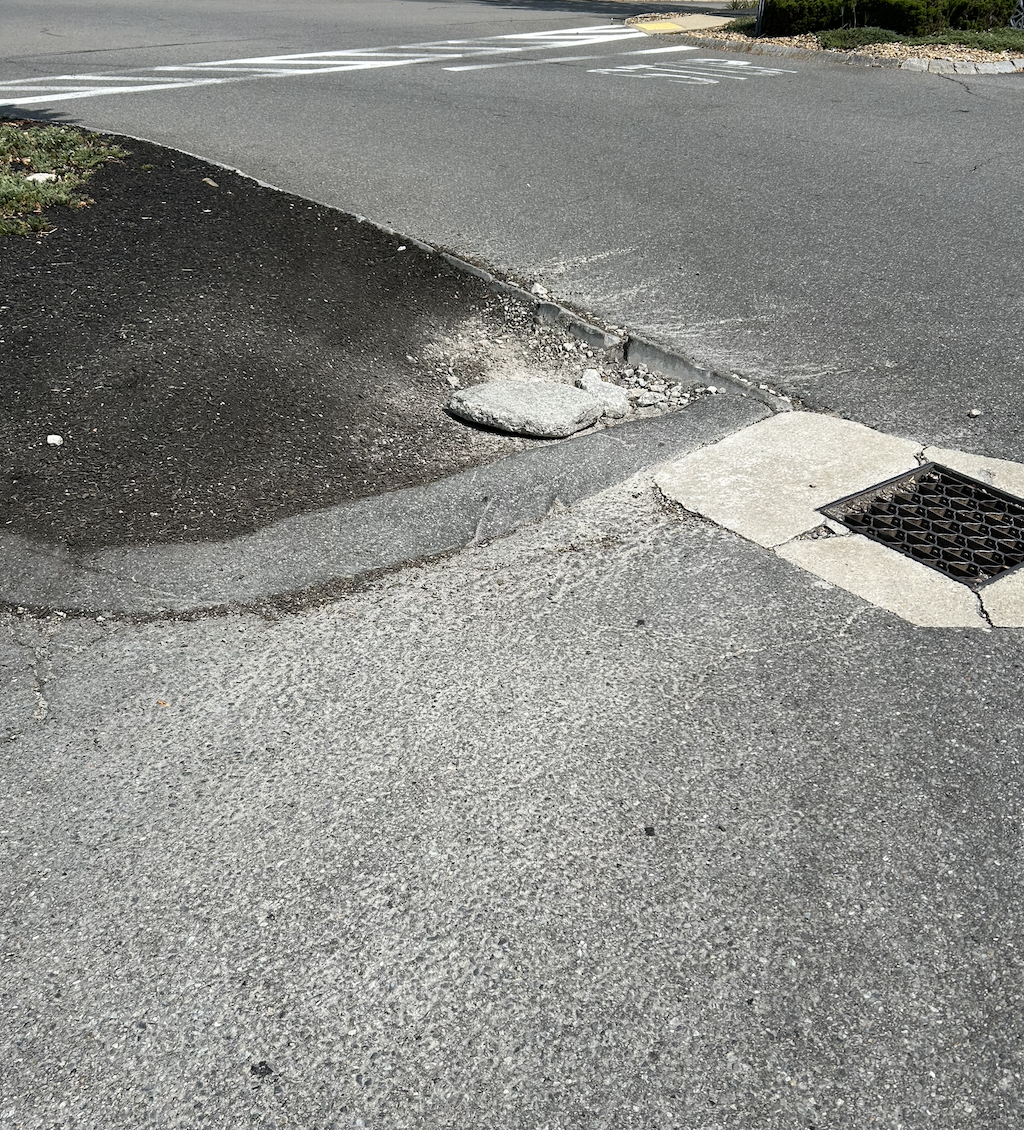
They all drove over the curb. It seemed odd at first, but it was almost every car.

There was both surprise and panic on each driver’s face. “What just happened?”

Various degrees of possible damage to cars. Especially the low ones and to rims.

The sudden jolt of the SUVs going “off road.” Not so smooth when jumping the curb.

I couldn’t help but think of that TED talk.

Almost 20 years ago, Seth Godin gave a talk called “This is Broken.” It is easy to see things broken all around us after watching.

Seth gave examples of things broken for various reasons, including “not my job.”

This popular coffee shop has a problem. The parking lot is tight.

Customers are damaging their vehicles. The curbing and layout were part of a plan.

The plan was approved and met some standard. The reality is different than what was planned.

The plan is no longer working. Someone decided to put a large cement paver in that space to help ease the pain of each curb jump. To mitigate the issue.

This is Still Broken. The original design is not working.

Yet, it will be someone’s job to repair the curbing, and perhaps periodically replace the cement paver.

Yet, it will be someone’s job to fix rims, and pull dents.

Yet, it will be someone’s job to reply to possible claims.

But, whose job is it to fix this?

Whose job is it to develop better designs and regulations?

Whose job is to find what is broken and offer solutions?

Look around you (especially after you watch Seth’s talk). You may be surprised what is broken around you.

(Warning: you cannot unsee this video and you will notice everything that is broken!)

You will see what others can’t.

You will notice what is broken.

And, it just might be your job to fix it!

Acting As If

It was painful to the touch.

I never realized how heavy my own head could be, especially when I could barely turn or lift it.

The pain radiated from the back of my skull through my neck, clavicle, and down my back.

An accident? Nope.

An injury while doing something risky? Again, no.

An event that happened that required physical feats of strength? I wish.

Apparently just “sleeping wrong” created this overload of spasms and agony. Mid-life occupational hazard.

Four days. Ibuprofen overload.

Four pain-filled days. Learning to move, not move, and do simple tasks.

Relief. Physical Therapy and stretching.

The next few days were interesting.

Despite being pain free, I found myself acting as if the pain was still there.

Cautiously moving, acting as if the soreness and stiffness remained.

Acting as if…

Acting as if is a concept in positive psychology that has us aspire to what we want to become or goals we want to achieve, and then start acting as if we have already arrived or achieved those goals in the face of challenges or obstacles.

Acting as if, builds our self confidence, our self-perceptions, and helps against self-sabotage and builds a more positive mindset.

By the second pain-free day, I began to notice the power of acting as if.

When I was acting as if the pain was still there, I was stiff, cautious, moved slower, and was afraid.

In that moment, I had to remind myself that the pain was gone and start acting as if things were normal. My movements became more fluid and natural.

My mind wandered to all the times I have been acting as if pain, limitations, and obstacles are still here. Limiting me.

I began to think about all the time WE have all been acting as if a lot of things are still present. Limiting us.

Where could we all try acting as if?

Acting as if that pain is no longer present.

Acting as if we achieved our goals.

Acting as if we are enough.

I look forward to hearing about your acting as if journey, and until then I will be here acting as if we have already arrived together.

Work Life Separation

images

We get a quick note on the weekend.

“Sorry to bug you about work on a weekend, but I need…”

Or a text late at night.

“Hey, sorry, I know it is late, but can you send along…”

And there was an email early in the morning.

“Sorry, this is last-minute, but can you give us a call right away…”

These requests were simple. They took just a few moments of our time.

We enjoyed being able to respond. It didn’t even feel like work.

There was a time when we thought we needed work life separation.

There was a time when we thought this divide was important.

There was a time when work felt like work.

Over the past few years the work life separation wall has slowly been dismantled.

Brick by brick, the need to be distinct and have boundaries has faded away.

The work life separation wall has become a smeary, messy, blended tapestry.

30a535101222356fc1c98a2ef4eff251

When our work, and life is about helping others, both happen at interesting hours, times, and moments.

It doesn’t feel like work. It isn’t distinct from our life. It just is.

We live and work at weird hours when there is a need. There are no office hours.

We aren’t counting the days until we retire. We just live.

We live and work in various locations, and at various times.

We meet the needs around us throughout our entire journey.

There is no longer a need for the work life separation.

The absence of that artificial barrier sets us free.


Reclaiming (y)our Life

Listening to people can be revealing. If you listen (really listen), people will tell you a lot about themselves. Listen to the story they are telling. Listen to the one that they may not know they are telling.

While connecting at a conference, a story came to light.

“Carl, glad to hear that all the girls are doing well, still hard to believe your kids are that old, because you are so much younger.”

During the same conversation, we began to talk about running. I extended an invite to run with our group later that day.

“I am running more, but I am so old compared to you guys. I could never keep up.”

And later that day.

“Since I am so much older, I don’t have the same energy I used to.”

The real story was pretty clear.

As the group run was finishing, this person was finishing their run (ironically we all finished at the same time) and we were all standing in the lobby. I had a choice. Should I let their story continue or was there an opportunity to engage in this storyline?

“You know I couldn’t help but notice how much of your dialogue is about your age, how old you are, especially compared to others.”

“Is it that obvious?”

We reviewed our earlier conversations and that pattern that was previously hidden from them became clear.

“I didn’t realize how many times I said it.”

“Why do you think you are so defined by your age?”

“I think that so much of my life was defined by the roles that I have played: spouse, parent, and professional, that now I feel that I am trying to reclaim my life.”

“What do you mean reclaiming your life?”

“There are few decades of my life that went by so fast, and I was so focused on others, that I lost myself.”

We continued to talk. I could relate to this feeling of losing yourself when the demands of life, work, family, and career are competing to define us. We also talked about the role that these words are playing in the current reality. How the focus on age, and being older in some ways is not helping. Those words are trying to create a new limiting definition.

We agreed on two things:

1. We would be more aware of any self-limiting dialogue.

2. We would continue this journey of reclaiming our life and check in once in a while on the progress.

As we were about to part ways, I couldn’t help but ask one more question.

“How old are you anyway?”

It turns out that their perception of some vast age gap between us, was only four years.

Here are a few pieces of advice.

1. Listen. Listen to those around you, and your own words. How are you shaping your future reality by the word you use? What stories are you and others really telling?

2. Reclaim. Identify areas where you need to reclaim your life. What are those things that you had hoped to do, but your roles got in the way?

Keep me/us posted on your progress either in the comments section or via email on the contact me page.

(P.S. Just last night I read this story which may help all of us realize what is still possible, despite our age. And I thought running into our 80’s was possible…)

The Decade of Training

Wander Tag(Image Courtesy of Etsy.com)

Through a combination of coaching conversations, and reflections on my own life I have noticed a pattern. Many of us wish we were further along in our lives, careers, or relationships. We speak as if there is some place we should be, but we are behind in the race. We speak with regret and sadness as if we are currently missing out and life would be somehow different.

“I have been in this job for 6 years now and am in a rut and it feels wasted.”

“I didn’t really know what I wanted to do, and moved from job to job and didn’t make progress.”

“School was not a focus for me, and I wasted those years.  Now I have to go back again.”

“Just imagine where I would have been if I didn’t squander those years.”

These conversations made me think of that quote from J.R.R. Tolkien. Maybe it is okay to wander for a little while, because those years are not always lost.

Instead of seeing those years (however long it has been) as a waste, maybe a perspective change would help. Perhaps we could view that time as the Decade of Training.

The Decade of Training helped form who we are today.

The Decade of Training helped us create goals and start to pursue them.

The Decade of Training helped us try different things.

The Decade of Training helped us know that failure is part of the journey.

The Decade of Training helped us learn to get back up and keep moving.

Those years in the Decade of Training are not necessarily lost, unless you give up and assume that it is too late to pursue the goals for your life, career (or second career, or third career), or relationships.

Most of us today will live into our 90s. To put that in perspective, when we reach 60, we will still have 1/3 of our lives ahead of us.

The real question is now that you have been trained, what will you do with it?

Keep Your Story Fresh

“What do you do with all that random information?”

A close friend asked me the other day. I must have been spouting off about some random facts that I had learned, but the details today escape me.

Apparently, my habit of trying to learn everything about anything I can get my hands on can be a little annoying if you are on the receiving end of my latest rant.

Within a week, during a routine drive time conversation with another close friend they experienced a question from a colleague after presenting to a large group.

“How do you know all that random information that you somehow weave into your presentation?”

“I need to keep my story fresh” they replied.

Those words resonated.

I need to keep my story fresh.

If we are going to stay relevant, current and in demand the old stories won’t do.

We have to learn, grow, develop, and stay teachable.

The seemingly random facts.

The new interactions.

The new class.

The new book.

The new experience.

They all join together to keep your story fresh.

To my first friend, I finally have the answer about my random rants and continual need to devour any information that comes my way.

“I am keeping my story fresh.”

To my second friend, thanks for the words we all needed to hear.