Chapter One: The Three Rules

The Law of the Few:  Well, there is nothing better when considering epidemic-like events than discussing the spread of STDs…but it does help make the case for how a few people can spread an idea or a product.  The 80/20 rule seems to apply well especially as Gladwell describes the characteristics of the few as how much more “sociable they are, or how energetic or knowledgeable or influential among their peers.”  (Page 21)  Think about people in your circles whose influence seems to outweigh the average person, do you listen to them?  Do they impact you?  Are you that person?

Stickiness Factor:  The ability for something to remain appears to be a key factor, essentially it has to “stick” with you in order to make the kind of impact Gladwell describes.  “Stickiness means that a message makes an impact.”  (Page 25)  What was the last thing that “stuck” in your head?  Was it a song, a commercial, a person, an event?

The Power of Context:  Understanding the situation people find themselves in is the last rule and states “that human beings are a lot more sensitive to their environment than they may seem.”  (Page 29)  The “bystander problem” as described in this chapter was pretty alarming to me, and made me think about when I see an accident or lose power in the neighborhood.  I mostly assume someone has already called 911 or the power company and I don’t pick up the phone.  I do not always act because in context, there are so many people in the same situation, assumptions are easy to make.  Does the environment impact you?  How do you feel when you come home to a sink full of dishes, you witness an argument, or it rains on the day you planned that big outdoor event?

Gladwell is making the case, or perhaps building his case that these three rules need to be in place in order to pass the tipping point.  Have just one of these, and it is not enough.  You have two of them?  Sorry, you still need another one.  Can you think of an example of each rule in your own experience?  If so, please share it with the group.

As a reminder, please read a chapter each week, post a thought about the reading, and comment on at least one other person’s post. 
The votes are in: The Tipping Point, Malcolm Gladwell

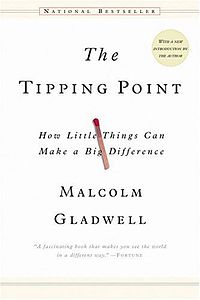
The votes are in and the winner is The Tipping Point, by Malcolm Gladwell.  I have read his other books, use Outliers in a training session with leaders, and am excited to read this book together.  This book club will get The Tipping Point off my nightstand and into our collective minds.

The book club will begin next Monday and I will post on a chapter a week.  Counting the introduction, it will take us nine weeks to read together.  Please find, borrow, buy, share, download, or check out a copy of the book to participate (there are still libraries out there).  The goal is to have each of you reply to the weekly post and/or each other every week.  If you have any questions please let me know.

Maybe together we will learn how our small actions will make a big difference.

Are you always the Good Guy/Girl?

I was listening to a speaker the other day with some friends.  During one part of the speaker’s message a friend leaned over to me and said,

“The trouble is, we all think we are the good guys.”

The more I reflected on those words, the more profound they became.  Being “the good guy (or girl)” has a huge impact on our perspective, our narrative, and our story.  Over the next few weeks I listened to those around me with this new frame of reference.  What I heard confirmed this theory.

When my kids argued and sought fatherly judicial proceedings, each child described the wrongs committed.  Each child described a scenario where they were clearly the “good one” and the other sibling was “bad.”

I heard spouses, friends, and family members describe various issues.  Again and again the common theme was they were “good” and others were “bad.”  The story-tellers seemed completely unaware of how they were describing the other person.  Then, I listened to my own words.  If I was offended or had some problem, clearly I was the “good guy” only leaving one option for the other party.

Breaking away from this self-centered mindset is not easy.  Becoming aware and changing a pattern of behavior can be worlds apart.  For the next few weeks I am going to try by asking a simple question.

“What if I am not the good guy?”

Maybe something so simple will shake the foundation of our self-centeredness.

To my friend who leaned over and said that simple phrase: thanks for the game-changer.  It will certainly help us on the way to changing the (our) world.

A Few More Hours of Voting

We are in the home stretch.  The idea is to have a virtual book club where we read a book together over the next few months.  We have made a few book suggestions and your votes will determine which book we collectively read.  The poll will be open until midnight tonight.  If you haven’t voted, please do so.

The Virtual Book Club Poll


Voting begins today and will last a week, vote early, tell your friends!  This should be a fun experience.  I am looking forward to the results!

Collective Challenge Day 6 (My 50th Post!)

Two ceremonious events collide today:

1.  We are just about done with our first week of the challenge, and the comments (especially from yesterday’s post) and the phone call from a friend confirmed that we are doing something great together.  Sometimes I wonder if these ideas, questions, or challenges are just ramblings…and it is typically when I am doubting this blog or myself that one of you confirms the impact it has had on your actual life. It is this confirmation that helps us press on together.

2.  This is my 50th post!  This is a milestone.  As I shared with you before, I have not always been the type to sit down and set yearly goals.  Last year I did.  One of those goals was to actually write on a regular basis.  I was inspired by a friend who helped me realize that I didn’t have to write an entire book in a weekend, but could begin by regularly disciplining myself to write.  

Remember part of this challenge is to Dream Big.  Sometimes once you identify that dream, trying to figure out how to accomplish it can be overwhelming.  But the first step is making a decision to start towards that dream.

It was gaining the understanding that a small decision made every day could really change your life that helped me know where to begin.  I didn’t have to do it all at once, and neither do you.  This blog is the result of a small scary decision made on a regular basis!

I know I say this a lot, but thanks again for being part of this journey together.