The No Strings Attached Apple Crisp

apple-crisp

A few months ago I made apple crisp for a team that I serve on at work. The apple crisp was partly to celebrate our accomplishment, partly because I love a good apple crisp, and partly because they totally guilted me into making it. (I made one for another team and this team got jealous, but that is another story.)

We consumed most of that crisp, with many having two or three helpings.

Some apple crisp remained.

In order to be able to clean the baking pan, I called another co-worker and offered the remaining apple crisp.

“Hey, I made this apple crisp, it is really good. Do you want some?”

Long pause…

“I guess so…but what do you need?”

I was a little stunned at the reply. I had to regroup.

“I don’t need anything, you see I made this for this particular team, and we had extra and I thought of you.”

Another long pause…

“Ok, but seriously, do you need something from me?”

Eventually the crisp was delivered. A cautious first bite, followed by a second and a third. As I left their office, the suspicion remained.

A few weeks later, I stopped by that office again (not because I needed anything). It was then that the real story came out.

At a company prior to this, if someone did something for you, it was not simply a gesture of goodwill. There were strings attached. Receiving from others created an obligation for you.

Nothing was free. Everything came with a price.

Maybe what we all need is a little more no strings attached apple crisp.

Try it out. Do something for others without expecting something in return. It may be awkward at first because of the expectation of strings from those around you.

Let us all know how it goes. Next time I may try cookies.

The Decade of Training

Wander Tag(Image Courtesy of Etsy.com)

Through a combination of coaching conversations, and reflections on my own life I have noticed a pattern. Many of us wish we were further along in our lives, careers, or relationships. We speak as if there is some place we should be, but we are behind in the race. We speak with regret and sadness as if we are currently missing out and life would be somehow different.

“I have been in this job for 6 years now and am in a rut and it feels wasted.”

“I didn’t really know what I wanted to do, and moved from job to job and didn’t make progress.”

“School was not a focus for me, and I wasted those years.  Now I have to go back again.”

“Just imagine where I would have been if I didn’t squander those years.”

These conversations made me think of that quote from J.R.R. Tolkien. Maybe it is okay to wander for a little while, because those years are not always lost.

Instead of seeing those years (however long it has been) as a waste, maybe a perspective change would help. Perhaps we could view that time as the Decade of Training.

The Decade of Training helped form who we are today.

The Decade of Training helped us create goals and start to pursue them.

The Decade of Training helped us try different things.

The Decade of Training helped us know that failure is part of the journey.

The Decade of Training helped us learn to get back up and keep moving.

Those years in the Decade of Training are not necessarily lost, unless you give up and assume that it is too late to pursue the goals for your life, career (or second career, or third career), or relationships.

Most of us today will live into our 90s. To put that in perspective, when we reach 60, we will still have 1/3 of our lives ahead of us.

The real question is now that you have been trained, what will you do with it?

I Stink at Positivity

When you listen to people, you can hear the funniest things. We were connecting with a friend the other night and were talking about being positive.

“I stink at positivity!” They blurted out.

We all laughed.

For the remainder of our time together I kept coming back to that statement. I haven’t been able to shake it.

Our words reveal so much about us.

We can be so hard on ourselves.

Our words can create self-imposed limits.

We stop pushing against and become defined by those limits.

Spend the next few days listening to your own words, and those around you. Listen especially for the “I am” statements. Once you understand the landscape, maybe a similar approach can be used to reverse the trend.

Instead of limits, we could speak of possibilities.

“My positivity can be better, and I am making progress.”

This conversation reminded me of another recent interaction I had with someone who runs. I kept hearing the same statement over and over.

“I am not a runner.”

When I pressed further, I realized that this person ran about five races last summer. They trained hard, but past self-limits had convinced them that they were not a runner. They had convinced themselves that “a runner” was a specific kind of person who was better, faster, and thinner than they were.

We talked about how contrary this self limit was in the face of the evidence.

Running Shoes: Check.

Running regularly: Check. (But the internal voice kept telling them it wasn’t enough.)

Running outfits: Check.

Running five races: Check.

The evidence was clear: and it added up to a runner.  However, the self-limiting narrative remained. It took few tries, but eventually they were able to articulate the change.

“I am a runner.”

Without these self-imposed limits…we may just Change the World.

Inspired Vision or Dictated Standard?

IMG_0623

(Image courtesy of my daughter who loves to snap photos while we drive.)

While working with a group of senior leaders they described some compliance issues especially with those further down within the organization. Procedures were not being followed, routine issues were on the rise, along with a rise in negative attitudes.

Many of these leaders have a behavioral bent towards adherence to and creation of rules, so I pushed in a little with some questions.

Were these particular procedures and rules important?

Yes. This is a high risk endeavor with lives on the line.

Okay, then why is there such pushback on these rules, procedures, and policies?

The culture below us seems to create this tension.

How do you communicate these procedures and rules?

Memos and operating procedures.

With a few more questions, a few additional clues were revealed. The memos, and operating procedures were then implemented by middle or front-line supervisors who didn’t always agree with or embrace the policies. 

Instead of seeing the importance of these procedures, the policies were viewed as a dictated standard instead of part of a larger inspired vision of keeping everyone safe.

Out of context, the constant emphasis on procedures can feed a negative culture. Those leaders needed to inspire a larger vision and continually explain why these small changes added to that overall vision.

As with all leaders, they needed to tell their own story and not always rely on others to explain their inspired vision.

Imagine how many times we try to get our employees, our organizations, our families, our kids, or our friends to follow some rule or procedure, yet it doesn’t resonate or create action. Instead we are left with the grumbling culture around us despite the fact that those rules would help keep everyone safe, ease some difficulty, or just make things run more smoothly.

Maybe we can all learn from these leaders.

Inspire a vision and provide the context for changes and rules. Stay on message about how these changes are important to the organization, the family or the relationship.

If not, simply dictating a standard may not be enough.

After Injury

As a follow-up to my the post “I am good as possible” it seemed important to share what can happen when we take that risk, try something new, and stretch ourselves.

My Right Knee

(Image Courtesy of My X-Ray, My Youngest Daughter and a Ski Jump)

Injury. It happens to all of us.

In this case, it happened to my right knee. While skiing/trying to catch up with my youngest daughter, I followed her over a jump. Regret arrived almost as quickly as the decision was made, only to be overshadowed by intense pain.

Obviously, it was not a great decision. That split second resulted in numerous bags of ice, pain relievers, doctors visits, x-rays, and some physical therapy.

But, we all sustain injury. Injury may be physical, emotional, or relational. Injury can happen at home, at work, on the slopes, or just about anywhere.

Injury will happen.

Some injury can be prevented, but not all.

During injury, we have to manage the pain, rest, and rebuild.

The choices we make after injury may be the most important.

We may choose to avoid.

We may choose to fear.

We may choose to stop trying.

We may choose to try again, but perhaps with a little more caution/wisdom.

The decisions we make after injury determine if our world becomes a smaller place, with less risk, less adventure.

Keeping our world big after injury is its own risk.

As my leg healed and the pain left, I kept anticipating that the pain would return. My steps were more cautious, and the memory of the pain was almost as real as when it actually hurt.

The other night was my first time chaperoning without skiing. I was not ready to put on those skis, so I modified my role. I encouraged the kids. I made sure they all knew where they were going, and cheered them on.

I have decided to ski next week. I am making the choice to keep my world big, despite the fear and memory of the pain, and possibility of another injury.

Where has injury impacted you?

What choices can you make after injury?

To continue in my role from the other night…

Don’t give up.

You can do it.

Keep your world big.

Get back up.

Get back on those skis.

Iodine on Eczema

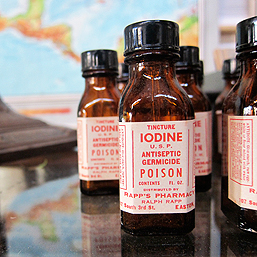
vintage_iodine_bottles

(Image Courtesy of http://www.misopocky.com)

A few weeks back, I was asked for some advice about how to address the media about a recent story where a news outlet really got the story wrong. The reporter got a hold of some facts, but out of context the story unfolded in a negative light.

The person was prepared to unload on the reporter based on some advice, and “set the record straight.” While we talked, we discussed the possible outcomes and various questions.

Would this approach improve the situation? Would the reporter write a better story as a result? Would this escalate or calm the negativity?

As the conversation progressed, they shared a story with me.

When their child was young, they came home with something that looked like ringworm on their arm. Based on some advice, they immediately applied iodine to the area (look it up kids, this was our parents cure for a lot, especially minor cuts: we think it was the sting that they liked the best).

The area worsened, and became more inflamed. More iodine was applied and the cycle continued.

Eventually, they sought additional advice from a doctor.

“What you have here is a case of eczema.”

“So it is not ringworm?”

“No, and that iodine is just making it worse.”

While we spoke again about the reporter and the story, the question became an easy one: Is this going to be like putting Iodine on Eczema?

The answer was simple: Yes.

Instead of an aggressive approach, they decided to put the facts together like a story. A story that wove in the reasons and the successes associated with those original facts. Instead of just sending it along, they called the reporter and asked for a meeting.

A few days later, I received an email with a link to the new news story. It was positive and even the headline made reference to the earlier article being like comparing apples with oranges.

I had to ask myself, when have I put Iodine on Eczema? When would a little healing salve made things so much better for my situation, my work, my story, or my relationships?