Are you always the Good Guy/Girl?

I was listening to a speaker the other day with some friends.  During one part of the speaker’s message a friend leaned over to me and said,

“The trouble is, we all think we are the good guys.”

The more I reflected on those words, the more profound they became.  Being “the good guy (or girl)” has a huge impact on our perspective, our narrative, and our story.  Over the next few weeks I listened to those around me with this new frame of reference.  What I heard confirmed this theory.

When my kids argued and sought fatherly judicial proceedings, each child described the wrongs committed.  Each child described a scenario where they were clearly the “good one” and the other sibling was “bad.”

I heard spouses, friends, and family members describe various issues.  Again and again the common theme was they were “good” and others were “bad.”  The story-tellers seemed completely unaware of how they were describing the other person.  Then, I listened to my own words.  If I was offended or had some problem, clearly I was the “good guy” only leaving one option for the other party.

Breaking away from this self-centered mindset is not easy.  Becoming aware and changing a pattern of behavior can be worlds apart.  For the next few weeks I am going to try by asking a simple question.

“What if I am not the good guy?”

Maybe something so simple will shake the foundation of our self-centeredness.

To my friend who leaned over and said that simple phrase: thanks for the game-changer.  It will certainly help us on the way to changing the (our) world.

Learning to Say NO!

(Image Courtesy of Sharon Young: Thanks Sharon!)

Learning to say “No” is not always easy.  People ask us to agree to things all the time.

“Will you help out on this committee?”

“Can we get together soon?”

“Will you watch my kids, paint my house, be my friend, volunteer your time, follow me and my cause, buy crap from my kids (well you get the idea).”

I am beginning to hear what I call the “soft yes” in response to these multiple requests. The “soft yes” isn’t really a yes, it is a “no” veiled in terms that are our attempt to politely decline, but we don’t feel comfortable saying it.  I find myself doing this at times and recently this is what I am hearing:

“I guess I can.”

“If I have to.”

“Maybe…”

“Okay.”

How many times have you agreed to something where your heart really wasn’t into it, and you would have preferred to say “no”?  In striking a balance between your life, your work, your family, and just being you, there will be things you need to say no to.  You cannot be all things to all people, and the over-committed life is not a pleasant one (for you or for those around you).

Where do we start?  In his book, Magnificent Mind at Any Age, Dr. Daniel Amen states that the inability to say no (or impulsively say yes) creates an overwhelmed state where you become immersed with other people’s priorities that distract you from your own goals. He offers us a way to reply and encourages us to learn the following phrase when someone asks us to do something:

“I need to think about it.  If I want to do it, I will get back to you.”

Wow.  Simple yet effective.  That one phrase may help bring needed balance to your life. Be prepared, if you have been on “automatic yes” or “soft no” and still agreeing in the end, this may feel strange to those around you.  It is funny, just recently I realized how much I have been giving a “soft no” to someone who has been trying to get together with me, but the truth is I should have just said no instead of stringing them along and rescheduling the meeting.

Try it out, let me know how it works.  This may bring some needed balance to your life, and let you find yourself, not just serve others.  Use it well, and let me know how it goes.  I have a hard phone call to make, but it would have been easier if I had used this phrase in the beginning.

“The art of leadership is saying no, not yes.  It is very easy to say yes.”  Tony Blair

Power Distance and Plane Crashes

I am a fan of Malcolm Gladwell.  I like his writing, his stories and his perspective.

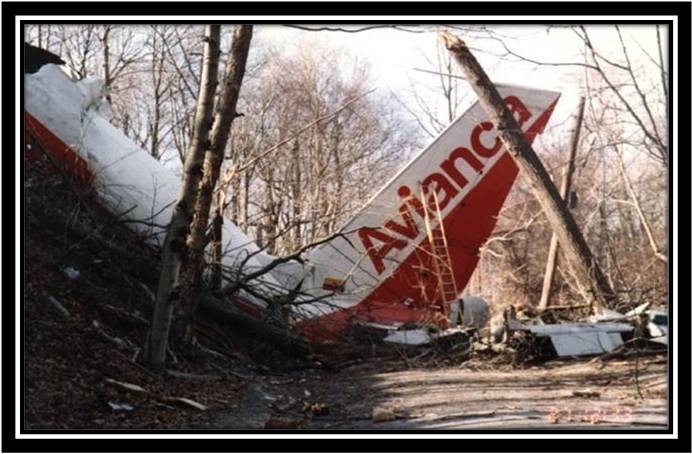
In Chapter 7 of Outliers (The Ethic Theory of Plane Crashes) he discussed Power Distance, or the space that is created when authority, hierarchy and culture disrupts our ability to interact with or communicate with each other.  Beyond creating nervousness about flying anytime soon, this chapter challenges leaders to consider how closely tied communication is to your ability to lead. (See Leading and Communicating)  And how as a leader you may be completely unaware of the distance between you and those you lead.

I won’t spoil the chapter, but some of the reasons planes crash are surprising.  It was not the big stuff, the reasons were more a combination of minor mechanical issues, lots of errors, and most importantly a failure of teamwork and communication.  The Captain (the leader) is making decisions and the First Officer or others (the followers) cannot seem to break through the power distance and yell “stop” before it is too late.

The most alarming part of the chapter is an experiment where both Captains and First Officers are provided a scenario.  Each group is instructed to ensure that their planes do not pass through a stormy airspace.  Each group was provided communication options ranging from strong Command options (essentially turn the plane) to much weaker options such as Hinting (the weather up there looks mean).

The results startled me.  Captains picked the strongest communication option and the First Officers picked the weakest option.  This reminded me of my time in the Navy and how that command structure played out.  While in the presence of the Captain instructions were barked towards me.

“Weber, I want the ComSysLantOpt report with a focus on BoatShipAftBowStern!”  (or whatever it was) was barked then I was dismissed.

Yes Sir!  Consider it done! 

I turned to the person next to me and asked if they had any idea what that meant.  Nope, but “good luck.”  In the presence of that leader, “consider it done” was the only acceptable reply.  The Power Distance was huge.

The more organizations I work with, the more this Power Distance issue comes to light if the leaders are not tuned in to the distance their positions create.  Once identified, there are great ways to combat this in the workplace.  The airline industry had to teach junior crew members to speak up in a clear and assertive manner.

Listen to those around you.  Especially anyone who reports to you, or where your position creates some authority over someone else.  Listen for the “hints” that they use because a direct conversation is too risky for them.

While listening recently I found a surprising “hint” near me.  Two of our daughters are in college.  College kids spend money, and need money all the time.  And I replayed a few conversations and/or texts.

“Wow, these books this semester were really expensive.”

“I am not sure if I saved enough money during the summer.”

My first response to these was “Great” thanks for letting me know.  But that was not their real intention was it?  They needed money and didn’t want to come out and directly ask.  There is a Power Distance in my position as a parent, and I learned was how intimidating (Captain like) I can be, even with my own kids.

My challenge for you is this: Spend the next week listening to yourself and others. Identify who hints around you, where you hint, and why.  Once identified, find one area where you can actively and deliberately communicate to shorten the Power Distance.

Maybe this simple step will prevent our workplaces, relationships, or “planes” from crashing.

I got a text the other day.

Dad, can you put $10 on my flex card so I can print out my report?

Yes.

Now that is progress.

Fly Your Flag

I don’t know about you, but I spend a lot of time in the car.  Commuting, shuttling kids around, running errands and my job requires me to drive around…a lot.  To put things in perspective, my car is a 2005 and I have 172,000 miles on it.

Making the most of this time has become an art.  Listening to podcasts of my favorite speakers and teachers, thinking about upcoming talks, or projects top the list of ways to use this time.  I have also learned to use this time to connect with others.

There are a few people I call regularly during these drives to get centered, be accountable as a leader, dad, and husband, or just deepen the relationship.

Today was one of those days, with one of those calls.  I will try to paraphrase some of it.

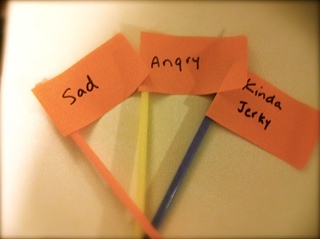
“Sometimes it would be so much easier in life if people had little flags that popped up and told you what kind of mood they were in.”

“Why?” I asked.  (I know, I know, pretty deep question.)

“That way when I am angry people would see the flag and know to leave me alone.  And if they were in a certain mood, I would know how to talk to them…or avoid them altogether.”

After a few minutes of trying to quickly patent this new device and develop a business plan around the “emotional flag” idea, we laughed and agreed I would show all of you the prototype.  It appears below.

Maybe we were on to something. Knowing someone’s else emotional state while revealing our own, might just be the secret to great communication.

Go ahead.  Fly Your Flag.

Be Thankful for Your Actual Life

What a concept.  As you may have guessed, our power is back on.  Four days can feel like an eternity, an especially difficult one.  Difficult times can put your life in perspective, and help you appreciate small things.  Power, lights, warm water, and heat recently come to mind.

During our brief time without power, I tried to stay positive.  After a few days, and one shower with 56 degree water I was becoming a little snarkey.  I found myself being stressed, upset and angry a little more often.  Lack of sleep and low temperatures are not a great combination.

Right in the middle of this power outage, my friend who just got back from Tanzania sent me an email.  The email was a summary of the days spent helping others.  As I read about their work on a children’s home,  I learned that the home was in rough shape and in need of work, but much better than living on the streets.  I looked outside at both my shed and tree house, the realization of my ungrateful ways fell upon me.

After the first few days, I started to notice how much I was complaining, even whining.  As I drove around, something hit me.

There are people on this planet who would walk hundreds of miles to have shelter in my shed, because my lawnmower lives in a better home than many cold, hungry, and distraught people.

My complaining stopped.  Perspective is a wonderful thing.  Going without power for a few days helped remind me of what we have all around us and fail to notice.

I decided to be thankful instead.  I didn’t expect this, but my mood improved.    I heard someone say once that there is a secret to happiness in this life:

Stop Complaining!

I am thankful for a friend who let us borrow a generator.  I am thankful for the neighbor who came over late that night and connected it to the furnace so we could be warm.  I am thankful for the candlelight Lego building, thankful for the quiet of no TV or electronics, and thankful for connecting with others.

Let’s try an experiment together over the next few weeks.  Be thankful for your actual life.  I look forward to hearing how it goes.

What is Going Well?

I attended a conference recently.  No speaking role, just attending.  I had an opportunity to connect with others and talk to them.  And if you haven’t guessed by now, I love to ask questions.

I started out the day with the typical, “how are things?” and received the typical replies.

“Times are hard, people are stressed, and we may have to downsize.”

Throughout the day, everyone’s and I mean everyone’s answer was just about the same.  Everyone was doing more with less, trying to manage people who are stressed and working hard, and facing the hardship of decreasing revenues.  I began to see that I was asking the wrong question.  

So at lunch, I sat with some folks and began to ask a different question.

“What is going well?”

[A period of stunned awkward silence.]

“That is a good question…”and then the answers started to flow.

My conversations turned a corner and became something else.  Something great.  I learned about great new teams that formed where they never did before.  I learned about creative ideas that were developing, being heard, and were implemented.  I heard story after story about people banding together and doing great things.

To think I would have missed all of this by asking the wrong question.  It is amazing what a difference asking the right question can make.  

Today I ask you.  What is going well?  I am looking forward to hearing your answer.