Decisions versus Feelings

Whether running or life in general, I have noticed a pattern. Feelings can interfere with our decisions

Feelings can disrupt us.

Feelings often provide the much desired excuse to stop moving forward.

Recently I have just been observing how often I hear myself or others verbalizing how feelings have the veto power over our decisions.

Here is what I found: we say these things all the time.

“I am not sure if I will feel like running later.”

“I will let you know how I feel before I decide.”

“I don’t know if I feel up to doing 6 miles today.”

“Let’s see how we feel before we say yes.”

Who gave feelings this power over us? Who said feelings are ahead of everyone else in the line of importance? I understand that feelings are part of the mix, but when did feelings take the chair at the end of the table? The corner office? When did feelings start running the show?

After noticing this pattern during a recent conversation, I couldn’t help but bring it up.

“I heard you say multiple times that this decision is dependent on how you feel. What is preventing you from making the decision now?”

“Multiple times? Really?”

“Yup.” (I know, I know, great follow-up.)

“Well, I guess it is really fear. Fear of not being able to do it. Fear of not being successful after I put myself out there.”

Fear.

One of the most disruptive of feelings. Fear seems to be elbowing its way to the front of the feelings line.

There is a little secret to put feelings in their place.

Decisions.

Decisions to go for that run ahead of time.

Decisions to take on the project.

Decisions to take a risk.

Decisions to push yourself.

I heard a great quote about feelings:

“Feel what you feel. But do not trust them as objective reality.”

When feelings start elbowing their way to the front of the line, try making a few decisions to put them back where they belong.

P.S. Our little running team made the decision to run the other day when it was below 20 degrees and dropping almost a degree every 15 minutes.
Reclaiming (y)our Life

Listening to people can be revealing. If you listen (really listen), people will tell you a lot about themselves. Listen to the story they are telling. Listen to the one that they may not know they are telling.

While connecting at a conference, a story came to light.

“Carl, glad to hear that all the girls are doing well, still hard to believe your kids are that old, because you are so much younger.”

During the same conversation, we began to talk about running. I extended an invite to run with our group later that day.

“I am running more, but I am so old compared to you guys. I could never keep up.”

And later that day.

“Since I am so much older, I don’t have the same energy I used to.”

The real story was pretty clear.

As the group run was finishing, this person was finishing their run (ironically we all finished at the same time) and we were all standing in the lobby. I had a choice. Should I let their story continue or was there an opportunity to engage in this storyline?

“You know I couldn’t help but notice how much of your dialogue is about your age, how old you are, especially compared to others.”

“Is it that obvious?”

We reviewed our earlier conversations and that pattern that was previously hidden from them became clear.

“I didn’t realize how many times I said it.”

“Why do you think you are so defined by your age?”

“I think that so much of my life was defined by the roles that I have played: spouse, parent, and professional, that now I feel that I am trying to reclaim my life.”

“What do you mean reclaiming your life?”

“There are few decades of my life that went by so fast, and I was so focused on others, that I lost myself.”

We continued to talk. I could relate to this feeling of losing yourself when the demands of life, work, family, and career are competing to define us. We also talked about the role that these words are playing in the current reality. How the focus on age, and being older in some ways is not helping. Those words are trying to create a new limiting definition.

We agreed on two things:

1. We would be more aware of any self-limiting dialogue.

2. We would continue this journey of reclaiming our life and check in once in a while on the progress.

As we were about to part ways, I couldn’t help but ask one more question.

“How old are you anyway?”

It turns out that their perception of some vast age gap between us, was only four years.

Here are a few pieces of advice.

1. Listen. Listen to those around you, and your own words. How are you shaping your future reality by the word you use? What stories are you and others really telling?

2. Reclaim. Identify areas where you need to reclaim your life. What are those things that you had hoped to do, but your roles got in the way?

Keep me/us posted on your progress either in the comments section or via email on the contact me page.

(P.S. Just last night I read this story which may help all of us realize what is still possible, despite our age. And I thought running into our 80’s was possible…)

Running into our 80’s

I am a runner.

Sometimes my narrator tries to convince me that I am someone who used to run, or someone who just runs now and then.

Sometimes when I tell other people I run, they try to convince me that running will ruin my knees.

Sometimes I wonder if I will injure myself again.

Sometimes I think about giving up, and slowing down.

Sometimes fear creeps in.

But,

Maybe it is each and every choice to run that makes me a runner.

Maybe my voice can override those other voices.

Maybe it is lack of activity that also ruins knees.

Maybe I could listen to the orthopedic doctor who said I would be running into my 80’s with the right plan.

Maybe my miles will decrease, but my activity will remain.

Maybe learning to dance with fear is better in the long run.

Where have you been convinced that you should give up, slow down, and stop “running”?

Where has the fear or the voices told you that it is too late?

Perhaps we could all be running into our 80’s.

Perhaps you could be [insert your activity, goal, or dream here] into your 80’s.

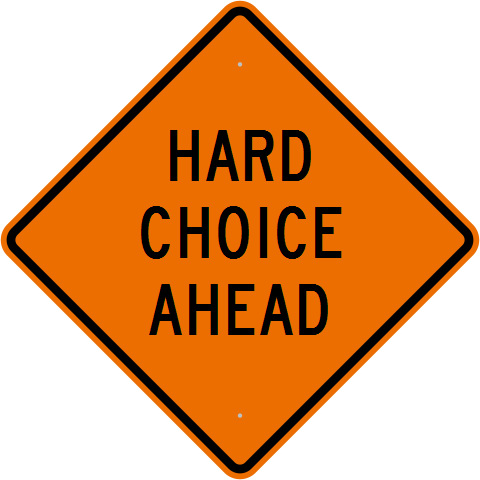
Hard Choice Ahead

Hard Choice Ahead

(Images created on roadtrafficsigns.com)

The interview went well. They answered the questions. They were hired. After a few months their performance begins to fade.

You hear from a few people around the office that deadlines are missed. Others are covering the work that is not getting done.

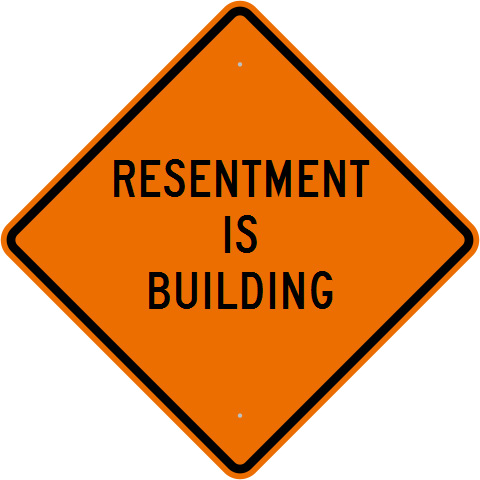
RESENTMENT IS BUILDING

A few of your peers come and talk to you about the issues and what you are doing to correct the problems.

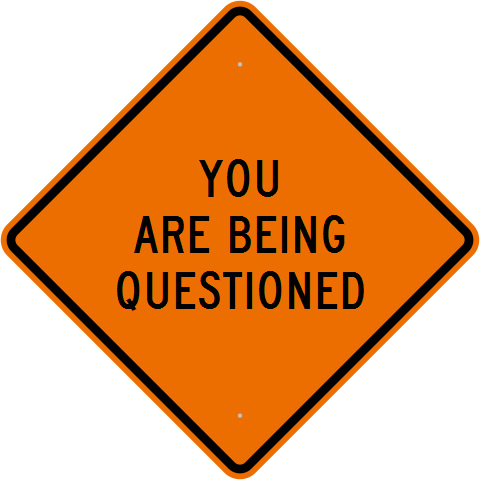
YOU ARE BEING QUESTIONED

Your boss sends you an email asking about your department’s performance.

YOUR TEAM IS UNDER SCRUTINY

There were signs.

Looking back you may be able to see them.

Unfortunately, signs don’t always show up along our journey with bright colors and with enough repetition so they cannot go unnoticed. Failing to see the earlier signs prevented corrective action.

Maybe it was a relationship. Maybe it was a project that has not taken off. The specifics are yours to fill in.

Missing the earlier signs tends to result in one final sign: Hard Choice Ahead.

The choice won’t be easy.

But it needs to be done.

The choice will have consequences.

But it will bring the resolution.

Maybe next time we will become more attuned to watching for those earlier signs.