私に好意的に見てください (Please look favorably on me)

At breakfast the other day, a close friend mentioned that a Japanese exchange student would be staying with them soon. In order to prepare for the visit, they were brushing up on their Japanese to welcome the student.

At first I thought “who brushes up on their Japanese?” but I pushed that reaction down to listen to the phrases.

The phrases began with “nice to meet you” and “I am (insert your name)” pretty standard interaction when meeting with new people.

It was the third phrase that caught my attention.

“It is a pleasure to meet you” or more literally “please look favorably on me”.

I was struck by the importance of this request: please look favorably on me. It is a simple request. Essentially be nice to me and treat me well, but for me it went a little deeper.

Please look favorably on me includes not reading into my actions and assuming negative motives. Please look favorably on me encourages others to look towards the positive and not simply pointing out my flaws or shortcomings. Please look favorably on me asks for the benefit of the doubt and a level of grace for who I am and what I do.

How many times do we connect with others for the first time, or for the hundredth time that this simple reminder would provide some helpful ground-rules for the interaction.

There are a lot of people who I have to interact with over the next few days that provides numerous opportunities to try this out.

What simple phrase would help you? How can you provide a simple request to assist you in your relationships? What are the few words that could reset the dynamics in your workplace or family?

Having the courage to utter the phrase may be hard, but the reward may be worth the risk of being vulnerable.

I will let you know how it goes…but first, please look favorably on me.

I still have work to do…

About a month ago, I attended training on a new tool to help match individuals to a job, or to help coach them on a deeper level. This new tool can identify someone’s capacity in various attributes, and how they view the world, understand systems and people. The tool doesn’t stop at the outside world.

This new approach also takes a peek at how you are doing on the inside. Do you understand and balance your various roles, do you see your future as bright or muddled, and are you moving forward or just hanging on.

During the training, the instructor eventually passed out our results throughout the room. My little table of four slowly received the results and each person began flipping through the pages to gain some insight. Somewhat guarded, we all peered at the pages occasionally glancing at the others at the table. Eventually we shared the results.

Despite the individual variation, there was one theme. Each person at the table had a good handle on other people and how to help them (most were consultants or HR professionals), but all of us could use a little work on ourselves. I couldn’t help but feel a little uneasy and my Narrator seemed to try to tell me that unless I get my own act together, I shouldn’t be telling others how to improve.

In the far left corner of the room, there was another consultant. This consultant has been working with individuals and companies for almost 43 years. When speaking or providing insight during the session the room hushed as if everyone in the room wanted to let the words and insight of this wise sage penetrate our minds. It was amazing and intimidating at the same time.

This consultant called me yesterday. Mostly because of my half-joking statement at the end of class when each of us was asked to say what we learned the most during the training.

“I learned that I need to be coached by you” I said speaking directly to that consultant.

It got a laugh, but imagine my surprise during our call. When we were discussing some of the potential areas I may need to develop and work on, I heard the following.

“You know Carl, when I read my own results and report, I realize that I still have work to do.”

It was reassuring that someone who has worked with others almost as long as I have been alive still has work to do and their development journey is far from over.

This conversation reminded me that there are two paths.

One path makes a bold statement.

“I have it all figured out and I will tell you how to make your life, career, job, and world better.”

The second path echoes the simpler statement I heard while on the phone.

“We are on this collective journey together. We still have work to do and if some of the insights we learn help us…great. Let’s see where this takes us.”

I still have work to do, and I look forward to this journey together.

Recovery Days

Life can be hectic. Work can be demanding. Our schedules fill up with commitments. This endless sea of activity will take its toll.

Our bodies wear down. We become sick.

Our creativity decreases. We go through the motions like empty shells.

Our relationships suffer. We react instead of respond to others.

What is the solution? Since no progress has been made on the Super Secret Bonus Day, the solution requires some discipline.

During a much-needed get away with some amazing friends, we discussed possible solutions. The consensus was clear: Recovery Days.

Recovery Days are days that each of us has to put on our calendars periodically that allow us to gain back energy (rest), creativity, and connection. These Recovery Days become more important during seasons of our lives that require more creativity, more commitment, or more hours.

Striking this balance can seem impossible. Don’t wait too long, or until your calendar is already packed. Once your calendar is full, it is too late. As your calendar begins to fill and commitments are piling up, find the space for a Recovery Day and lock the day. Honor the commitment to yourself in the same way you would for a client or customer.

I just scheduled my first Recovery Day for June, right after a busy two weeks. Go ahead and schedule your Recovery Day today. Imagine what your work, creativity, and relationships may look like when you have recovered. You may find yourself ready to take on that next challenge, and who knows, it may just Change the World.

Support

Support

Support takes many forms. Support can be listening to a friend, or coworker. Support can be making a meal, or remembering to call. Support can be a random text that reminds another person that you are there and thinking of them.

Support is being the kind of boss that remembers that people have lives outside of work. Support is the parent that encourages, even when things are tough. Support is helping people stretch, especially when they are afraid. Support is help picking up the pieces when it goes wrong.

Lending a hand. Helping others. We all need support. We all provide support.

In the long run, support must be in balance in our lives. We are receiving support while providing support to others. Many times this balance is disrupted. Either we are receiving a disproportional share, or providing the increased support. In the short-term, this one-sided equation is acceptable. Perhaps an event required this unequal ledger (loss of a loved one, job, or relationship). Righting that balance requires us to understand the role of support in our lives.

Sometimes you find yourself in a support deficit, that place where you have been providing support without reciprocation. The support deficit can be draining, and may be a sign that you need to set some boundaries with those around you. It may signal that you need to speak up.

What support are you providing? What support are you receiving? Are you remembering to give as you receive? Is there that friend who calls, but you do not initiate calls? Call them.  Is there someone coaching you and encouraging you? Reach out to them, but not just because you have a need.

Use your own need as a measure of how you could be providing support to others.

Need encouragement? Encourage. Need a friend? Be one. Need help? Be helpful.

You can do it. Together we can change the world.

What is YOUR Legacy?

Sometimes people get right to the point. After about the third sip of a cappuccino with a friend in a local coffee shop, they asked me this question.

“What is your legacy?”

Still trying to sip some of the foam from the cup… “What?”

“You know, what is it that you hope to leave behind? What are you building? What impact to you hope to have beyond yourself and how will it remain?

The question challenged me. The question made me wonder about how we live our lives. My mind started to wander towards goals. Goals are great, but far too often, goals have a starting point and an endpoint. Once the goal is accomplished, we reach the destination and we stop.

A legacy is something you are building. Building something and arriving at a destination are not the same thing. A legacy challenges us to build our entire lives. A destination is simply a place we came to and stopped.

These thoughts wandered further towards the concept of retirement. For many retirement is a destination. Once you have enough resources, you arrive at your destination…and stop. You stop working, stop connecting, and stop building.

Legacy is calling. It is calling us to keep creating, keep contributing, and keep building. Legacy says there is still more to be done. Legacy shatters the myth that all of our accumulated experience and knowledge is no longer needed. Legacy reminds us that we are valuable, and the world needs us.

One simple question remains. 

What is YOUR Legacy?

Who is your Edison?

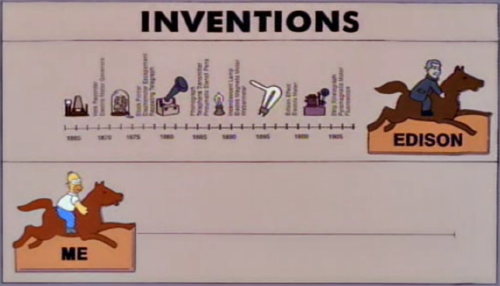
homer_edison

I was reminded the other day how much we all compare ourselves to others. Despite our successes, there is always someone out there who seems to be ahead of us.

Image Courtesy of http://christineschallenge.blogspot.com/2011_02_01_archive.html

Their lead in life becomes a benchmark that we measure ourselves against. Homer Simpson suffered this comparison in a classic episode where he decides to become an inventor. He is plagued by how much more successful Thomas Edison was at his age, and keeps the poster on the wall to measure his own success.

I find myself doing the same thing, especially with a few successful people around me. While connecting with a few of them, I listened to them talk about their Edison. The person who they are comparing themselves to and coming up short. Those people who I was comparing myself to, were busy comparing themselves to others.

I couldn’t help myself…and blurted out:

“Oh, they are your You!”

After an awkward laugh, I began to realize how unfortunately universal this comparison has become. Homer became so upset with comparing himself to Edison, that he drove to the museum to destroy Edison’s work. When he got there, he discovered another poster similar to his own. It was Edison’s poster comparing himself to Leonardo da Vinci.  Even Edison had an Edison.

Who is your Edison? Maybe today is a good time to realize that you are not Edison. You are you, and that is good enough.