What did you want to be when you were a kid?

I was meeting with someone the other day who is moving away and making some life changes because their spouse’s job requires it.  During our meeting, we discussed careers and how the recent changes were about to create a real directional shift.  What started as a series of questions regarding their current field took an interesting turn.

 “Are you going to try to find a job in your field?”

“I am not sure, I have been doing this for a while.”

“Well, what did you want to be when you were a kid?”

It is a pretty simple question, but a stunned silence filled the next few moments.  Their face said it all.  There was something deep down that had been with them since their youth, but had not been uttered in years.

“I wanted to be an Egyptologist.”

The remainder of our time together included trying to figure out just exactly how an elementary kid even knew that that job existed.  We tried to determine how long this job idea continued.  It appears to have continued through the beginning of high school.  But reality set in later in school, and the pursuit of more concrete and practical jobs prevailed.  I could see by the spark and enthusiasm that came alive at the mention of this forgotten dream that it still held some power.

“So, where you are going, do they have a good museum?” I asked.

“Yes, yes they do.  Maybe I can try to get a job with them, or at the very least, volunteer some time.”

“Great idea.”

What did YOU want to be when you were a kid?  A pilot, an astronaut, a teacher, a writer, a baker, a dancer, an artist, a hero…an Egyptologist?  It is not too late to reach towards the dream of your youth.  Maybe just remembering will provide the spark you need to try something new.  Go ahead, the world is waiting for you.

The “My Way” Blind Spot

We all have blind spots.  You have them, I have them, we all have them.  The hardest part about blind spots is that we do not see them.  I suppose that is why we call them “blind spots.”  When this happens while driving, another car can essentially disappear from view, yet be right beside us. If we turn or change lanes, the damage will be immediate and severe.

When our blind spots are personal, the damage is no less great, but they can occur gradually…almost without our notice.  Until we discover our personal blind spots (typically because someone else points them out) we tend to just plug along not realizing the damage we are causing by this inherent flaw in our perspective.

Recently I discovered that I suffer from the “My Way” blind spot.  This was reluctantly pointed out to me by my team after I wanted a project to be done a certain way.  The banter between them went something like this…

“You mean you wanted it done the “Carl Weber Way?”

“Yeah, it is like Carlito’s Way, only with less violence.”

“Most of the time when you assign a project we will end up doing it your way in the end, even if we have other ideas.”

I was stunned.  I resisted the natural urge to defend myself and just listened.  Arguing about your blind spot is as foolish as turning your car into that crowded lane because you just know there is no car there…while hearing the crash.  Instead I listened.  I really listened.  It became clear that the “My Way” blind spot was real and having an impact on others.  My tendency to delegate without freedom created tension and a lack of trust.  Over time, this can create followers who feel unable to be creative or do things their own way.

Identifying the blind spot was the first step.  The next, and much harder step, is trying to figure out how to change a pattern of behavior that I didn’t know existed.  It will not be easy, but leading well never is.  I will have to check those mirrors a little more often before changing lanes.

What is your blind spot?  Where are you speeding along without seeing what is right beside you?  Are you causing unaware damage?

My advice today is simple: Listen and look.  But be prepared to deal with what you find.

How Do You Define Teamwork?

Teamwork.  There is a seemingly endless list of how to define it, thousands of books written about it, and the notion that we should all strive to obtain it.  Teamwork has been rattling around in my head lately, and I was trying to remember a defining moment for any team where I was a member.  Nothing was coming to mind until I met recently with a member of this team for breakfast.

This particular team had been through some rough times together, but also celebrated well during successes.  The defining moment that I remember was during a meeting where we had been instructed to reduce our budget.  It wasn’t just a little reduction, the reduction was large enough that it would cause everyone in the room to take a hit.  I had instructed each of them to bring a list of what was important that needed to remain, and a list of what could be reduced.

One by one, each member of this team shared their list.  The items on the lists were important things that would have a significant impact on each person’s part of the operation, their ability to provide the right level of service.  After all the lists were read, it became quiet.  Part of me expected the real battle to begin, and each person around that table would start lobbying about why their department should be retained, and someone else should take the cut.

It was at this very moment that I witnessed teamwork, and what I heard had and still has an impact on me.

“After listening to the group, their lists seem more important to the overall operation.  I think I can reduce a little more.”

“I can take the hit, let’s make sure that other department has what it needs this year.”

“I don’t know how I am going to explain this to my employees, but I am withdrawing my list of needs, the other lists just seem more pressing.”

One by one, every member of that team saw the overall organization and operation as more important than their particular department, silo, or fiefdom.  Each member of that team knew that the only “win” was ensuring that the organization “won” not whether or not it was a “win” for them individually.

How should we define teamwork?  Maybe the definition is simple.  Teamwork is when everyone that is working together can look beyond themselves, see the larger picture, and “take the hit” for others.

Maybe Your Boss Is Right?

Okay, okay, bear with me on this one.  I was listening to a friend talk about not railing against your boss, your employer, your job or your organization.  The message really resonated with me and I realized how often we hear this in everyday conversations. Are there bad bosses?  Yes, they made a movie about that.  Are there bad jobs?  Again, yes.  Is the boss always wrong?  Maybe not.

The benefit of working with so many individuals across various workplaces is themes begin to appear.  This theme or sentiment seems pretty ingrained with a lot of us.  A while ago while working with a leader, they described that the real conflict was with their boss. The lack of trust, and second guessing that their boss did made the situation impossible for this leader to function.

The more we talked, the more I asked questions about what was actually happening in this leader’s workplace.  Towards the end of our time together I had one final question.

“Now that we talked about what is really happening in your operation, was your boss right or wrong?” I asked.

There was a long pause.

And another.

“Right, [expletive], it.”

The revelation was clear.  The boss was trying their best to coach this leader about an identified problem in their operation.  The boss was right.  The leader could not see the problem, but focused on the issue with the boss instead.  The whole time this leader was fighting against the boss, valuable time had been lost and the situation was getting worse.

My friend’s message and this meeting made me think about my own life.  How often do I take something personally or let my ego get in the way of becoming a better leader, manager, husband, father or employee?

I am taking my friend’s advice to identify these situations and try to be a little more humble.  Whenever I find myself disagreeing or saying that someone is “wrong” I take a step back.  Maybe the boss (or whoever is trying to tell me something) is right.

Work

Work.  Sometimes it can feel as if life is passing you as each day blends into the next.  I was talking about this a lot with a friend when two events happened.

1.  We got to participate in a creative event where people are encouraged to use their creativity.

2.  An invitation came to do a talk on work life balance.

The enclosed video was the result.  I hope you enjoy it.

Credits:  

Photos (all the good ones):  Iain Young

Song:  Work, by Jars of Clay

Fly Your Flag

I don’t know about you, but I spend a lot of time in the car.  Commuting, shuttling kids around, running errands and my job requires me to drive around…a lot.  To put things in perspective, my car is a 2005 and I have 172,000 miles on it.

Making the most of this time has become an art.  Listening to podcasts of my favorite speakers and teachers, thinking about upcoming talks, or projects top the list of ways to use this time.  I have also learned to use this time to connect with others.

There are a few people I call regularly during these drives to get centered, be accountable as a leader, dad, and husband, or just deepen the relationship.

Today was one of those days, with one of those calls.  I will try to paraphrase some of it.

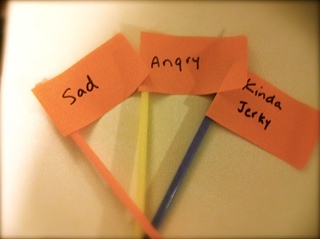
“Sometimes it would be so much easier in life if people had little flags that popped up and told you what kind of mood they were in.”

“Why?” I asked.  (I know, I know, pretty deep question.)

“That way when I am angry people would see the flag and know to leave me alone.  And if they were in a certain mood, I would know how to talk to them…or avoid them altogether.”

After a few minutes of trying to quickly patent this new device and develop a business plan around the “emotional flag” idea, we laughed and agreed I would show all of you the prototype.  It appears below.

Maybe we were on to something. Knowing someone’s else emotional state while revealing our own, might just be the secret to great communication.

Go ahead.  Fly Your Flag.