Affirmation or Revelation

“I didn’t need it, they don’t need it!”

Usually said loudly and with passion.

Usually said with a negative and sometimes angry tone.

Usually as a response to the idea of coaching, encouraging, or recognizing employees.

Usually while being critical and perhaps judgmental of perceived generational or work-ethic differences.

“I didn’t need someone to tell me I was doing a good job!”

“I didn’t need a trophy just for showing up!”

“I didn’t need to be coached, I just worked hard!”

“I didn’t need a reward, it was my job!”

When these statements enter the room or conversation, pause and watch what happens.

These statements tend to weave their way through the crowd.

There are usually two responses to these statements that you can visibly witness.

  1. Affirmation 
  2. Revelation

Affirmation: people who have experienced similar treatment, management, or upbringing that nod and agree. This is what they were given, and they continue to give the same back to others.

Revelation: people who may have experienced similar treatment, management, or upbringing, but disagree with the past. They are making a decision to give to others in a different way than what as given to them.

After the short silence, typically one of the Revelation responders will speak up.

“I understand that you didn’t receive the affirmation, coaching, or reward along the way in life. I didn’t receive it either, but I realized how much of a negative impact it had on me. Was there a time when you wanted to hear something positive, a simple word of encouragement, or a little coaching?”

With a few simple questions, Affirmation may turn into Revelation.

They did need to be recognized.

They did need some coaching and encouragement.

They did need a reward for the sacrifice they were making.

The lack of what they needed made them hardened.

Instead of Revelation, the result was Affirmation of the very treatment, management, or upbringing that caused the negative impact.

Which response will you have?

Affirmation or Revelation?

Guess…with positive intent

Yesterday we had one of those conversations.

The kind of conversation that matters.

The kind of conversation that means something.

We talked about marriage and when you just take the leap.

We talked about kids and parenting.

We talked about struggling when you are young, in the middle, and when you are older.

We talked about roles in life.

We talked about jobs and insurance.

We talked about finances and trying to create and stick to a direction.

We talked about good advice we get from others.

We talked about bad advice we get from others.

We talked about making plans.

We talked about trying to make everything perfect.

We talked about waiting to act.

Road Map

We talked about how in life there isn’t some clearly defined road map. And depending on your circumstances or life story it is easy to feel completely lost without a good example of how to move forward.

We don’t have all the answers.

We are not always sure which way to go.

We are not given a map in life.

We have to guess.

We decided that the best advice is guess with positive intent.

We decided to define a “guess with positive intent” as evaluating options, and taking your best shot at the time, but with the intention of doing something good, positive, and meaningful. This doesn’t mean that we will always get it right, but this option moves us forward without having to be perfect, but our desire is to do something well and meaningful. If it was not the “perfect” choice, you make the next guess with positive intent, and keep trying.

How do you become a good parent? No idea. Try stuff. Guess. But guess with positive intent.

How do you know when to get married? No idea. Guess. But guess with positive intent.

How do you know which career path to take? No idea. Guess. But guess with positive intent.

How do you make a relationship last? No idea. Guess. But guess with positive intent.

How do you decide when to switch careers, or try something new? No idea. Guess. But guess with positive intent.

How do you [insert your question or dilemma here].

Our advice. Guess. But guess with positive intent.


The Elephant in the Room

We all have conflict in our lives. Some good, some not so good.

Recently I had the privilege of working with a leadership team on conflict and their conflict styles.

We talked about the various ways or methods to conflict well as a team.

We talked about our styles and the impact on our ability to conflict.

We talked about our tendency to avoid conflict.

We talked about avoiding the elephant in the room.

I remembered a story I read about Kayak.com and their solution to avoiding conflict. They have highly visible conference room, and placed a stuffed elephant in that room, a room that was a designated place to encourage open and healthy conflict.

As described in the Bloomberg.com article by Claire Suddath:

There’s an elephant in the room at Kayak.com. An actual elephant—a two-foot-tall stuffed animal named Annabelle that Kayak’s co-founder and chief technology officer, Paul English, bought and put in a conference room. “So often at work, people have issues that they can’t resolve because they won’t talk about it,” says English. “I don’t like that. We try to be shockingly transparent about everything here.” Annabelle is a symbol of that.

We laughed about the story, and talked about ways this team could take the elephant in the room approach to conflict.

This team could find a space that is visible and open.

This team could start to practice engaging in conflict in a healthy way that sets an example for their peers, and for the organization as a whole.

The day was coming to an end.

We recapped some of the lessons and strategies to move forward and make progress as a team.

The leader encouraged everyone to apply the lessons learned, and to begin to practice some of these new methods.

To help the team apply these lessons, the leader did something else.

The leader reminded everyone that they do have a visible and open conference room.


The Elephant Room

The leader also invited a special guest.

The Elephant in the Room

Where have you avoided the elephant in the room? What reminder would help you learn to conflict well?

Find a space.

Find a reminder.

Go and conflict well.

The Actual Book List

180 (1)

A while back I gained some perspective when I read the blog post from Wait But Why about how much time we may have left at any given point in our lives. One of the things that rattled me (besides the fact that I may only have 20 more holidays left with certain people) is how many books I may read by the end of my life.

Life is busy and distracting, and although I like to read, I am not a fast reader and start a lot of book, yet never finish them. I typically would have 6 to 8 books on my nightstand. With a series of fits and starts I would go back and forth between all of these books, yet never finish them.

At my then pace of about 4 books per year (I am only counting actual books that I actually finished – you know all the way to the last page) at best I only had 180 books left to read.

180.

With the millions of books in the world, and thousands being added everyday, 180 books became a scary proposition.

I used to brag about books I was reading, or books I intended to read. But those books remain unfinished.

For 2016, I decided to create a new pattern, a new approach.

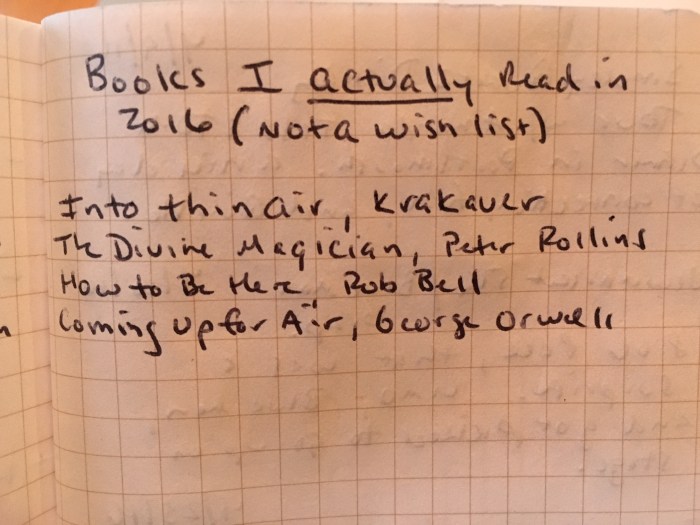
I now have the actual book list.

These are books I have actually read in 2016. I write them down right after I finish and savor that last page. There is something important about that transaction. Instead of the pressure of seeing those stacks of unread books, I now have a list of what I actually did.

I am a big fan of lists. But lists, especially aspirations or dreams can feel so unattainable that those same lists that are designed to help us, can become an overwhelming burden of non-accomplishment.

The Actual Book ListInstead of a list of what I would like to accomplish, the actual book list records the progress that I actually made. There is something more satisfying about this list.

The good news: at this pace the 180 may just become 360, but I don’t want to get ahead of myself.

The real number is 4 for 2016 as of today. But even 4 in the midst of a crazy, busy, and distracted life feels like an achievement.

Changing Perspective

It was one of those breakfasts. Balancing trying to eat while savoring each sentence, word, and idea that comes to life when you get together with one of those inspirational ones.

Mind racing.

Pen furiously trying to keep up with the gems.

Another great idea.

That phrase.

That idea.

That thought.

An interesting story unfolds.

A new office. The old one is cluttered. The new office represents a new start. A new set of patterns. Walking in a new larger role.

But the moving day was delayed. Projects, ideas, and work was spread out in a conference room instead. On a larger table.

Instead of sitting, hunched over, almost closed off, they had to stand.

Standing allowed for a larger view, a change of perspective.

Changing perspective was a reminder to get above the piles, the issues, the projects.

Changing perspective was a reminder to take it all in and get above the weeds.

The physical change prompted the mental one.

Changing perspective serves as a good reminder for all of us.

Make a change, find a new space. Stand up, go get a coffee. Try physical changes that may prompt the changing perspective you need.

Hating Salmon and Lemon Squares

“He hates Salmon.”

“He hates Lemon Squares.”

“He is grumpy if he doesn’t eat.”

“He is grumpy if woken from a nap.”

“He [insert event, either one time or a repeated event that happened, and form a hard-wired rule about the person despite the passage of time, even years].”

There was a time when I didn’t really like eating salmon. You know the poached (was it boiled?) kind smothered in a creamy sauce with dill.

Rule #1: Carl hates salmon.

There was a time when desserts in general were not my favorite, I am more of a savory person, and since periodically I may be training for something or trying to lose weight, sweets of any kind are not my friend.

Rule #2: Carl hates lemon squares.

Years later, the remnants of those rules still appear. People are surprised when I eat Salmon (grilled and savory is my favorite) or take a bite of a lemon square.

The preferences at that moment were not meant to create a hard-wired rule.

The preferences were a snapshot in time.

But, times change.

And people change.

We think we know them.

We think they are the same.

We think we had it right.

How many times have these hard-wired rules created obstacles between us?

How many times have these snapshots been held up as a representation of us?

Be careful of the hard-wired rule trap.

You have changed, and so have the people around you.

P.S. I am also not always grumpy because I am hungry or when I wake from a nap, sometimes I am just grumpy.