
The Relationship Reset Button

Reset Button

(Image Courtesy of Acceleraction.com)

So often in relationships, whether at home or work, with family or friends or loved ones, the past can overly shape the present.

You had a disagreement with that person. Now every interaction is awkward.

You lost your cool. Now others walk on eggshells around you.

You used to be fascinated by someone’s uniqueness. Now these issues only seem to cause you frustration.

You overly questioned someone’s work. Now they feel that you don’t trust them.

While working with a small group, we noticed this pattern and discussed how it impacts their ability to work together. The more I reflected, the more I noticed this pattern in my own circles.

The past interactions do not disappear, they build on each other to form a strange and often distorted view of others. I read recently that our memories can deceive us. Our memories exist, but each time we access them again they can change and the newer version of the story replaces the old memory.

I thought about how this can impact our relationships. Perhaps this is why it is so hard not to feel like a little kid around your parents. Maybe this is why people in more close relationships are heard complaining about the other one (many times in front of that person). This may be why it is so hard to rebuild a relationship at work that has gone south.

Those memories keep building and changing in a way that reinforces the negative issues.

What we could use is the Relationship Reset Button. This handy device would be available to any two people or a small group where all parties decide to let go of those past hurts, judgements, or misunderstandings. With a simple press of the button, everything would reset. They would be able to start fresh, start new, and get another chance at their relationship.

Yesterday I worked with this small group again. They pushed the Relationship Reset Button. There was history. There was conflict. There was a past. It wasn’t easy, but they stared over.

They let go, and began to appreciate each other’s differences.

They started to anticipate what the others may need, and started to provide that instead of being frustrated by requests.

They started to see that together they could accomplish so much more.

Along the way, some of the past began to return, but they would get together and remind each other that they had started over. These occasional issues didn’t build a new history, but were seen as lingering shadows that would continue to diminish as their new relationships grew.

Where can you use the Relationship Reset Button? Where has the past overly shaped and distorted some of your best relationships? The new year is about to start, so why not go ahead and press it and see what this year brings?

Their Own Role In Their Story

ant-lifting-log-300x228

(Image Courtesy of soulseeds.com)

During the final session of a five-part series with leaders, we asked them to create an intentional leadership plan and present it to the rest of the group. Each leader tackled the greatest challenge before them in the next year, and described how they were going to make progress.

This can be an intimidating group. They are the top in their field. They have accomplished a lot. They are all viewed by each other as very successful.

Many outlined how knowing themselves helped lay the foundation for this project. Some had slides and handouts. Others simply stood up and talked. All were open about their own weaknesses.

It was the weaknesses that resonated with me the most. These leaders were pretty hard on themselves. At times, the group would interrupt the presenter, just to encourage them and remind them how incredible they really were, despite those weaknesses.

I was having a conversation with one of them afterwards.

“It’s funny, we see others strengths, and our own weaknesses filtered through some insecurity.”

They replied with something that stuck with me.

“Totally, though I was surprised at some people’s inability to see their own role in their story, including me.”

Their own role in their story. It is so easy to see others as strong, courageous, determined and successful, while discounting yourself.

We see their strengths, but know our weaknesses.

We see their success, but see our failures.

We hear their words, but hear our inner voice.

Where have you discounted your own role in your story? Where have you focused on your weaknesses, while forgetting the strengths?

You have an important role to play in your story and your life.

If you could only see yourself the way we see you. You’d be surprised at how strong and courageous you really look.

Jumping to Offense

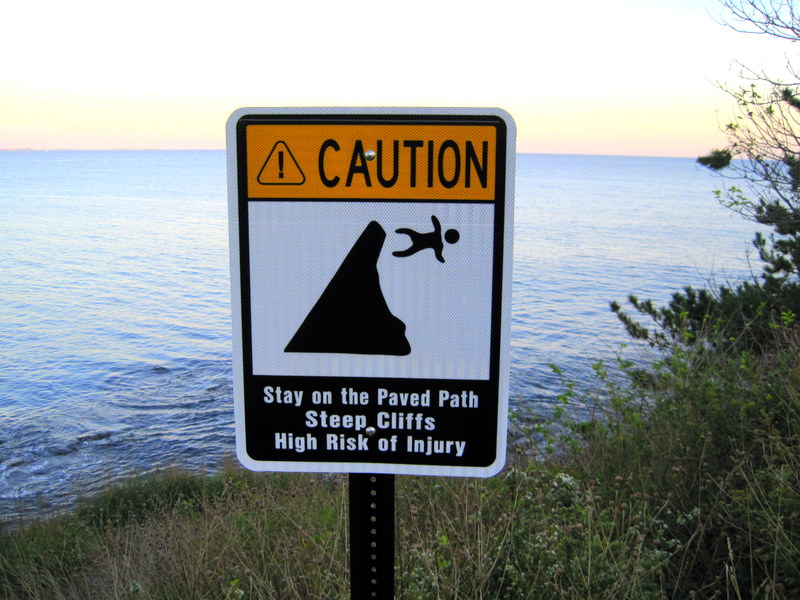
Cliff Sign

(Image Courtesy of http://www.aroundtheworldl.com)

The other day during a conversation with someone close, I noticed something about our interaction. It was a simple conversation, nothing too deep or seemingly important, but a pattern revealed itself.

The pattern was simple: I jump to offense.

Let me explain. This means that my mind appears to be on a quest to find a way to be offended at what someone else is saying. By quest, I mean that my mind considers this its highest priority and will devote both time, energy, and resources to ensure the quest’s success.

Here are a few examples:

“It is getting kind of late for sending out Christmas Cards”

My Jump: So are you saying that I should have sent these out?

“It would be nice to do more interactive things at the next holiday with everyone”

My Jump: So they expect me to plan this then be responsible for meeting everyone’s idea of what is fun?

“We need to make sure we are attentive to the bottom line”

My Jump: So they are saying that I am overspending?

There are risks in jumping to offense, just like the risk of jumping off a cliff. It is dangerous and there is unseen peril just beyond the lip. Luckily I am beginning to notice this pattern as it occurs (or shortly afterwards).

I realize that I need to retrain my mind to see the warning sign on the edge of that cliff before I go off jumping. Picturing that warning sign helps, but also explaining to the person I am talking with if it begins to happen.

Here are a few tips for my fellow jumpers:

  1. Recognize your bent toward Jumping to Offense.
  2. Understand that Jumping to Offense is dangerous, for you and others.
  3. Slow down and listen, don’t respond right away.
  4. Ask clarifying questions, make sure you understand what the other person is saying.
  5. If you do jump, climb back up and reconcile with those around you.
  6. Repeat steps as needed.

Where are you Jumping to Offense? Take a few moments to think about where you could, as my grandmother always used to say, “look before you leap.”

P.S. I am going to print out this photo and put it where I can see it every day.

Throwing the Javelin

London Olympics Athletics Women

(Image Courtesy of http://ydtalk.com)

Over the past few weeks I have been part of an experiment. A learning experiment. Seth Godin, one of the coolest people on the planet recently announced a new way of learning: Learning Together.

Beyond creative, the Krypton Community College (with its cool narwhal mascot) is an experience in learning with other people. The first class was centered on help to move past (or dance with) our fears, pick ourselves, and move projects forward. Part of an early assignment included interviewing people who brought something into the world and how fear played a role in the process.

The thought of asking pretty amazing and accomplished people about fear was scary in itself.

What if these folks didn’t really experience fear?

Maybe fear is just what the rest of us feel.

Was that what sets them apart in their success?

Maybe that is why I am not as successful.

I pressed on and scheduled an interview anyway (dancing with my own fear). When the questions moved away from the details of what this person had accomplished to how they felt and dealt with any fears that were part of the process, an amazing story emerged.

I learned that this person had to give a talk on a technical topic to hundreds of experts in this field. This person was not a technical expert on the subject at hand, but was part of trying to raise awareness, address challenges, offer solutions, and help increase funding for this issue.

Speaking to this crowd did bring fear (which surprised me because they are so confident). Fear of not being credible, or coming across in a way that would not acknowledge the depth of knowledge in the room and limit the receptivity to these new ideas.

So, they called their dad for advice.  I will let them tell the rest in their own words:

My dad’s stellar advice on how to handle presenting information to a group of providers who were twice my age and real experts in the issue was to start off my presentation by joking that I was actually going to teach them how to throw the javelin.

It worked like a charm. I started to get into the stance, told them I was intimidated by their knowledge and expertise and recognized they knew the field much better than I did. So, I said that I’d changed up my plan for the presentation and was teaching javelin instead since I was the expert in that.

They all laughed, and were super supportive when I actually got into the real presentation. I also felt way more comfortable. And, throughout our time together a number of them became great thought partners/mentors/teachers and took me under their wing.

I think acknowledging my fears, owning them, and accepting them really helped start our work off on the right foot, and rather than feeling skeptical the group wanted to help me and later felt more comfortable sharing their fears about the work we were doing.

Great advice for any of us wrestling with our next project, idea, task, or talk.

Acknowledge the fear.

Own the fear.

Accept the fear.

And begin by Throwing the Javelin.

The Optimism Zone

optimistic2

(Image Courtesy of Real Balance Wellness)

Soccer, youth travel soccer to be specific, now fills most of our days. Practices fill the week. Games fill the weekend.

Each week we are surrounded by increased skills, increased playing ability, and an increased level of teamwork.

Each week something else has also increased: the negativity of the spectators.

Negativity creeps in, when something doesn’t go the right way. At first negativity is hard to notice, and it may begin as disappointment.

The collective “OH NO, TOO BAD” when a goal is missed, turns into “UGH.”

The “GOOD TRY” becomes “WHY DIDN’T YOU MAKE THAT PLAY.”

About a week ago, the negativity became so loud during the game that it made my emotional glass cloudy. For hours after that game, I had the kind of emotional hangover that lasted for more than a few hours.

At the next day’s game, we set up early and made a declaration:

“This area right here (pointing to the imaginary large circle surrounding our folding chairs) is a declared Optimism Zone. If you feel the need to be negative, you need to go someplace else.”

For the first few minutes of the game we had to remind others a few times.

“As a reminder, you are in the Optimism Zone, all statements and comments should reflect that, if not, you should find another area to sit.”

The game, the comments, and our experience improved dramatically. We were returning to positive comments, and encouraging remarks.

The original negativity comes partly from how much these parents, friends, and family care about the players and how much they want them to succeed, and to win.

What began as coaching, became tearing down. What began as cheering, became criticism. Once negativity becomes the dominant way to express emotions, it slowly becomes the only channel.

Our attitudes and emotional state are contagious.

Perhaps we could all use an Optimism Zone to recalibrate our interactions.

Keep Your Story Fresh

“What do you do with all that random information?”

A close friend asked me the other day. I must have been spouting off about some random facts that I had learned, but the details today escape me.

Apparently, my habit of trying to learn everything about anything I can get my hands on can be a little annoying if you are on the receiving end of my latest rant.

Within a week, during a routine drive time conversation with another close friend they experienced a question from a colleague after presenting to a large group.

“How do you know all that random information that you somehow weave into your presentation?”

“I need to keep my story fresh” they replied.

Those words resonated.

I need to keep my story fresh.

If we are going to stay relevant, current and in demand the old stories won’t do.

We have to learn, grow, develop, and stay teachable.

The seemingly random facts.

The new interactions.

The new class.

The new book.

The new experience.

They all join together to keep your story fresh.

To my first friend, I finally have the answer about my random rants and continual need to devour any information that comes my way.

“I am keeping my story fresh.”

To my second friend, thanks for the words we all needed to hear.