But I am not that way with YOU!

What we say matters.  How we interact with others matters.  Lately there has been a pattern in many conversations that almost went unnoticed until someone close to me pointed it out.  I call this pattern the unintentional high standard.

A quick definition is in order.  The unintentional high standard is when someone describes their expectation of something or someone else then proceeds to discuss how that other person or thing is not meeting that standard.  This can be in the form of a rant, complaint, or sometimes a tirade.

“I cannot believe that [insert name here] has not called me more often.  I feel like this relationship is one-sided.”

“Did you see the dish they brought to the party, did they even try?”

“I cannot believe [insert spouse or significant other here] wasn’t more [pick one: caring, compassionate, understanding, loving, excited, interested, engaged] about [insert topic here].”

At some point in one of these interactions while you are simply the bystander or listener, you begin to wonder how often this person says the same things about you to others.  If they are holding up this standard for others, even if unintentional, they must be holding this standard against you too.  Maybe you even dare to ask.

“So, is this the way you feel about me?  When I don’t call as often, or brought that crappy side dish to the party?”

“No, I am just ranting, but I am not that way with You!”

Really?  Are you the one exception to this high standard?  Do you get a pass that the rest of the universe doesn’t receive?  And how does it feel to be around someone who is always pointing out where others are not meeting the mark?

For the next week or so, spend a little time listening and see how often we all create these unintentional high standards.  Maybe we should do a little less ranting and a little less complaining.  I pointed this out to someone recently, and the saddest part was they didn’t even realize they were doing it.

Chapter Two: The Law of the Few

Gladwell describes how all people were not created equal when it comes to their influence on others.  There are a “few” people with a “particular and rare set of social gifts” who are either Connectors, Mavens, or Salesmen.

Connectors know lots of people and create those small degrees of separation away from everyone (including Kevin Bacon).  On page 39, he provides a list of names to help gauge your own level of Connector status.  I was amazed at how much variation existed within the various groups where he gave this assessment.  I am curious, what was your number?  My number was 45.  It did help that one of the names on the list was Weber. 

I particularly liked how Connectors are described on page 51: “The point about Connectors is that by having a foot in so many different worlds, they have the effect of bringing them all together.”  Poor William Dawes, it appears he was out ridden by a Connector.

Mavens are those that accumulate knowledge on things and readily share it with the rest of us.  We trust their views on cars, appliances, schools, books, or even ice cream.  “They aren’t passive collectors of information…once they figure out how to get that deal, they want to tell you about it too.”  Page 62.

Salesmen, or those people who can persuade us and convince us are the last group.  These are individuals that can change our minds, and sometimes even get us to buy things (even if it is just an idea).  Gladwell describes communication with this groups as more of a dance.  Think about your last interaction with an actual salesperson, what did you like or not like about that interaction?

Which are you?  ConnectorMavenSalesmen?  Who are the Connectors, Mavens, or Salesmen around you?  Do these few influence you?  If so, how?  Let us know, and what you thought of this chapter, and remember to post on at least one other person’s post.

Chapter One: The Three Rules

The Law of the Few:  Well, there is nothing better when considering epidemic-like events than discussing the spread of STDs…but it does help make the case for how a few people can spread an idea or a product.  The 80/20 rule seems to apply well especially as Gladwell describes the characteristics of the few as how much more “sociable they are, or how energetic or knowledgeable or influential among their peers.”  (Page 21)  Think about people in your circles whose influence seems to outweigh the average person, do you listen to them?  Do they impact you?  Are you that person?

Stickiness Factor:  The ability for something to remain appears to be a key factor, essentially it has to “stick” with you in order to make the kind of impact Gladwell describes.  “Stickiness means that a message makes an impact.”  (Page 25)  What was the last thing that “stuck” in your head?  Was it a song, a commercial, a person, an event?

The Power of Context:  Understanding the situation people find themselves in is the last rule and states “that human beings are a lot more sensitive to their environment than they may seem.”  (Page 29)  The “bystander problem” as described in this chapter was pretty alarming to me, and made me think about when I see an accident or lose power in the neighborhood.  I mostly assume someone has already called 911 or the power company and I don’t pick up the phone.  I do not always act because in context, there are so many people in the same situation, assumptions are easy to make.  Does the environment impact you?  How do you feel when you come home to a sink full of dishes, you witness an argument, or it rains on the day you planned that big outdoor event?

Gladwell is making the case, or perhaps building his case that these three rules need to be in place in order to pass the tipping point.  Have just one of these, and it is not enough.  You have two of them?  Sorry, you still need another one.  Can you think of an example of each rule in your own experience?  If so, please share it with the group.

As a reminder, please read a chapter each week, post a thought about the reading, and comment on at least one other person’s post. 

What is YOUR Number?

Earlier this year we talked about yearly goal setting as a way to bring focus to our lives, and give us something to aim our lives toward.

As part of our collective journey, I set my goals for 2012 as well.  One of these goals was to run a few races.  I had been talking about running races again for a few years and not actually racing.

I was falling into a trap as described by Derek Sivers on Ted.com where talking about your goals may not always help  you achieve them.

I did go against that advice a little and shared the race goal with a friend.  I decided to share it because this person is a runner as well and I knew they would encourage me, and hold me accountable for my periodic whining.  For other goals, I did take his advice because I have a tendency to talk about goals more than actually achieve them…

The Friday before the race, this person checked in with me with one simple question.

“What is YOUR Number?”

For all non-runners out there, here is what this question means:

“What is your total time goal for the race?”

Setting a time goal (or having a number) is a way to quantify the goal.  Having a number helped me stay on task to accomplish this goal well, and it made me train harder to make sure I could actually run that fast.  That number made ordinary runs (either outside or on the treadmill) mean something.  Each run was part of a larger goal.

Whatever your goals are for 2012, I hope the process of goal setting has helped.  For the more broad goals, are there ways to set specific accomplishments to help you achieve them?  In other words, What is YOUR Number?  You can decide whether or not to share it, but establishing that number may make the difference.

The Tipping Point (Introduction)

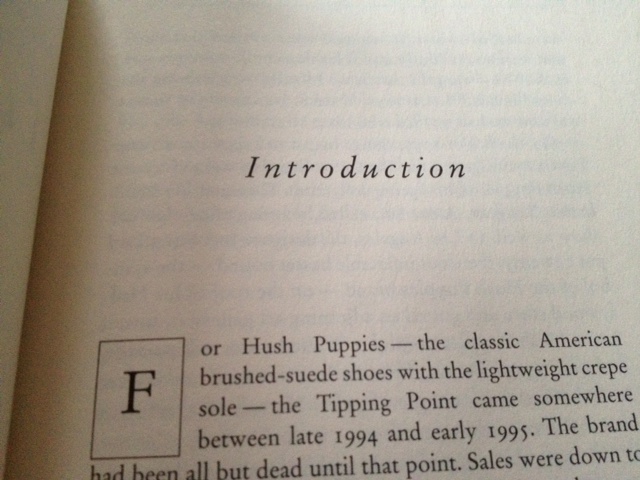
Malcolm Gladwell sets the stage for the Tipping Point by describing the rise in the sale of Hush Puppies, and the decline of New York City Crime.  Both events didn’t gradually change over time, but something (almost like the spread of a virus) caused a shift that seems disproportional to the effort behind it.

Gladwell describes how radical this idea can be for some of us because “We are, as humans, heavily socialized to make a kind of rough approximation between cause and effect.” (The Tipping Point, Page 10)  As I read this, I thought about how many times my mom and my grandmothers all had the same “we must all work really hard to make it” mantra.  Clearly, they were socializing me around this principle.

All around us, we regularly witness and even use the term “viral” to describe ways to market, or the latest video that a friend passes to us online.  Many companies, people, and ideas are trying to be that next overnight sensation by cracking some code, and getting past the tipping point.

Thanks for being part of this journey and I look forward to hearing from you.

Questions to Ponder

What was the last product, trend, or idea you witnessed that seemed to spread like wildfire?  How did you either hear about it or participate in it?

Of the three characteristics Gladwell describes (contagiousness, little causes having big effects, and change happening not gradually but in one dramatic moment) which seems the most radical compared to how you usually think about events, changes or movements?

Did you yawn during that section?  (Pages 9, 10)

The votes are in: The Tipping Point, Malcolm Gladwell

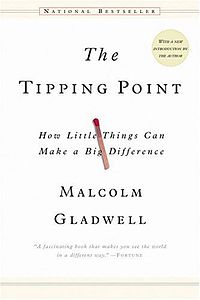
The votes are in and the winner is The Tipping Point, by Malcolm Gladwell.  I have read his other books, use Outliers in a training session with leaders, and am excited to read this book together.  This book club will get The Tipping Point off my nightstand and into our collective minds.

The book club will begin next Monday and I will post on a chapter a week.  Counting the introduction, it will take us nine weeks to read together.  Please find, borrow, buy, share, download, or check out a copy of the book to participate (there are still libraries out there).  The goal is to have each of you reply to the weekly post and/or each other every week.  If you have any questions please let me know.

Maybe together we will learn how our small actions will make a big difference.