Reluctant Leadership

Working with people can be a lot of fun.  Either in groups, or one on one, being able to help people discover themselves and their style is very rewarding.  The reward comes from knowing that their personal, professional or leadership journey is progressing and moving forward.  In some small way, you were there providing advice, suggesting a course of action, or just offering the encouragement they needed to do what they know needed to be done long before you arrived.

Lately there has been a notable trend: Reluctant Leadership.

Granted, some behavioral styles and inner motivations are more “natural” leaders.  Other styles are more prone to support others or take the second or third chair.  But this pattern of reluctance lately has even included people who would normally be wired to lead, and lead well.  Where is this reluctance coming from?

Not wanting to lead appears to go deeper than just behavioral style and opportunity.  This reluctance is a murky swamp of reasons more profound that I originally realized.  When talking with some of these individuals, the list has included guilt, shame, fear, doubt and the list goes on and on.  You can hear their Narrators shouting when you interact with them, providing the reasons not to lead.  It is almost as if someone or something knew the need for leadership and preemptively attacked them so they would not, or could not lead.

Are some leaders bad?  Yes.  Have you tried to lead and were unsuccessful? Maybe. Should you stop trying?  NO!  Leading others is messy, hard, tiring, and amazing at the same time.  People need you.  They need you to step up and lead despite your fears, doubt or whatever that reason is that keeps you on the bench and out of the game.

The more I read epic stories (the kind that last for generations) most have a reluctant leader who transforms into the Hero, despite their self-limiting perspective and doubt.  We all identify with that reluctance and fear, and the corresponding hope that they will be successful in the end.  Maybe those authors over the ages have been trying to remind us of something: the best heroes are those who led despite reluctance.

All styles can lead.  All styles can lead well.  In some cases, we have over-glorified the strong dominant leadership style making others feel as if they cannot lead.  Some of the best leaders are those who encourage others, mend prior wounds, and help others become great.

Ironically, in most of the classic stories, the reluctant leaders are the “good guys” and those who we typically would associated with type A commanding leadership styles are the “bad guys.”  Maybe those authors were trying to tell us something.
The Benefits of Yearly Goal Setting

The results of the Poll are in.  Thank you for participating.  It appears that most (almost 80%) are not formally sitting down each year to set clear, concise, and attainable goals.  For the 20% who sit down, reflect and set goals, this may seem more like a review.  Of the majority, about 15% set some sort of goals, and almost 60% have an idea of what to accomplish and press towards it.  This leaves the 7% who are just winging it out there.

Until recently, you could have put me into two of these camps.  I jumped between winging it and having a general direction or idea.  Was this effective?  I guess so, I somehow managed to accomplish things and provide a roof over our heads.  But there were always ideas, dreams or projects that seemed to just hover out there in space and never actually become reality.

Two things happened.  

1.  I was sitting next to a very successful person for a few days in training.  During one of many discussions, they asked me what my goals were for the next year, and what was my plan to accomplish those goals.

I struggled and stammered to find a response.  A combination of embarrassment and frustration filled that space.  I think they could tell I needed some help, and provided the much-needed relief.

“It is okay you know.  Maybe a simple worksheet would help.  Let me send it to you.”

2.  A friend called me out.

“I have heard you talk about that same goal year after year, and yet you have not made any progress.  When are you going to actually do it?”

These two events made me realize my lack of setting actual goals, left those big ideas or dreams just floating out there from year to year.  Periodically, I would try to make progress and tackle some part but it would seem overwhelming and I would stop.

During this same period of time, numerous requests came my way to help senior teams and organizations set goals.  As I stood before them, facilitating their long-term vision and strategy my own lack of a plan began to make me feel like an impostor.  For no other reason, I wanted to make sure if they asked me about my own goal setting I had an answer.  I took the advice and the worksheet and began to set some goals.

The process of setting the goals was more helpful than I ever imagined.  Setting goals required me to think about and choose between various conflicting visions and dreams.  Once created, the list provided me with the focus and accountability I needed to make actual progress.

As the new year approaches, maybe a simple worksheet will help you as well.  It can be overwhelming, but take the first step.  Maybe the best place to start is with Your Sentence. I hope that process provides the vision you need to set that first goal.

Managing Your Energy & Goals Worksheet

Normally, I would tell you to get out there and tell someone about your goals, but Derek Sivers at TED.com made me think twice about offering this advice.  Perhaps after setting your goals, you should keep them to yourself.  Or maybe start with one person ONLY if they will push you on the hard work necessary to actually accomplish that goal.

Now get out there and set some goals, 2012 is going to be great!

The View is Different from the Top

I was meeting with an executive the other day to discuss their behavioral style.  We talked at length about how this style may work in certain situations, but over the long-haul is the kind of style that may wear people out.

I could tell that it didn’t really sink in, so we covered it again.  That is when the real issue became clear.

“Well this is all well and good, but people who work for me need to deal with my style.  I get results, and I cannot be concerned about developing a relationship with any of them.”

The view is different from the top.  When you are in charge or in control, the temptation is to make everyone bend and conform to you.  As an employee you may see the need to change your behavior in order to be more successful, to fit in, to become part of the organization.  But as a leader, you may have one of the more prominent blind spots: You and your view from the top.

To compound the problem, if you are in charge, and have an intense style, no one around you has the guts to challenge you.  Well maybe once, but I bet they are no longer around, or learned right away to keep quiet.

Understanding that our views are different, also means understanding that the issues, strategy, and hard decisions may not be as apparent and understood by others who do not sit where we sit.  If you are somewhere else (besides the top) in an organization, your more limited view may not provide you with all the facts.  So be careful about drawing the wrong conclusions about those above you.

This clash of views can create real tension.  Soon we will talk about the power-distance created in our organizations, but for today, just realizing that our views are different and not necessarily wrong is the first step.

By the end of our session, the executive began to see the blind spot inherent in the top down view.

“So, what you are saying is my drive for results while intentionally distancing myself personally from my employees may give them the impression that I am kind of a jerk?”

“Yup.”

Progress.  One step at a time.

The Poll Results

Thanks everyone for participating in the first of many polls.  Part of what makes this whole blog process work is feedback and information from YOU.  So keep it up, and who knows where this thing may go…

The results are in, the poll is closed.  Just 25% of you have jobs that fit your style.  Good for you, I bet each day doesn’t really feel like work.  A smaller percentage (13%) are in jobs that do not fit, but since you have to eat you may have to tough it out.  Most of you (63%) feel that your job is “sort of” the right fit, with some parts you do not like.

I was asked to do a talk on Work/Life Balance a few months ago, and while preparing for that day, I came across an alarming piece of information:

“the Conference Board published results of a survey showing that 55% of American workers are dissatisfied with their jobs, the highest in 22 years.”

January 5, 2010 Daily Finance

Apparently, (according to this survey) a majority of us are dissatisfied with our jobs.  My survey was much less sophisticated, but only 1 our of every 4 of you feel like your job really fits you.  Strange isn’t it.  If you work from age 20 until age 65 and work a standard 40 hours per week, you will have spent 93,600 hours at work.

That means 93,600 hours of dissatisfaction for most of us!

That seems like an eternity.  How can this be?  I have a few ideas about why work feels so much like work.

1.  We are asked to pick careers way too early in life.  The world doesn’t even look remotely like it did when people expected me to make a choice and decide what I wanted to be.  Frankly, I am still trying to figure that out.

2.  Employers traditionally have hired on skills, not if you are suited to do the actual work.  I help a lot of people try to hire the right employees and have had to move beyond just asking about technical skills.  If I hear another “tell me your strengths and weaknesses” question I may just blow a gasket.

3.  The economy isn’t helping.  Many people are feeling a little trapped.  The “you are lucky to have a job” may be perfectly true, but doesn’t inspire us to be our best in the long-term.

What do we do with the results?

If you are a “sort of” or “not really” when it comes to your job, take the next few days to take an inventory.  (Yes I am always giving some sort of homework.)  Write down the parts of your job that you like, the stuff that doesn’t feel like work.  Then make the list of those aspects that seem both hard to accomplish, and make you exhausted.

Does talking to that customer really make your day?  Does pouring through the spreadsheets until everything is in balance feel like a win?  The parts you enjoy are most likely consistent with your behavioral style.  Then the real challenge begins: finding the “right” job for you.  But that is a topic for another day.

I Hate That Guy

A few months back, I got to work with a fairly new leadership team.  All of the leaders had been in their positions less than two years, some only a few months.  The session focused on their behaviors (how they do the job) as well as their values/motivators (why they do the job).  The goal was to make sure that by understanding their own behaviors, they could work together as a team, and learn to manage well.

As the session kicked off, it was clear that individuals on this team had one thing in common: very extreme behavioral styles.  What I mean is that behaviors are typically measured on a 0 to 100 scale.  Extreme behaviors are when the scores are either in the 90 to 100 range, or 0 to 10 range.  To make this even more interesting, these leaders would have scores of 98 in one category, and 3 in another so the distance between behaviors was like a chasm.

More extreme styles make it hard to modify your behavior.  Modifying your behavior takes the energy and the conscious choice to behave differently.

How do you think you feel after a day of modifying your behavior? Mentally and physically exhausted.

If you get home and you are spent, think about what the day required.  Did you have to focus on the details of that report that was due?  Did you have to make those calls, go to those meetings, or make a presentation?  Gauging your energy helps you identify when you needed to modify your behaviors.

Reflecting on your style and what you may need to modify is a great way to improve your ability to do it.  If not, the exhaustion of one day will reduce your capacity to modify your behaviors the next.  Losing your ability to modify your behaviors can be disastrous for your career or relationships.

One of the leaders was significantly modifying their behavior (we can measure both natural styles and modified styles).  The change between the two styles was amazing. This leader was taking their foot off the gas for results (problems) and deliberately connecting with others (people).  I had to press in and ask about this change.

“Your change in style is pretty amazing, can you tell me how you feel after work?”

“Tired.”

“How are you able to do this, and why are you doing it?”

“When I look at my natural style, I Hate That Guy.  I make the choice to be a better leader than the leaders who formed me.”

“Can you continue to do it?”

“Yes, my people deserve better.”

I said it before, don’t wear your particular style as a badge of honor.  There are things that you do that impact others…in a negative way.  Pick one thing this week and work on modifying it.  In time, your natural style begins to shift towards that style, and it is less work to do it.  You will be tired at first.  It will be hard at first, but our people deserve better.

Anger is My Primary Emotion

Anger.  Yup, it is a part of my world.  Let’s face it, one of the problems with learning about different styles is coming to grips with your own.  All styles have great things and not-so-great things at the same time.

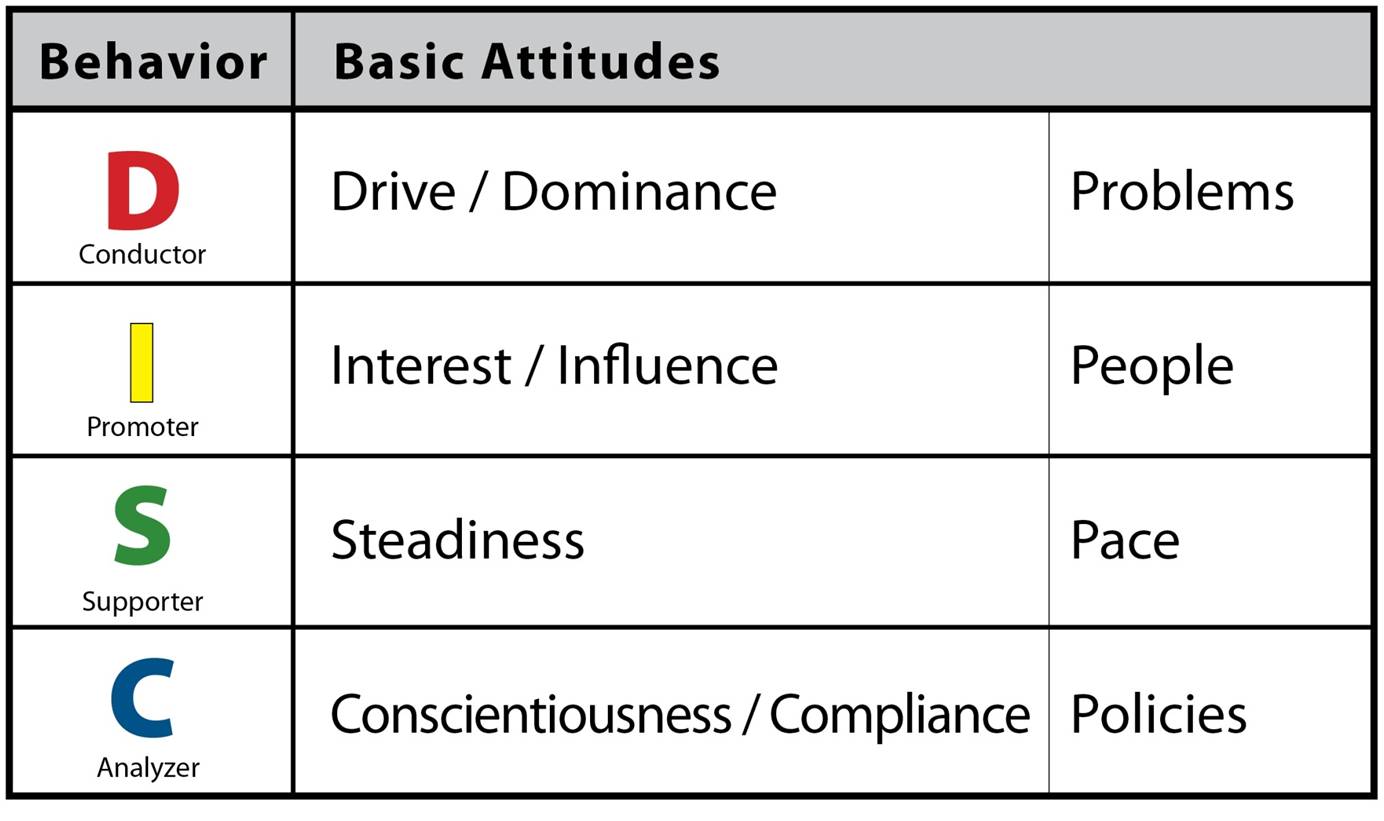
According to Marston and the DISC assessment, there are four styles.

Essentially, it can be summed up with four P’s or how you deal with:

Problems, People, Pace, and Policies

How we score impacts the intensity of each category.  Do you jump in to solve problems or are you more reflective?  Are you the life of the party or do you need a break from people? How about your ability to adapt to change or have consistency from day-to-day?  And then there are the rules, do you follow them, or do you consider it nice that other people need them?

“All people exhibit all four behavioral factors in varying degrees of intensity.”

W. M. Marston

All of this helps us understand who we are, how we lead, how we follow, and how we communicate with others.  It is applicable in the workplace, our relationships, our families, and how we interact with everyone around us.

One of my more intense behaviors is the D or Drive.  It is what helps me push to solve issues, find solutions and get results.  But it has a price to pay: Anger.  The great part of having this internal urgency to get things done is unfortunately combined with the not-so-great part of frustration and impatience.  Learning to balance or modify our behaviors can be the difference between success or failure.  (See post Missed Opportunities, Missed Expectations to watch this play out in the workplace.)

When I sit with people, especially leaders and review their style, I hear them consistency say, I wish I knew this earlier on in my [career, life, marriage, college major, or relationships].”

So think about who you are, and what you bring that is both great, and not-so-great.  Don’t wear your particular style as a badge of honor.  There is no one right style, all have a downside if you are unaware or apply it in the wrong situation.

But if you know yourself, you can change the world.

I try to be pretty up front about who I am, the good and the bad.  If you are interested in assessing your own behaviors, let me know.  It is a pretty fun ride.  When I brought home my own assessment for the first time, I let my wife read it.  She cracked up.

“I think they must have followed you around all day.”

And better yet, our family was at an attraction up north.  Out of the crowd came a person that attended a seminar that I had given a few months prior.  This person walked straight up to my wife (right past me), winked at me and shook her hand and said:

“You must be the most patient person on the planet.”

Yes she is.  Thanks for putting up with me.