Giving What you Didn’t Get

They were a little late to the Zoom call. Technical issues.

They were nervous. You could hear it in their voice.

They won the contest at a recent supervisory training.

The prize was a one on one with me.

“I want you to know that I listened to everything during the training. I started applying it right away.”

They have been in this industry a while. It’s not glamorous work. It is hard work.

They were used to doing things the way someone else taught them. How to do the work, how to speak to others, how to give orders, how to set the standard, how to provide correction.

“I didn’t realize that my employees needed something different. I’ve been just doing what I have been doing for years.”

They never thought about their own style.

They never thought about their employees’ style.

They just gave what they were given.

Then it all changed.

“I realized how often I am just correcting others. How often I point out what is wrong, tell them how I would do it, and make them do it my way. No questions, no feedback, just telling. I never considered “how it feels on the other side of me” as you challenged us.

I suddenly understood that I was the problem. My style, my approach, my choice of words, how I was taught to do this job – all of it. It was not what they need from me.”

Within days they met with every employee. More questions than directives.

What did they need?

What was getting in the way of doing the job well?

“I also took seriously your challenge to “go find what is right” and tell my employees about it.”

They found what was right. They told them.

Barking orders stopped.

Engagement.

Latitude on decisions and process started.

Two-way conversations.

Insight and new ideas on how to do the work.

They started to give differently.

“My biggest takeaway is realizing that I was giving exactly what I got, instead of giving what I didn’t get.”

Giving what you didn’t get.

Giving more than what you got.

Giving especially what you didn’t get.

Where can you give what you didn’t get?

In this season of giving, maybe this is what we all need.

Let’s all try to give something that we didn’t get.

Let’s start today.
Decidedly Different: A riff about workplace culture

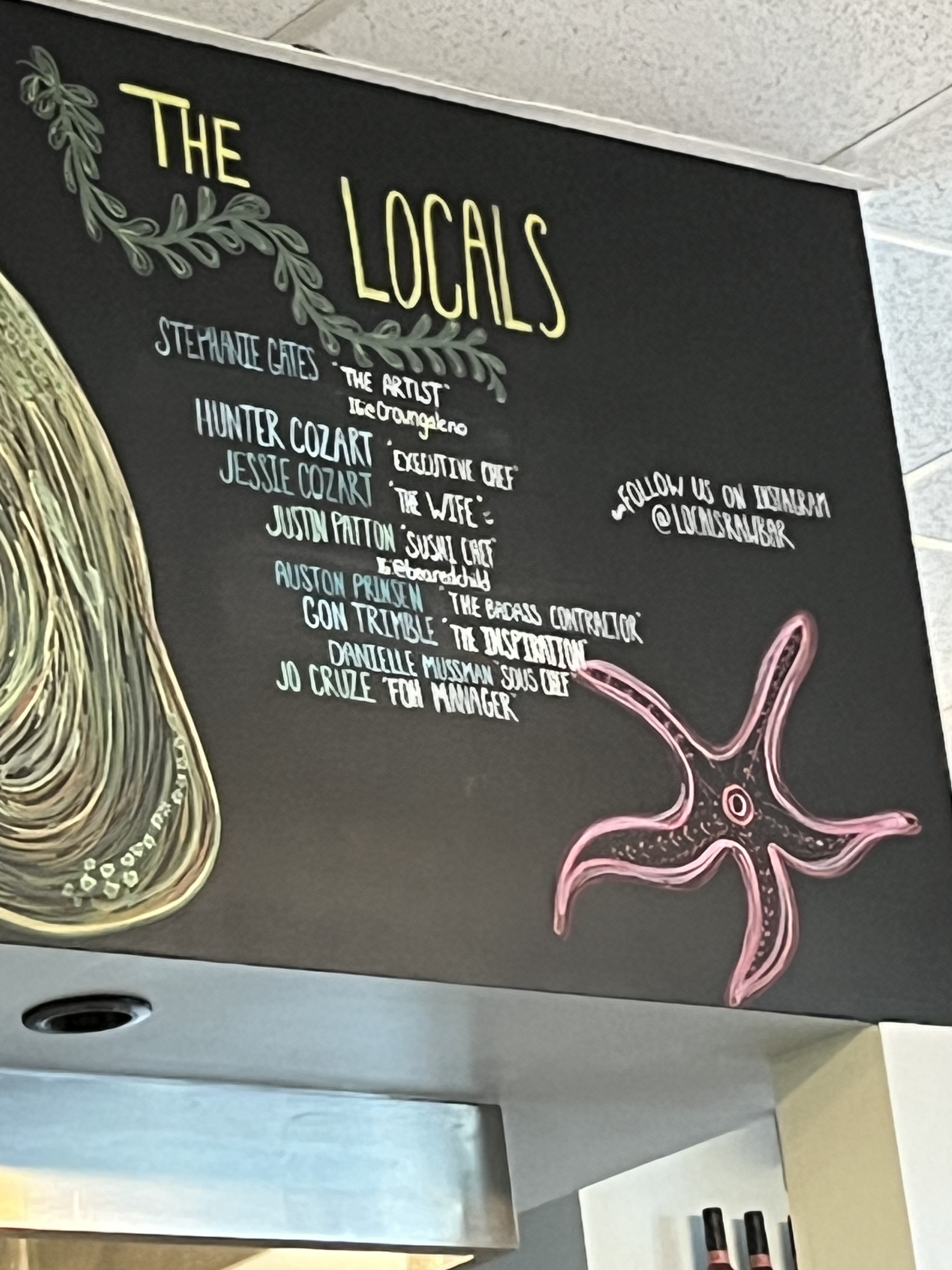
Jessie Cozart, Justin Patton, Christopher Roberts, Hunter Cozart, and Danielle Mussman.

The “Magic” behind Local’s Raw Bar

https://www.facebook.com/people/Locals-Raw-Bar/100091781995548/

I’m in the middle of preparing a talk for an upcoming leadership program.

I have presented before this group before, but they are looking for something different.

Something new.

Something fresh.

In my little notebook I sketched out the talk. Ideas that would challenge them on the impact that Culture has on recruitment, retention, and productivity.

I could already hear the opposition.

“You don’t understand the constraints we have.”

“This is how we were treated and trained.”

“In this industry, we cannot change the way things are.”

I needed an example, but serious writers block set in.

Lunch seemed like the appropriate remedy.

I wanted something different, and did a little search.

We arrived, but it was closed. I neglected to check the hours and the fact that a few days a week they are “out fishing.”

Hunter greeted us at the door. It was his place, and he was excited to tell us about the food, and the fish that was coming in the following day. We made plans to return (when it was open).

We sat at the bar. We could see everything happening in the kitchen.

The greeting, seating, chopping, slicing, sushi rolling, frying, mixing, plating, and serving.

Something was different.

There was flow.

There was timing.

There was fun.

There were minor adjustments.

There was respect.

Everyone had a part to play.

Everyone was part of this team.

The mezmerizing symphony played out before our eyes.

The food was amazing, but the culture was just as memorable.

We returned a second time.

They remembered us and greeted us.

The cultural symphony played again.

We returned again. Third time in a week is a charm right?

This time I had to ask.

I had to understand why this was so different.

Jessie came over and gave us some of their story.

Young local couple works in a high end restaurant in a big City.

They learn lots of skills, but see the culture: big egos, yelling, disrespect and negative Culture.

They move to another City, another high end restaurant.

More Skills.

More of the same Culture.

They decide to make a change.

They move back home.

They start something new.

They leverage their skills, but decide to create a different Culture.

Respect, Fun, and Passion.

Something new.

Something fresh.

Exactly the example I needed.

It takes courage to go against the Culture of your industry.

It takes courage to try something new.

How can you be Decidedly Different with your workplace Culture?

How can you leverage the skills, but have the courage to abandon the negative parts that don’t serve you or your staff?

Based on the crowds on our fourth visit, I would say it is well worth the risk.

Great, Great, Great, Great, Great, Not Great

Image by Gerd Altmann from Pixabay 

They pulled me aside during the break. We were just talking about giving feedback and showing appreciation to others. They stayed at their table while everyone else got up for the break and snacks.

“Can I share something with you?”

I came in a little closer, my mind racing to replay the last few minutes to see if I said anything weird.

“You talked about providing sincere feedback and appreciation. Making sure that it is not a superficial ‘drive-by’. I just realized that I was taught to do this in college, and have been providing this my whole career.”

They studied physical education. They were taught a method of feedback. It was intended to help young children with basic early skills.

In order to pass this class, they were timed and had to provide 5 quick positive feedbacks, before they could provide 1 redirecting ones. They were filmed and each positive had to be different but quick.

Great job.

Nice job.

Awesome job.

Way to go.

Yay.

You could do this better.

They didn’t realize it but had been following this method for more than 20 years.

They saw that their feedback was systematic not sincere.

They realized that this scattering of seemingly shallow praise was not hitting the target.

They were well intentioned, but needed to change.

They didn’t even realize the pattern they formed.

What feedback patterns are you caught in?

How has systematic replaced sincerity?

Over the next few posts we will tackle a few ways to provide feedback and appreciation.

Until then, start to notice your own pattern.

Delegation and Trust

Image courtesy of Pixabay.com

I used to give an assignment to leaders and supervisors at the end of a session.

“Go back to your organization and find a project to delegate down to someone else.”

The reason for the assignment was simple. We had discussed the importance of conveying trust in others and to build their capacity within the organization. We reviewed some some key points from Dan Pink’s book Drive and discussed how delegating projects would resonate with the key drivers for all employees: Autonomy, Mastery, and Purpose.

Weeks or months later, I would check in with these leaders. Almost no one delegated a project.

I asked why.

“You don’t understand, I got back to the office and am so busy, I just couldn’t find the time to sit down with someone and explain it, it was easier to do it myself.”

“They wouldn’t do it right anyway, and when you think about it, I was saving them from failing.”

“I need this done a certain way, and don’t want to worry about if it is done right.”

The lists, and the excuses kept coming. For the few leaders that did delegate projects, many of them picked the worst project on their list and passed that down to someone.

Each excuse was almost a direct hit against the primary drivers for employees.

Autonomy – people want some self direction and control over their working environment which may mean taking on projects and doing it their way. Lack of delegation sends the message that you are in complete control and there is no room for others to develop their own way or style.

Mastery – people want to be good at things, and that means trying new things, working on new projects that develop and refine skills over time. Lack of delegation keeps their skills shallow, and maintains your expert status.

Purpose – people want to feel like their work matters, and their time is meaningful and makes a difference. Lack of delegation makes others feel unimportant, and worse conveys that you do not trust them or value them and their contribution.

I had to change the assignment.

“Within 2 weeks, find the project or assignment is BIG and IMPORTANT that would give you the most satisfaction, organizational recognition, and reward and delegate that one. AND find your partner here today and tell them about this project then call each other each week to ensure it is delegated.”

At first you could have heard a pin drop.

The big and important one? YES!

The one that would give the most rewards? YUP!

Now when I check in with these leaders I hear a different story.

“It was pretty scary to give up a big project like that, but I was surprised, they took it on and completed it. They seem more energized and are looking for the next project.”

“They went in a different direction then I expected and that made me worry, but the result was better than expected and frankly maybe better than I would have been able to do.”

“Not only are these employees taking on more projects and responsibilities, I find that I have more time to do my core job and I am less frantic and busy.”

So the choice as leaders is simple. You can keep everything to yourself (most likely out of fear and control) or you can learn to pass down important projects and assignments. When you choose to keep it, you convey a lack of trust and your work will continue to be hectic and busy. When you choose to pass projects to others, you convey trust and importance in others, and build their capacity.

One leader candidly expressed their fear in doing this.

“What if I delegate these important things down, and my employees become better at these things than me? Won’t I be working myself out of my job?”

My response was simple.

If you are the kind of leader that can build the capacity of teams in a way that you are no longer needed, you most likely have a much larger and more important career as companies will pay a lot to replicate that in their organization.

Taking Initiative

(Image Courtesy of Pixabay.com)

The session is about conflict and learning their preferred styles and other styles.

The session ends with some group work and a case study.

The case study provides a scenario and context to apply what they just learned.

The scenario describes being partnered with a peer to organize and work on a project together. But, when they arrive at the meeting, the peer has already started the project and assigned work to other members of the team.

Participants are asked to describe what they would do.

The response to this scenario has ALWAYS been the same.

“I would confront this peer about moving forward without me.”

“I would address this peer’s behavior and establish some structure and boundaries so we are working together on this project.”

“I would talk to my boss about this peer and make sure our roles are clear.”

The response to this scenario has ALWAYS been the same.

The response to this scenario has ALWAYS been the same, until recently.

This group surprised me.

“I would thank the peer for taking initiative and ask them how I can help moving forward.”

“I would support this peer and see if they need me to take a more active role.”

They went on to explain their response.

“You see, I am super busy. And just because it didn’t work out perfectly, or not exactly what I had in mind, that is fine with me. I appreciate when someone takes initiative and gets things moving. I don’t always have to be in charge, sometimes I can play a support role for what is already in motion.”

Wow.

Let me say that again. Wow!

A much different response and view of someone else taking initiative.

A response that rewards action and doesn’t take things personally.

How many times do we see taking initiative as a threat?

How often does our ego get in the way of movement?

How often do we see negative things when there is something positive to be appreciated?

Maybe it is time for a new response to taking initiative.

Just because that project, that dinner, that event was not exactly what you had in mind, can we learn to appreciate those taking initiative instead?

Let me know if you struggle with others taking initiative and if you try taking this alternative view in your own world, workplace, household, or lives in the comments section.

The Weeds

(Image courtesy of Pixabay.com)

“You’ve got to stay out of the weeds.”

Leaders are told all the time to stay out of the weeds.

The more senior the position the more we hear this advice, and these words about the weeds.

“Let’s stay up at a 30,000 or 40,000 foot view on this issue.”

Then the advice switches to altitude and taking a big picture view.

Simple advice: stay out of the details and keep your distance.

This weed/altitude advice attempts to keep us from micromanaging the operation.

But over time, this weed/altitude advice keep removes us from the action.

Ironically, when we stay “out of the weeds” too long, weeds start to sprout, root, and take hold in our organizations.

Weeds of poor customer service.

Weeds of missed deadlines.

Weeds of a culture not focused on deliverables.

Weeds of excuses and justifying the lack of results.

We may need more balanced advice.

Sometimes get in the weeds and stay close to the action.

Sometimes you need to get your hands dirty. You need to get in the dirt and pluck weeds.

When should you get in the weeds?

When a pattern of customer complaints emerges?

When deadlines are missed?

When more time is spent justifying than solving?

Maybe regularly enough before patterns of complaints and lack of results can take root.

Gardens need regular weeding. Our organizations need regular weeding too.

If you don’t spend time in the weeds, those weeds may be the thing that chokes out your organization. Weeds make us vulnerable to losing market share, customers, and good employees.

Balancing time in the weeds and big picture thinking time will have to be a topic for another day. But for now, if you have been up at 30,000 or 40,000 feet and removed from the action; walk around, get close, and look for weeds. And when you find weeds, get rid of them.