Work

Work.  Sometimes it can feel as if life is passing you as each day blends into the next.  I was talking about this a lot with a friend when two events happened.

1.  We got to participate in a creative event where people are encouraged to use their creativity.

2.  An invitation came to do a talk on work life balance.

The enclosed video was the result.  I hope you enjoy it.

Credits:  

Photos (all the good ones):  Iain Young

Song:  Work, by Jars of Clay

Fly Your Flag

I don’t know about you, but I spend a lot of time in the car.  Commuting, shuttling kids around, running errands and my job requires me to drive around…a lot.  To put things in perspective, my car is a 2005 and I have 172,000 miles on it.

Making the most of this time has become an art.  Listening to podcasts of my favorite speakers and teachers, thinking about upcoming talks, or projects top the list of ways to use this time.  I have also learned to use this time to connect with others.

There are a few people I call regularly during these drives to get centered, be accountable as a leader, dad, and husband, or just deepen the relationship.

Today was one of those days, with one of those calls.  I will try to paraphrase some of it.

“Sometimes it would be so much easier in life if people had little flags that popped up and told you what kind of mood they were in.”

“Why?” I asked.  (I know, I know, pretty deep question.)

“That way when I am angry people would see the flag and know to leave me alone.  And if they were in a certain mood, I would know how to talk to them…or avoid them altogether.”

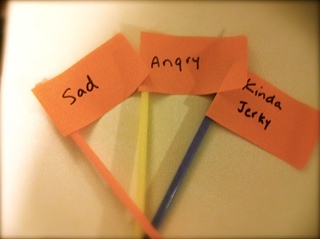
After a few minutes of trying to quickly patent this new device and develop a business plan around the “emotional flag” idea, we laughed and agreed I would show all of you the prototype.  It appears below.

Maybe we were on to something. Knowing someone’s else emotional state while revealing our own, might just be the secret to great communication.

Go ahead.  Fly Your Flag.

The View is Different from the Top

I was meeting with an executive the other day to discuss their behavioral style.  We talked at length about how this style may work in certain situations, but over the long-haul is the kind of style that may wear people out.

I could tell that it didn’t really sink in, so we covered it again.  That is when the real issue became clear.

“Well this is all well and good, but people who work for me need to deal with my style.  I get results, and I cannot be concerned about developing a relationship with any of them.”

The view is different from the top.  When you are in charge or in control, the temptation is to make everyone bend and conform to you.  As an employee you may see the need to change your behavior in order to be more successful, to fit in, to become part of the organization.  But as a leader, you may have one of the more prominent blind spots: You and your view from the top.

To compound the problem, if you are in charge, and have an intense style, no one around you has the guts to challenge you.  Well maybe once, but I bet they are no longer around, or learned right away to keep quiet.

Understanding that our views are different, also means understanding that the issues, strategy, and hard decisions may not be as apparent and understood by others who do not sit where we sit.  If you are somewhere else (besides the top) in an organization, your more limited view may not provide you with all the facts.  So be careful about drawing the wrong conclusions about those above you.

This clash of views can create real tension.  Soon we will talk about the power-distance created in our organizations, but for today, just realizing that our views are different and not necessarily wrong is the first step.

By the end of our session, the executive began to see the blind spot inherent in the top down view.

“So, what you are saying is my drive for results while intentionally distancing myself personally from my employees may give them the impression that I am kind of a jerk?”

“Yup.”

Progress.  One step at a time.

Three Lessons I Learned in the Navy

Today is Veteran’s Day.  At school this week, the kids were asked to bring in some photos and information on a veteran.  They picked me.  I believe proximity and availability of photos strongly influenced their decision.

I don’t think about my time in the Navy a lot, but their curiosity caused a little reflection.  Twenty years ago seems so far away, and such a different time that even looking at the photos is a strange experience for me.  I do get a kick out of how my daughters’ eyes light up when they see pictures of me doing crazy things.

“Is that really you jumping out of that helicopter Daddy?”

“Yes.”

“Really?”

“Yes.”

This went on for quite sometime.

As I reflected on that time, there were three lessons that I learned that are worth sharing.

Lesson 1:  The World is a Big Place

I grew up in New Hampshire in a small town and spent most of my childhood here. Spending more than half of my four years out at sea I witnessed the enormity of this planet.  When you steam across the ocean for days and there is no land in sight it puts things into perspective.

Seeing the Pyramids, the Colosseum, the Holy Land combined with visits to most of the European countries that border the Mediterranean Sea provided additional reinforcement.  A friend of mine once said that every place you go, every person you meet changes you in a small way.  Standing at the base of pyramid blocks that are larger than your car has a way of reminding you how large this world really is.

Lesson 2:  Education is Important

The funny thing is, I don’t think the Navy intended to teach this lesson…but they did.  I enlisted right out of high school, just a few days after graduation.  After training you are assigned to a ship, and one thing you notice right away is that you are wearing blue (kinda goofy) uniforms that consist of bell-bottom jeans and white hats.  Officers (those with an education) are in khaki uniforms that are almost “business casual” in appearance.

Early on in your ship-board experience all enlisted people have to spend three months working in the galley.  So essentially you get to experience first hand the behind the scenes way you feed 360 people everyday, four times per day, with the amazing honor of cleaning the dishes, pots and pans for 16 to 18 hours per day.

If you are good, you get picked for more honorable assignments.  After a week, I got to work in the officer’s galley.  Not only were their meals better, they ate in a dining room with cloth napkins and real silverware.  They also lived in staterooms (about the size of my current walk in closet) and not in summer camp like beds stacked three high.

It didn’t take a genius (thankfully) to learn this valuable lesson: if you have an education, the odds are you will live in a better place, wear better clothes, and eat better food.

Despite graduating in the top 10 percent of the bottom 1/4th of my high school class, I headed right to college after my four years of service and it was great.

Lesson 3:  Don’t Be So Afraid

Not being afraid seems harder to keep putting into practice, especially as the years pass. While looking at some of the photos, I realized that fear was not a large part of what drove me.  Yes, I was much younger, but the mission or the work seemed important enough to allow me to put that fear aside.

I used to jump out of helicopters…really.  Now I get nervous when standing on a ladder that is a few stories in the air.  What happened?  Age and time I guess, but for other less risky activities there are times that fear appears bent on halting my pursuits.  There are days that even this blog becomes fear’s next target.

The motto of rescue swimmers is this:

So Others May Live

That mission was enough to move me beyond fear and leap out of a perfectly good helicopter.  Today I encourage you to find your motto, your mission, your purpose, and remember that when the fear creeps in to try to stop you.  Remembering the larger purpose and reasons why will help you move past fear and take that first step.  (The rest was easy, gravity did all of the actual work.)  

And to the Navy, thanks for the lessons.

Happy Birthday…(to Me)

Yes it is true.  Today is my birthday.  Another year has passed. I am a year older and (hopefully) wiser.

You may be thinking: That is great Carl, but what does that have to do with us?  Did you just do this so we would say “Happy Birthday?”

Answer:  Keep reading, I will do my best.  And what is wrong with saying “Happy Birthday?”  I am not going to make you sing today, but that would be cool…anyway I digress.

Birthdays for me are a time to reflect.  A time to think about the past year and answer a few questions.

1.  Did I live my sentence this year?

2.  Did I accomplish my goals?

3.  Have I made progress?  Both personally and professionally?

4.  Why or why not?

This process helps provide focus and direction the goals for the next year to begin to form. So as you may have guessed, it starts with more questions.

What do I want to be?  This one requires a little explanation.  I have noticed an interesting thing as we age, we stop asking this question.  As if once you reach a certain age, the rest of the story is written and you cannot try something new, change your career, or take a new risk.  I was talking to a friend recently and we agreed that as we get older, our behavior should become riskier…skydiving here we come!

What is the most important thing I could improve to be more effective with my wife, kids, co-workers, clients?

What is my greatest fear?  I will try to remember to write more about this one.  We give fear too much credit and far too great a role in our lives.

I was fortunate to grow up living next to my great grandmother.  We would regularly go over and hang out, talk and play games.  One thing I remember about her is this little saying that everyone saw when you walked in her door:

We get too soon old and too late smart.

I am often reminded of this little saying as I reflect on my life each year.  It is funny to look back each decade and realize how much your perspective changes and how much “smarter” you may have become.  We cannot control the fact that we are getting older.  We can control the progress we make each year.

She also had one more saying hanging next to the first one.

The secret to a long life is eating fresh vegetables and fruits for 85 years.

Thanks Gram.  I am almost halfway there.

I Hate That Guy

A few months back, I got to work with a fairly new leadership team.  All of the leaders had been in their positions less than two years, some only a few months.  The session focused on their behaviors (how they do the job) as well as their values/motivators (why they do the job).  The goal was to make sure that by understanding their own behaviors, they could work together as a team, and learn to manage well.

As the session kicked off, it was clear that individuals on this team had one thing in common: very extreme behavioral styles.  What I mean is that behaviors are typically measured on a 0 to 100 scale.  Extreme behaviors are when the scores are either in the 90 to 100 range, or 0 to 10 range.  To make this even more interesting, these leaders would have scores of 98 in one category, and 3 in another so the distance between behaviors was like a chasm.

More extreme styles make it hard to modify your behavior.  Modifying your behavior takes the energy and the conscious choice to behave differently.

How do you think you feel after a day of modifying your behavior? Mentally and physically exhausted.

If you get home and you are spent, think about what the day required.  Did you have to focus on the details of that report that was due?  Did you have to make those calls, go to those meetings, or make a presentation?  Gauging your energy helps you identify when you needed to modify your behaviors.

Reflecting on your style and what you may need to modify is a great way to improve your ability to do it.  If not, the exhaustion of one day will reduce your capacity to modify your behaviors the next.  Losing your ability to modify your behaviors can be disastrous for your career or relationships.

One of the leaders was significantly modifying their behavior (we can measure both natural styles and modified styles).  The change between the two styles was amazing. This leader was taking their foot off the gas for results (problems) and deliberately connecting with others (people).  I had to press in and ask about this change.

“Your change in style is pretty amazing, can you tell me how you feel after work?”

“Tired.”

“How are you able to do this, and why are you doing it?”

“When I look at my natural style, I Hate That Guy.  I make the choice to be a better leader than the leaders who formed me.”

“Can you continue to do it?”

“Yes, my people deserve better.”

I said it before, don’t wear your particular style as a badge of honor.  There are things that you do that impact others…in a negative way.  Pick one thing this week and work on modifying it.  In time, your natural style begins to shift towards that style, and it is less work to do it.  You will be tired at first.  It will be hard at first, but our people deserve better.