A Few Moments for Yourself

I was meeting with someone the other day to help them understand who they are behaviorally.  A lot of what I do is helping people with their journey in life and work and how their particular behavioral style works for them (the good news) and how it doesn’t (the bad news).   

Coffee shops and bookstores with coffee shops are a great venue to deliver such news.  For no other reason, both options provide a great opportunity to people-watch while waiting for the other person to arrive.  The other fun thing about these public places is how often those around us appear to be so engaged with our conversations about how and why we live, work and communicate that they cannot help but eavesdrop.

During meetings with people I ask a lot of questions.

“How has your style become a barrier at work?”

“When was the time your style really worked for you?”

“How do others perceive you?”

During this particular meeting as we sipped lattes in that bookstore, another question came to mind.  Well, a lot of questions always do during meeting like this, but one kept bubbling up inside my head and I couldn’t shake it.  As I listened and heard more and more about how busy life for this person can be, I had to ask it.

“When was the last time you had a few moments for yourself?”

“What do you mean?”

“When have you ever stopped scheduling things for everyone else, and just went to a bookstore like this and just walked around?”

“Never.”

How often do you have a few moments for yourself?  If you are like most of the people I talk to…not very often.  Life is full of our work and managing our lives.  At the end of the day, you can lose yourself and the things you would like to do.  Maybe I think about this more because I am now half way through this life.  Between a pretty demanding job, a family, and a lawn that always seems to need mowing, time can just simply slip away.

It is ironic that someone will schedule time with me at one of these places, even if they won’t schedule time for themselves…at the same places.  It is tragic how many times everything else dominates our schedules leaving no time for us.

As our bookstore meeting was winding down, I couldn’t help myself.  I had to return to the matter at hand.

“So, we are already in a bookstore.  I am leaving.  You could take the next hour or so for yourself and just wander around.”

“Really?”

“Yes.”

And they did.  I got an email a few days later describing how wonderful it was.  Life can be busy, especially when your job and situation requires you to constantly serve and coordinate everyone else.  What does your schedule look like?  Does your name appear on it?

Take a few moments for yourself.  Put YOU on your schedule.  

You are worth it.
Making a Difference

Are you making a difference?  Not just in the cosmic sense, but how about right now…today.  What is the one thing you can do this morning, this afternoon, or this evening that could positively impact your workplace, your home, or your community?

Does a coworker need encouragement?

Does a client need a call (and not just to sell them something)?

Is someone at work struggling; a peer, or maybe even your boss?

Is there a project you could assist with?

Is there an opportunity to lend a hand?

Is there something that is “not my job” that needs to be done?

Imagine if life was different.  Imagine if each day was given to you one day at a time.  To be given the next day you had to provide an answer to one simple question.

What was the one thing you did that made a difference today?

Would your answer earn a tomorrow?  The clock is ticking and I look forward to hearing your answer to the question.  

Go Make a Difference…Today.  You can do it!

Silencing the Narrator (Part 3)

We are in the home stretch…You can do it, you can make it through!

The Narrator appears in various ways.  Various types of negative “self-talk” are easy to identify if you listen.  I have developed a habit of listening for other people’s narrator, and I hear them all the time.  (Yes, it gives me something to do at parties.)  If you listen carefully, you may hear them as well.  Let’s look at a few examples.

Black or White Thinking:  Either you are perfect or you are a total failure.  “They didn’t like the report’s conclusion, why did we even try?”

Pessimistic Thinking:  It is never going to work out right.  “No matter how hard we try, management will never listen, they never do.”

Catastrophic Thinking:  Taking one event and magnifying it to a fictional conclusion. “My boss mentioned that I need to work harder, times are tough, he and other managers were working late…are they meeting to fire me?”

Comparing:  Measuring yourself against others.  “My sales will never match their numbers, they have it all together.”

Discounting:  Not being able to accept positive feedback.

This is one I hear the most, especially in the workplace.  Just this week, I was talking with someone and attempted to provide some feedback because their performance has been great.  I stopped by to see them and started up a conversation.

“Hi, just wanted to stop by and check in.  Your efforts to get out into the customer base in the past few months has really paid off…”

(Before I could finish) “I know that it has not been enough and I am not great at this you know…I will try harder.”

Do you hear that Narrator trying so hard to take away any positive news?  As a manager or leader are you listening to those around you, and listening for the Narrator?  If not, you may pass right over this without even noticing.  Having your team know their value may require a little more effort because of the Narrator.

Recognition is important, and doing it doesn’t really cost you much. Without being in tune with your people your efforts may not be penetrating through their Narrators.

Mind Reading:  Assuming people are thinking the worst about you.

Actually.  A pretty harmless word right?  But watch how this can play out.  During a recent conversation, I realized how much of a trigger this word can be for me.  It was during this dialogue that I realized how much my Narrator keys in on certain words or phrases and tries to insert the mind reading technique.  Here is how it went down.

“Actually Carl, that was pretty insightful.”

(My Narrator): So Carl, did you hear how surprised they were that for once you were “actually” insightful.

Luckily, I have become more aware of my own Narrator and can address it when it appears (not always, but it is getting better).  I joke with this person now when we talk about their use of “actually” and how my Narrator can no longer use it against them.

If you listen you will hear Narrators in the workplace, in your homes, and in your organizations.  Our role as leaders, managers, peers, or friends can be to provide some positive narration and call out the Narrator when we hear it.  Identifying these Narrators is the first step.

Be a Good Narrator.  First for yourself, then for others and watch what happens. Silence that Bad Narrator for a minute and hear this: You can make a difference.  

After my first post, someone questioned me about why they would silence their Narrator because their Narrator was a little cheerleader in their head.  I laughed and was reminded of one of the techniques they taught those Navy Seal candidates was positive self-talk and their passing rate went from 25 percent to 33 percent.  I smile just thinking about a bunch of tough guys sitting around telling themselves “you are good enough” and “you are going to make it.”  Can you hear their little cheerleaders?  Silence the Bad Narrator, encourage the Good One.

Silencing the Narrator (Part 2)

I began to think about the Narrator, and its influence on our ability to lead, interact with others, or achieve our goals.  During this time of reflection, a few events stuck in my mind.

The first was a program on the History Channel called “the Brain.”  While discussing fear, and our brain’s reaction to fear, the show depicted Navy Seal training.  The show highlighted one of its hardest aspects: Pool Comp.  Pool Comp is a series of underwater exercises when a candidate is pushed to the limit while an instructor is systematically disrupting their air supply.  These candidates need to override what is happening in their brains.

In developing an approach that would lead to greater success the Navy realized that candidates had to tackle “self-talk”…that inner Narrator.  The difference between “Can do” and “Can’t” from the Narrator impacted a candidate’s ability to override the fear associated with the activity (trying to function while not drowning) and succeed.  

The study also concluded that a person’s inner voice or Narrator can speak somewhere between 300 and 1,000 words per minute.  I have been told that I speak quickly, but even I can’t compete with that.

The second event happened closer to home.  When my youngest was five, I heard her say something that I will never forget.

“I am just a bad girl.”

She was five!!!  Where did she hear this?  How did she come to this conclusion?  What was going on?  Who told her this?

I replayed the past few weeks and months in my mind.  I searched for what could cause her to reach this conclusion…and there it was.

To provide a little context, for about the six or eight weeks prior to this statement, she was trying to make her own breakfast each morning.  She was five.  She was trying to be more independent.  Each day started off the same:  get a bowl, a box of cereal, and a gallon of milk and pour them together.  The result was a huge mess.  Every morning the ratio between what ended up on the floor and what landed into the bowl was about 90/10.  I also pictured my dialogue during this time.

“Don’t spill.”

“Why are you doing it that way.”

“Just let me do it.”

“Why don’t you pour it this way.”

Unintentionally, I sided with and encouraged her Narrator.  Apparently, my daughter, potential Navy Seals and all of us have something in common: the Narrator.  How we deal with and silence the bad Narrator, while encouraging the good Narrator may make the difference between success and failure.  We will tackle some of that next.

Sorry for the many parts, but there is a lot of ground to cover.  Hang on it will be totally worth it.


Silencing the Narrator (Part 1)

Lately when talking with various leaders and individuals, the concept of story comes up a lot.  I seem to hear or read people using it more often or maybe I am just more inclined to hear it.  One day I was describing the notion of “story” or the “hero’s journey” in our lives. (See Joseph Campbell’s book: The Hero with a Thousand Faces.)

Essentially, the idea is that classic stories follow a pretty consistent pattern.  The protagonist lives a simple life, is called into something larger than themselves, faces hardship, doubts themselves, makes hard choices to push forward (while longing for their old life – one that no longer exists), succeed despite the odds, and become the hero that causes our hearts to stir and cheer for them.

I was describing this in the context of leadership.  How everyday choices we make, how we interact with others, the risks we take, either add to our role as the protagonist, or because of our words and actions, we may switch roles in the story.  We sometimes become the sort of character that would even stop us from cheering for ourselves.

But I had a revelation, but as soon as I said it I had to take it back.

“The trouble in our lives versus a Story is there is one major difference.  Great stories have a Narrator.  Our lives do not.”

I could feel how wrong I was the minute the words left my mouth.  All of a sudden, my past failures, mistakes, and poor choices seemed to flash before me.  And I heard a Narrator, both then and now.  An inner voice.  It wasn’t good.

Think back when you failed.  Think about a mistake, a failure.  What did you hear?  What do you still hear?

“Stupid.”

“Why did you even try?”

“You should just give up.”

“You are not [insert word here] enough.”

For some of us, the words we hear are even worse.  I had to modify my statement about our stories.

“I guess there is a Narrator, but unfortunately, it is a Bad Narrator.”

What does your Narrator say when your story becomes dark?  Are you continually reminded of mistakes and failures?  Reminded how you don’t measure up?  Does this inner dialogue disrupt your interaction with others, your ability to manage well?  If so, you are not alone.

Over the next few weeks, we will tackle some of the ways to Silence the Narrator but for now, just recognizing that it exists is a good first step.  As a good friend of mine reminded me recently, “your narrator sucks!”  

If so, why are we listening to it?

How Tired are You?

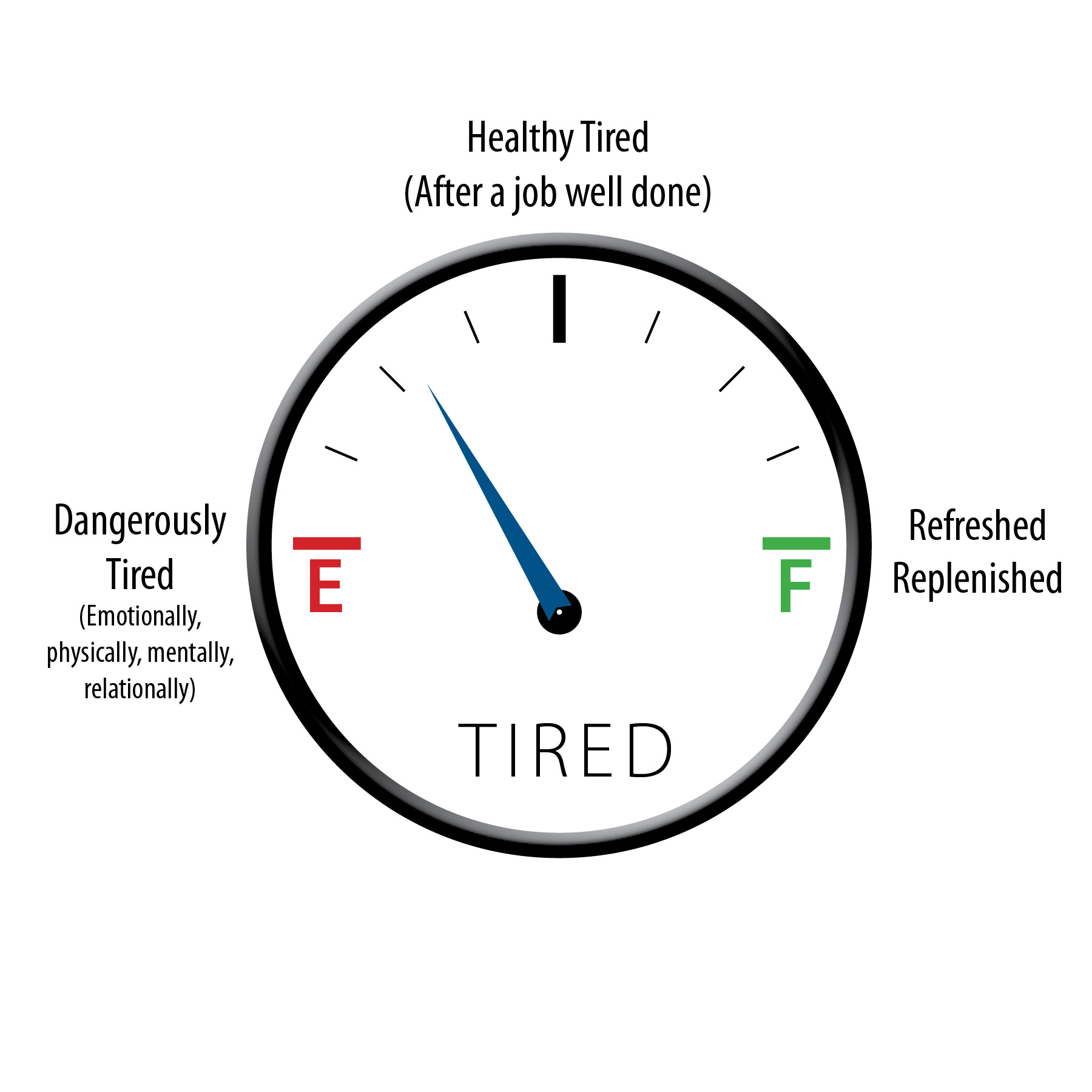
Are you tired?  If you are anything like anyone I know, you are tired.  You are not alone.  Everyone is Tired.  I was recently listening to a podcast by Ruth Haley Barton and she mentioned a “tired continuum” as a way to measure how tired we are.  While explaining this to my graphics friend she came up with this illustration.

(I like that it looks like a gas gauge.)

In describing this continuum, Ruth mentioned that we should be operating somewhere between “healthy tired” (after a job well done) and being replenished and refreshed from real rest.

Unfortunately, most of us operate somewhere below “healthy tired” and  a lot closer to “dangerously tired.”  

Being in a continual state of exhaustion impacts our work, our lives, and those around us. It has become too easy to tough it out, have that fourth cup of coffee, and ignore how tired we really feel.

When we are exhausted, our ability to regulate our own emotional state becomes next to impossible.  Someone called me out on this recently.

“Your emotional buffer is almost non-existent today.”

“What do you mean?”

“You appear to be overreacting to just about everything.”

So, my question to you today is a simple one.  How tired are you?  Are you masking or ignoring the signs of being beyond healthy tired and running on empty?  Are those around you, at work or home, or elsewhere getting you at your best?  Or just the burned out shell of yourself?

Do yourself and those around you a favor: REST!

Seriously.  Go take a nap or something.