Take the Journey

gI_90214_8303Frontcover

A good friend recently published her story of taking an adventure across America. It was great learning more about her story and her journey. This book serves as a reminder for all of us to go ahead and take the journey, take the risk, and to live a life worth reading about.

From spotting Moose and various other creatures, to sarcasm and obscure Simpson’s references (loved this part), through fear and doubt, loss and love, Gloria Jean invites us to ride along with her on a larger quest to find treasure in places less traveled.

There is something magical and awful about road trips. They require us to put in the hours to reach a goal, especially when there are faster and easier ways to take the journey. Maybe that is the point to racking up the hours behind the wheel: all those miles give us opportunity to think, process, and wonder.

Thanks Gloria Jean.

Thanks for setting the example for the rest of us.

What journey is waiting for you?

What risk should you take?

Go. Live. Write.

We are all waiting to read your story.

Meticulous Framing

IMG_5987

During a recent conversation with a close friend, we discussed the importance of building things that last.

Relationships.

Businesses.

Creative Stuff.

Sometimes we don’t always start the right way.

Sometimes we have to go back and fix.

In order to build on what exists, you have to make sure what is underneath is strong enough to handle what comes next.

Strong enough to last.

The very next day I was on a job site for the construction of a new home.

I met the team responsible for framing the home.

It wasn’t my first job site, but this site/this work stood out.

Clean, straight, and beautiful.

Meticulous Framing.


IMG_5997

After the tour, there were many compliments directed towards the framing team.

The leader of the larger team and company responsible for the project told a quick story.

“My former partner used to say ‘this is framing, not finish carpentry’. I would remind him that if I did a crappy job framing, I’d end up spending more time messing around trying to fix things when I installed the finish trim, cabinets and doors.”

Everyone nodded in agreement.

The framing team agreed and spoke of how important it was to get this step done well.

I found it interesting, that once complete, no one will see the Meticulous Framing.

This Meticulous Framing is not glamorous: other things that sit on top will ultimately get all the credit for how this home looks.

This Meticulous Framing will be hidden from view, seemingly forever, or until someone makes a drastic change.

This Meticulous Framing will set the stage for the next several decades.

This Meticulous Framing may take a few extra days, but may save weeks later on.

The leader tells this story in the larger context.

“I like to say what you do in one part of your life is pretty likely to show up in other parts of your life…”

Couldn’t we use Meticulous Framing when building relationships?

Couldn’t we use Meticulous Framing when building businesses?

Couldn’t we use Meticulous Framing when doing creating stuff?

The next time you build something, ask your self:

“Am I building this in a way that will last, or will I be spending a lot of time messing around trying to fix things?”

Maybe Meticulous Framing is exactly what we need, so what we build will last.

Affirmation or Revelation

“I didn’t need it, they don’t need it!”

Usually said loudly and with passion.

Usually said with a negative and sometimes angry tone.

Usually as a response to the idea of coaching, encouraging, or recognizing employees.

Usually while being critical and perhaps judgmental of perceived generational or work-ethic differences.

“I didn’t need someone to tell me I was doing a good job!”

“I didn’t need a trophy just for showing up!”

“I didn’t need to be coached, I just worked hard!”

“I didn’t need a reward, it was my job!”

When these statements enter the room or conversation, pause and watch what happens.

These statements tend to weave their way through the crowd.

There are usually two responses to these statements that you can visibly witness.

  1. Affirmation 
  2. Revelation

Affirmation: people who have experienced similar treatment, management, or upbringing that nod and agree. This is what they were given, and they continue to give the same back to others.

Revelation: people who may have experienced similar treatment, management, or upbringing, but disagree with the past. They are making a decision to give to others in a different way than what as given to them.

After the short silence, typically one of the Revelation responders will speak up.

“I understand that you didn’t receive the affirmation, coaching, or reward along the way in life. I didn’t receive it either, but I realized how much of a negative impact it had on me. Was there a time when you wanted to hear something positive, a simple word of encouragement, or a little coaching?”

With a few simple questions, Affirmation may turn into Revelation.

They did need to be recognized.

They did need some coaching and encouragement.

They did need a reward for the sacrifice they were making.

The lack of what they needed made them hardened.

Instead of Revelation, the result was Affirmation of the very treatment, management, or upbringing that caused the negative impact.

Which response will you have?

Affirmation or Revelation?

Guess…with positive intent

Yesterday we had one of those conversations.

The kind of conversation that matters.

The kind of conversation that means something.

We talked about marriage and when you just take the leap.

We talked about kids and parenting.

We talked about struggling when you are young, in the middle, and when you are older.

We talked about roles in life.

We talked about jobs and insurance.

We talked about finances and trying to create and stick to a direction.

We talked about good advice we get from others.

We talked about bad advice we get from others.

We talked about making plans.

We talked about trying to make everything perfect.

We talked about waiting to act.

Road Map

We talked about how in life there isn’t some clearly defined road map. And depending on your circumstances or life story it is easy to feel completely lost without a good example of how to move forward.

We don’t have all the answers.

We are not always sure which way to go.

We are not given a map in life.

We have to guess.

We decided that the best advice is guess with positive intent.

We decided to define a “guess with positive intent” as evaluating options, and taking your best shot at the time, but with the intention of doing something good, positive, and meaningful. This doesn’t mean that we will always get it right, but this option moves us forward without having to be perfect, but our desire is to do something well and meaningful. If it was not the “perfect” choice, you make the next guess with positive intent, and keep trying.

How do you become a good parent? No idea. Try stuff. Guess. But guess with positive intent.

How do you know when to get married? No idea. Guess. But guess with positive intent.

How do you know which career path to take? No idea. Guess. But guess with positive intent.

How do you make a relationship last? No idea. Guess. But guess with positive intent.

How do you decide when to switch careers, or try something new? No idea. Guess. But guess with positive intent.

How do you [insert your question or dilemma here].

Our advice. Guess. But guess with positive intent.


The Elephant in the Room

We all have conflict in our lives. Some good, some not so good.

Recently I had the privilege of working with a leadership team on conflict and their conflict styles.

We talked about the various ways or methods to conflict well as a team.

We talked about our styles and the impact on our ability to conflict.

We talked about our tendency to avoid conflict.

We talked about avoiding the elephant in the room.

I remembered a story I read about Kayak.com and their solution to avoiding conflict. They have highly visible conference room, and placed a stuffed elephant in that room, a room that was a designated place to encourage open and healthy conflict.

As described in the Bloomberg.com article by Claire Suddath:

There’s an elephant in the room at Kayak.com. An actual elephant—a two-foot-tall stuffed animal named Annabelle that Kayak’s co-founder and chief technology officer, Paul English, bought and put in a conference room. “So often at work, people have issues that they can’t resolve because they won’t talk about it,” says English. “I don’t like that. We try to be shockingly transparent about everything here.” Annabelle is a symbol of that.

We laughed about the story, and talked about ways this team could take the elephant in the room approach to conflict.

This team could find a space that is visible and open.

This team could start to practice engaging in conflict in a healthy way that sets an example for their peers, and for the organization as a whole.

The day was coming to an end.

We recapped some of the lessons and strategies to move forward and make progress as a team.

The leader encouraged everyone to apply the lessons learned, and to begin to practice some of these new methods.

To help the team apply these lessons, the leader did something else.

The leader reminded everyone that they do have a visible and open conference room.


The Elephant Room

The leader also invited a special guest.

The Elephant in the Room

Where have you avoided the elephant in the room? What reminder would help you learn to conflict well?

Find a space.

Find a reminder.

Go and conflict well.

The Signs

There are signs everywhere.

Literal signs.

Stop signs. Directional signs. Yield signs. For Sale signs. Parking signs.

You get the idea.

Signs are everywhere, so much so that you may not even notice how cluttered our spaces have become with signs.

My favorite signs to observe are in workplaces, because they are typically aimed at someone’s behavior that someone else is trying to correct.

“Please clean up your dishes in the sink, we are not your parents.”

“Keep this door clear.” That has morphed into, “Keep everything away from this door, boxes, carts, and supplies.”

These signs are sending messages. Messages about expected behavior. Messages about who you are as an organization.

I see these signs so often that sometimes their messages simply blend into the background noise of life.

Two signs recently caught my attention, but for different reasons.

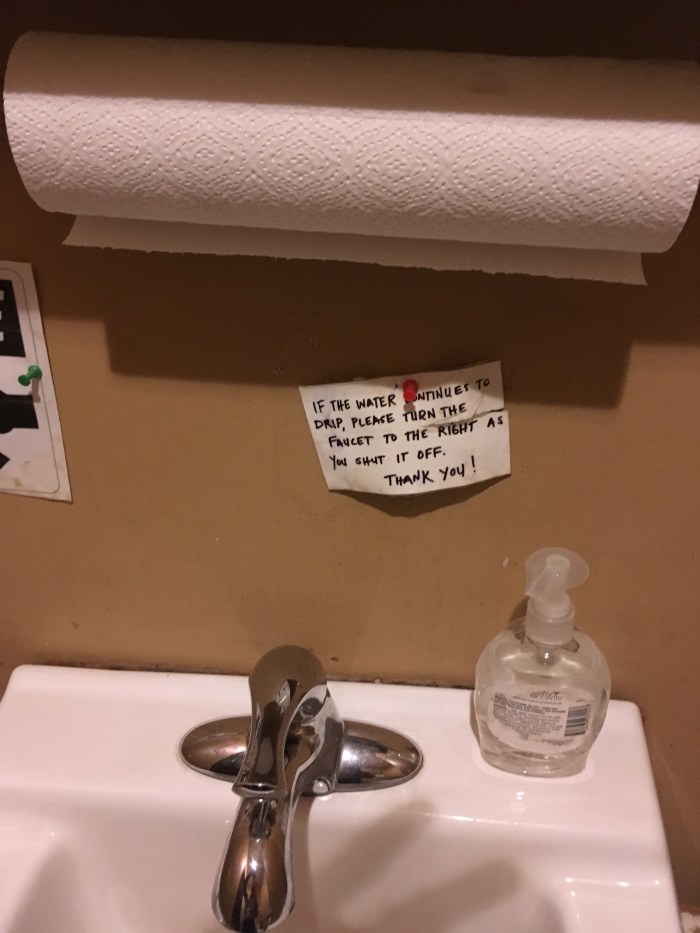
Sign Number One: The Sink is Still Broken

Yes the sink is still broken

An example of a perfectly helpful sign: the sink is broken. However, I have now witnessed this sign for over a year. This issue and the sign have been here for more than a year now.

The message: We know something is broken, but we are not fixing it. Our solution is for your to do a little more work, but clearly we are not about to fix the problem we both can see.

Sign Number Two: Who Cleans City Hall?

Who cleans city hall?

The message: We take pride in what we do, enough to tell you that we are actual people who are cleaning up this heavily trafficked building. If you are not happy with the level of service, you know exactly who is responsible.

Take a look around your organizations.

Where are the signs?

What messages are those signs sending?